Showing posts with label 1990s. Show all posts

Saturday, September 3, 2011

Oven-Fried Zucchini, and Cookbook Give-Away

A Little SomethingI'm an apartment dweller, with no yard or patio or porch of my own, and no real strong motivation to schlep tools several blocks daily to manage a plot at the community garden. This is to say: I never have too many tomatoes. I never have to find someone to take some cucumbers off my hands. And I never, ever, ever have to figure out a way to use up an over-abundance of zucchini. If you are a gardener, though, you probably are coming into zucchini, and  A Little Something has a way for you to get through the bounty.

Oven-Fried Zucchini
The secret to the zucchini's crispiness is double dipping in egg whites -- finally, double dipping is acceptable! These are excellent with Horseradish Yogurt Sauce or prepared tomato sauce.
Makes 4 servings
Vegetable oil cooking spray
1/4 cup seasoned dry bread crumbs
2 tablespoons freshly grated Parmesan cheese
1 cup zucchini, cut into 1/4-inch wedges
2 large egg whites
  1. Preheat the oven to 450°F. Liberally spray a baking sheet with vegetable cooking spray.
  2. Combine the bread crumbs and Parmesan in a large bowl. Set aside.
  3. Dip the zucchini in the egg whites and then coat with the bread-crumb mixture. Repeat.
  4. Place on the prepared baking sheet, and spray liberally with cooking spray. Bake until golden, about 30 minutes. Serve with Horseradish Yogurt Sauce.
Okay, you're not going to get through five grocery bags of zucchini this way. One cup of zucchini? Not  going to get you as far as hoped. So, I say, keep cranking these out. Crispy veg for dipping = a good movie day/night snack. Try it.

The sauce recipe is on the same page of  A Little Something but rather than type it all out in proper format, let's go easy: Take a container of plain yogurt, mix in 1 or 2 tablespoons prepared horseradish. Ta da. That's sauce. Or, you know, use lemon yogurt for a bit of extra tang -- this sauce is what I put on roast beef sandwiches.

I may have to make this later this weekend, as I've eggs and breadcrumbs in the house from the great meatball experiment.

Speaking of... time to put the balls in the sauce.

But before that... how's about a giveaway?

The First Ever Take One Cookbook... Cookbook Giveaway!


Yes, I'm giving away a cookbook! In fact, I'm giving away this week's cookbook: my well-worn copy of  A Little Something.

You can get up to four entries in the drawing. How? Leave a comment on this blog post with one of the following:
  1. An appetizer you love to make.
  2. A recipe from Take One Cookbook... that sounds really good to you.
  3. A recipe from Take One Cookbook... that sounds appalling to you.
  4. A link to your tweet or blog post wherein you tweet or blog about Take One Cookbook... in some way.
Each comment is one entry; don't put all four in one, or you'll confuse and confound me when it comes time to draw a winner.

Drawing will take place on Sunday, September 11, because we need a little happy on that day. Get your entries in by midnight Eastern on Saturday, September 10.


Friday, September 2, 2011

Island Delights: Four Recipes, No Rum

A Little SomethingThe whole concept of A Little Something is, really, party tidbits. Little bits of food to serve at parties. Little bits of food to soak up some wine or cocktails. Even the picture on the cover has a glass of wine.

So, you'll understand my dismay at the following group of recipes, all of which are clearly missing a vital ingredient:

Rum.

Rum.

Sure, sure, they'll say "add some light rum" but that's hardly how one writes a cocktail recipe. Tell me I'm wrong here.

Island Delights
Relax, sip, and enjoy. Add some light rum or a scoop of vanilla ice cream if you like. These drinks are excellent with nachos, flavored nuts, potato skins, guacamole, black bean dip, chips, and of course, your favorite something.
Makes 1 to 2 servings
Strawberry Banana Colada
1 banana
1/3 cup frozen strawberries
2 tablespoons canned cream of coconut
1/4 cup pineapple juice
1/2 cup ice
Piña Colada
1/4 cup canned cream of coconut
1/2 cup pineapple juice
1/2 cup ice
Island Paradise
1/2 cup frozen sweetened strawberries
2 tablespoons canned cream of coconut
1/4 cup orange juice
1/4 cup pineapple juice
1/2 cup ice
Strawberry Daiquiri
1/2 cup frozen sweetened strawberries
1/4 cup sweet-and-sour mix
1/2 cup ice
Place all ingredients in a blender and blend until smooth. Garnish with fresh fruit slices or wedges if desired.

A daiquiri is not a daiquiri if it doesn't include rum. Okay, purist might well say that a daiquiri isn't a daiquiri unless it's just rum, lime juice, and simple syrup. And coladas aren't coladas when they're just fruit.

Call 'em something else, please. "Island Paradise" is fine by me.

Or, call 'em Frozen Drinks. Some of my friends (Heather & Philip, of Picaroon Blog) used to host a Frozen Drinks Party every summer, where they supplied the booze and everyone brought frozen fruit, ice, and other add-ins. A good time, every year.

Okay, okay. I'll admit it. I don't tend to do frozen, blended cocktails. I like my margaritas on the rocks. I like my daiquiris in theory. But I'm being crotchety, and A Little Something has let me down on this group of recipes.

Henceforth, I'm going to pretend that these are Frozen Drinks, or Mocktails, or Fancy Drinks For Baby Showers And Children's Parties. I'm an information architect; labels are important. With the right label, I'll stop this recipe rant.

Wednesday, August 31, 2011

Chocolate Truffles with Kahlua and Pecans: This Is a Keeper

A Little SomethingWe've been savory for far too long here on Take One Cookbook... (Yes, I'm conveniently forgetting the week of Jell-O.) It's time for something decadent, something sweet from A Little Something to help you roll into the holiday weekend.

And, really, when you're looking for decadent and sweet, nothing fits the bill quite so nicely as a boozy homemade truffle. They are really, really, really easy to make, but you don't have to let anyone know that. Just like in that old Rice Krispies commercial where the mom makes a big deal about making rice cereal marshmallow treats and the family believes that they were the hardest thing to make in the world, the ultimate expression of maternal love.

No offense meant to said marshmallow cereal squares -- they really are darned tasty. Heck, I had an R.A. back at American University who was completely mystified by my ability to crank out Rice Krispie Treats.

He'd be gobsmacked by today's recipe -- you, too, can leave people dumbfounded.
Chocolate Truffles with Kalua and Pecans
These elegant chocolates are a perfect accompaniment to your favorite coffee or espresso. 
Makes 25
3/4 cup whipping cream
1 1/2 cups (12 ounces) semisweet chocolate bars, finely chopped
2 tablespoons Kahlua
1 1/4 cups finely chopped pecans
  1. Line an 8-inch-square baking pan with foil. Set aside.
  2. Bring the cream to a simmer, remove from the heat, and whisk in the chocolate until smooth and melted.
  3. Whisk in the Kahlua. Pour the mixture into the prepared pan and freeze about 30 minutes, until just firm.
  4. Cut the chocolate into 25 squares. Pour the nuts into a small bowl. Coat each square with nuts and roll into a ball.
  5. Place the chocolates on a small baking sheet and chill until firm, at least 2 hours. Serve cold.
Try some of these combinations:
  • Substitute Grand Marnier for the Kahlua.
  • Substitute almonds or hazelnuts for the pecans.

If you made up a batch of kaluha a few weeks back, you can certainly use it here.

You also don't have to step near the stove. Really! Heat up that cream in the microwave, and you'll have an easier time all around. Don't even think of touching a double boiler.

If you're sharing these with people who might have nut allergies, for the love of all things, do not put nuts in your truffles. You can replace the nuts with crushed vanilla wafers, or even some puffed rice cereal. If you go the Krispie route, I'd recommend melting up some more chocolate in the microwave so that you can coat the truffles and make them extra pretty.

Tuesday, August 30, 2011

Romaine Burritos with Blue Cheese, Chicken, Apples, and Pecans: On Not Being Pithy

A Little SomethingOne of the quirky joys of reading old cookbooks is delighting in the crazy recipe titles. Remember Watergate Cake? Or Hell Balls? And who could forget Home-for-Lunch Quickie? The author and editors of A Little Something seem to lack some imagination when it comes to recipe titles. They're all so very straightforward and prescriptive. Yesterday's Garlic & Cheese Twists were twists with garlic and cheese. Baked Clam Dip Loaf was a clam dip, baked, in a loaf of bread. Today's recipe is similarly direct.
Romaine Burritos with Blue Cheese, Chicken, Apples, and Pecans

Romaine, radicchio, butter, or iceberg lettuce are great low-calorie "wrappers." Make a platter for your next get-together or whip one up for a snack or light lunch.

Makes 8

4 ounces cooked chicken, diced
2 ounces blue cheese, crumbled
1 apple, peeled, cored, and diced
1/4 cup chopped pecans
2 tablespoons prepared Dijon mustard salad dressing or vinaigrette
8 romaine lettuce leaves, hard stem removed

  1. Combine the chicken, blue cheese, apple, and pecans in a small bowl, and toss with the dressing.
  2. Place the romaine on a flat work surface. Place a tablespoon of filling about 1/4 inch from the wide end of each leaf. Roll up burrito style, completely enclosing the filling.
Some other nice stuffings:
  • Tomato Salsa (page 28) mixed with diced chicken
  • Goat cheese Log with Sun-dried Tomatoes and Basil (page 42)
  • Dilled Shrimp Salad (page 94)
  • Chopped Eggs, Mushrooms, and Onions (page 61)
See what I mean? A direct recipe title.

It's... well, it's boring, frankly. Why not "Chicken Salad Lettuce Rolls"? Or "Bertha's Butter Lettuce Burritos"? Something with more character. Something pithy, or something that hints at a story untold. I'm willing to hear suggestions.

I don't know why the author felt a need to put "wrappers" in quotation marks. The lettuce is used as a wrapper. It's not a fake wrapper. It's not something something normally used as a wrap that is only containing items in some vague, molecular cuisine manner. The lettuce wraps the salad. If they'd wanted to put burrito in quotation marks, I'd understand. As is, it smacks of bad "sign" writing, where "people" put quotation "marks" around random "words" because "they" don't understand "language."

End rant. (For now.)

I suggest you use butter lettuce instead of romaine -- it is more pliable, and rolls easier. Also, the mild taste is lovely with chicken lettuce rolls. Also, there's no reason whatsoever to peel your apples. Wash 'em, sure, but leave the peel on, unless you're petrified of potential pesticide residue. Nuts are optional -- be aware of allergies of your guests.

And, really, you can make your own salad dressing. If you don't know how, leave a comment, and I'll post easy directions.

Monday, August 29, 2011

Garlic & Cheese Twists: Crunchy Goodness

A Little SomethingI bought A Little Something when it was first published, making it one of the few cookbooks in my collection that I bought in a regular ol' bookstore, paying publisher's prices. Back in '98, I was four years out of college, and starting to entertain like a grown up...or, at least, like I thought grown ups entertained. Today's recipe was one of the recipes that made my eyes go wide. This? This is Grown Up.
Garlic and Cheese Twists

These look lovely on a buffet table, but you'll also enjoy munching them while watching a good movie.

Makes about 20

Vegetable oil cooking spray
2 puff pastry sheets (10 by 15 inches), thawed
1/2 cup milk
2 egg whites
2 teaspoons garlic powder
2 cups freshly grated Parmesan cheese

  1. Preheat the oven to 400°F. Coat a baking sheet with cooking spray.
  2. Open the puff pastry and lay the sheets flat on a clean surface.
  3. In a small bowl, beat the milk and egg whites together. Brush evenly over one side of each pastry sheet.
  4. Sprinkle each sheet with 1/2 teaspoon garlic powder and 1/2 cup cheese. Roll lightly with a rolling pin to adhere. turn over and repeat.
  5. Using a sharp knife or pizza cutter, cut the pastry into long strips. Twist each strip. Sprinkle evenly with remaining garlic powder and cheese.
  6. Bake about 20 minutes, until golden.
For Cinnamon twists, omit the garlic powder and cheese. Substitute 1 cup sugar mixed with 2 teaspoons ground cinnamon. After brushing each pastry with the milk and egg mixture, sprinkle each sheet with 1/4 cup sugar and 1/2 teaspoon ground cinnamon. Roll lightly with a rolling pin to adhere. Turn over and repeat. Prepare and bake.
Okay, so it's not rocket science. It's not hard. It's not frou frou. It's dead simple, as long as you plan ahead far enough to defrost your puff pastry.

It's also really tasty, really pretty, and a bit of fun to eat. Breadsticks are all well and good, but puff pastry twists are flaky bits of crunchy goodness.

I made these once with my sister, Kelly, who's known for being a bit of a picky eater. I mixed up a peanut sauce for dipping, and while that wasn't entirely her favorite thing ever, the twists were a hit.

Even picky eaters like puff pastry.

If you take the "with a good movie" recommendation from the recipe description, you should also take my recommendation: Serve these with champagne. Puff pastry and champagne add instant elegance to any occasion, even if that occasion is a rewatching of "Megafault" on Netflix.

Sunday, August 28, 2011

A Little Something, by Susan Epstein: Baked Clam Dip Loaf

A Little SomethingToday, we move to a more modern cookbook: A Little Something: More Than 150 Snacks, Appetizers, And Hors D'oeuvres For Every Craving And Occasion by Susan Epstein (William and Morrow Company, New York; 1998). Epstein has the 150+ recipes, sure, but also puts them together in menus for every kind of party, every kind of budget.

So, a cookbook from the late 90s, with party food. I don't know quite what I was expecting, but "everything old is new again" wasn't at the top of the list. And yet...the modern recipes show more than a little bit of nodding to some of the more curious mid-century recipes. Case in point:
Baked Clam Dip Loaf

Surround this impressive dip with crudités, breadsticks, and the leftover bread cubes.

Makes 6 to 8 servings

1 large (1 1/2 pounds) unsliced round sourdough or black bread
4 containers (4 ounces each) herb or garlic cream cheese spread
1 cup mayonnaise
3 cans (6 1/2 ounces) minced clams, drained
4 green onions, finely chopped
  1. Preheat the oven to 350°F.
  2. Cut a slice off the top of the bread, about 2 inches down. Reserve the lid. Remove the insides of the bread, leaving a 1-inch shell. Cut the insides into cubes, and set aside.
  3. Using an electric mixer, beat the cream cheese spread and mayonnaise until blended. Stir in the clams and onions.
  4. Spoon the mixture into the bread shell and cover with reserved lid. Wrap tightly in aluminum foil.
  5. Bake about 1 1/2 hours, until the filling is very hot and bread is crusty.
If you prefer, you can substitute canned lump crabmeat for the clams.
Ah, there we go, I remember what I was expecting: fine-quality ingredients, and a bit more froofiness when it comes to preparation. The idea that we're using canned goods and containers of pre-seasoned cheese product is a bit disappointing. How about this instead: Soften 16 ounces of cream cheese, beat until fluffy, mix in minced garlic and/or chives. Use that instead of the pre-done stuff. And, hey, I understand that canned clams are convenient. I do. You can use them. If you happen to have fresh clams about, though, promise me you'll use those.

If you're thinking of serving this at a party, I'd stay away from the crab variant option. Why? Well, hot crab dip is something you can get on nearly every bar menu, and people will wonder why there's no artichoke in your crab-and-... dip. Subvert their expectations. Embrace the retro clambakiness.

Embrace, also, the knowledge that there are lots of folks out there with shellfish allergies. Put a sign with your dish letting people know that here there be clams. Of course, if you used fresh clams, you could just garnish with a scrubbed-clean clam shell--it's pretty darned unambiguous a statement.

Wednesday, December 22, 2010

A Different Green Bean Dish: Judías Verdes Rehogadas con Jamón

Delicioso!I'm nuts about Christmas. I blame it in part on the fact that my dad's a Christmas tree farmer. Whatever the reason, I know this for sure: I'm just giddy with excitement because Christmas Eve is just two days away!!!

If you're looking to change up your holiday side dishes, ditch the green bean casserole with the can of fried onion whatnots on top. Try instead this recipe from Delicioso! The Regional Cooking of Spain :
Judías Verdes Rehogadas con Jamón
(Green Beans Sautéed with Cured Ham)


Whenever we stay in Niserias in Asturias (as we often do, since my husband loves to trout-fish in the cares River) we dine at Casa Julián (see p. 113), where co-owner and cook Vincentina produces simple Asturian fare with an expert hand. My favorite first course is her sautéed green beans, seasoned with garlic and generously sprinkled with mountain ham.

Serves 4

Salt
1/2 small onion
1 1/2 pounds broad green beans, ends snapped off
2 tablespoons olive oil
4 cloves garlic, lightly smashed and peeled
2 ounces Spanish mountain cured ham or prosciutto, in small cubes or thin squares (about 1/4 cup)
Freshly ground pepper

Bring a pot of salted water to a boil, add the onion and green beans, return to a boil, then cook uncovered at a slow boil for about 20 minutes, or until cooked as desired. Discard the onion and drain the green beans in a colander. Refresh with cold water.

In a skillet, heat the oil with the garlic, pressing the garlic with the back of a wooden spoon to release its flavor, until the garlic is golden on both sides. Add the beans and the ham, season with salt and pepper, and sautée, stirring, over a medium flame, until the beans are hot.
If I read this recipe for the first time, I would say "Hell, no!" Then, I'd walk away, shaking my head. "Cook beans for more than 20 minutes? They'll be mush!" I'd laugh, disbelieving. "Boil the onion?!?!?! That onion should be diced and fried with the garlic!"

I'd have a wealth of culinary tradition and experience behind me.

I'd also be wrong.

Judías Verdes Rehogadas con Jamón, or Green Beans with Ham, photo by Wendy A F G Stengel, some rights reserved


This was the first course in our last meal in Spain. We'd made it to Santiago, we'd been to Mass, we'd waited in line for hours to get our credentials, and we had a celebratory meal and final communion for our pilgrimage group.

And this was damned tasty.

I'm not a cook-it-'til-it's-dead girl when it comes to vegetables. I'm really not. But, dang, these beans taste good after a long slow simmer with ham.

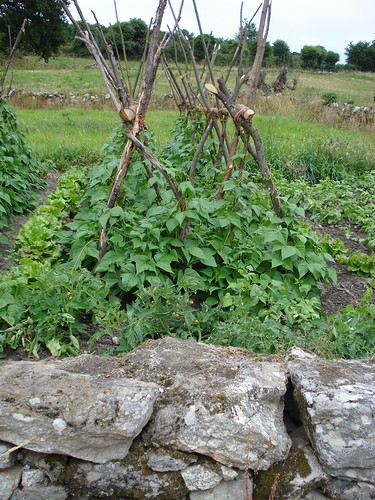
Need I say everything was local? Everything? Was local.

People grow their own everything.

Garden in Spain, photo by Wendy A F G Stengel, some rights reserved


Their own beans.

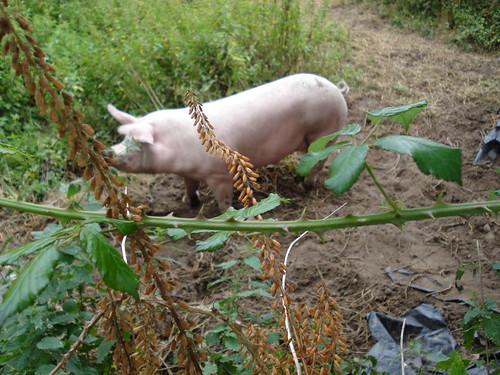
Backyard pig in Spain, photo by Wendy A F G Stengel, some rights reserved


Their own ham.

I know the pig's out of focus (and that it's not ham ... yet); I heard it grunting on the other side of a garden wall, held my camera up high, and sort of just hoped I'd get a picture of whatever was making the sound. So, out of focus or no, I love this picture of the ham-to-be.

But I digress!

I rather thought I might.

Point being: think outside the can of cream of whatever and tinned questionable crispy onionesque casserole topping, and bring a bit northern Spain to Christmas this year.

Tuesday, December 21, 2010

Santiago Cake and Nostalgia: Tarta de Almendra O Merlo

Delicioso!Christmas is just days away, and I'm filled with a hankering to bake. We had a cookie exchange at work a few weeks ago (I made 7 Layer Cookies), but there's still room in my holiday kitchen for something sweet. Okay, I'll admit it: almost all the cookies are already gone. There was a caroling party! It was raining! People ate cookies!

Getting back to the point, Delicioso! The Regional Cooking of Spain shares a baked good I had at the end of more than one happy meal in Spain.

Tarta de Almendra O Merlo
(Galician Almond Cake O Merlo)


There is hardly a restaurant in Galicia that does not offer the region’s traditional almond cake, often called tarta de Santiago because the cross of Spain’s patron saint, Santiago, is usually emblazoned in the cake with caramelized sugar.

Santiago, known in English as the apostle Saint James, was said to have traveled to Spain to preach the Gospel, and after he was martyred in Jerusalem his body miraculously reappeared in Galicia in a field that gradually developed into the glorious city of Santiago de Compostela (see my Discovering Spain: An Uncommon Guide for the full story). Santiago de Compostela became a place of mass pilgrimage in medieval times as millions of Europe’s faithful made the arduous journey on foot to reach the shrine of the Apostle. On of Galicia’s most enduring symbols is the distinctive cross of Santiago.

Tarta de almendra is a single-layer almond cake, simple and moist. Although served as a dessert in Galicia, we would probably consider it more appropriate as a tea cake. One of the best I have eaten comes from Alfonso Merlo, the owner and chef of O Merlo, in the provincial capital of Pontevedra, a restaurant specializing in tapas that are often meal-size. It is a great place to eat when here to visit the city’s quaint Old Quarter and delightful old squares.

Makes one 8-inch cake

6 ounces blanched almonds (about 1 cup)
6 tablespoons flour
¾ cup sugar
3 eggs
Confectioners’ sugar

In a processor, coarsely chop 2 ounces (about 1/3 cup) of the almonds with the flour. Remove from the processor and reserve. Now add to the processor the remaining almonds and ¼ cup of the sugar, and grind the almonds as fine as possible.

In a bowl, with an electric mixer beat the eggs until foamy. Add the remaining ½ cup sugar and beat until the mixture is light-colored and thick. Then beat in the sugar-and-almond and flour-and-almond mixtures. Pour into a greased and floured 8-inch springform pan and bake at 350°F for about 35 to 40 minutes, or until the cake springs back slightly to the touch. Cool, then remove the rim of the pan and sprinkle the cake heavily with confectioners’ sugar.

To burn the traditional cross in the sugar, heat a thin metal skewer (protect your hand with a pot holder) over a flame until the lower portion is red-hot. Press the skewer over the center of the cake to caramelize the sugar. Wipe off the skewer, reheat, and repeat to form a cross.

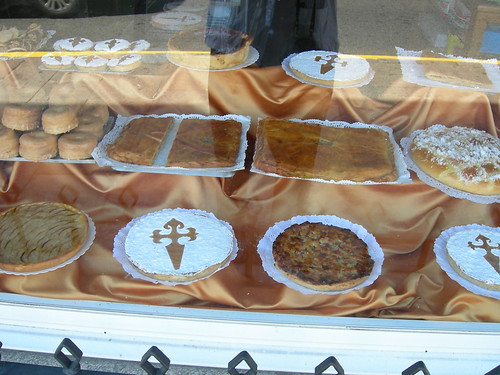
I never even once saw the cross burnt into the sugar. Never once. No, instead the cross was stenciled on to the cake with powdered sugar.

Santiago bakery window; some rights reserved


Oh, the bakery. This bakery was actually in Santiago proper, just as we were walking down the last hill into the center of town. You can see the full-sized cakes, and the smaller cakes. The apple pies. Oh! The donuts! And, dead center, there's even big empanadas.

The Santiago cake (and, yes, I only ever heard it called tarta de Santiago, and never de Almendra) is so very moist. Moist, and dense, and crumbly. I'd serve it with a dollop of stiff whipped cream on the side, and some raspberries or a sprig of mint. Even with the signature dessert of the region, things are kept best when kept simple.

I'll tell you, this goes fine with cider or wine, but I bet it'd also be amazing with some sherry. Or...some kirsch.

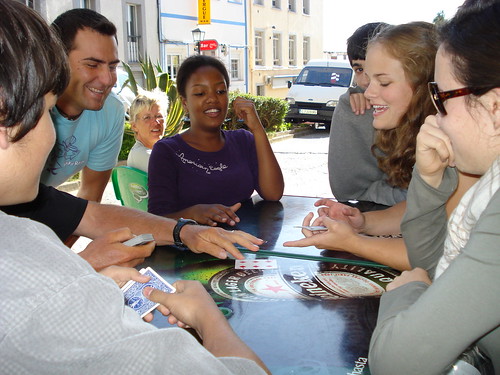
I think the first slice I had was in Palas de Rei, right after we met up again with Mr. and Mrs. Belgium. We knew their real names, but as they'd walked out their front door in Belgium months before and just kept walking, we called 'em Belgium. They thought it was funny. We played a mean game of Uno that afternoon, and a meaner game of Bullshit.

Card games on the Camino, photo by Wendy A F G Stengel, some rights reserved


The time walking on the Camino was special; the time together in the afternoons and evenings, tired and sharing a new common set of references... it was amazing. I'm feeling all nostalgic; all the youth who went on that pilgrimage with me have graduated, gone off to college... I hope I get to see them when they come back into town for Christmas.

It's not a bad time of year for nostalgia, served up with a slice of cake.

Sunday, December 19, 2010

A Forest of Greens In Every Yard: Caldo Gallego

Delicioso!Nearly every bar, restaurant, hotel, inn, and whatnot along the pilgrim trail to Santiago serves up a Menu Peregrino, a Pilgrim Meal. It's cheap as chips, three courses, and includes bread and wine. Lots of wine. Usually bottles of wine. Oh, the wine! Anyway. At nearly every place we stopped, I was offered and I greedily accepted a hot bowl of Caldo Gallego. Brothy, with greens and potatoes, and often nothing else that was identifiable, it still stood up to a tired pilgrim's appetite, especially when said pilgrim dunked in some bread. Delicioso! The Regional Cooking of Spain offers up this version:
Caldo Gallego
(Galician Meat, Potato, Greens, and Bean Soup)


Start preparation 1 day in advance
There is remarkably little variation from one cook to the next in the preparation of Caldo Gallego, the famous soup that has traveled the world with Galician émigrés. Only one ingredient, chorizo, is a point of contention. Purists reject it, yet many traditional recipes include it; it does, in fact, produce a richer, more flavorful soup. The kinds of greens may also vary, although grelos—closely akin to collard greens—are most typical. Caldo Gallego is hearty enough to be a meal, but you may choose to serve it in smaller portions as a first course or as an accompaniment to a light supper.

Serves 4-6

½ pound medium dried white beans
1 tablespoon olive oil
2 cloves garlic, minced
1 teaspoon imported sweet paprika
7 cups water
1 pound boneless beef chuck
1 beef or ham bone
¼ pound Spanish mountain cured ham, prosciutto, or capicollo, in a thick chunk
A 2-ounce piece slab bacon or salt pork
1 leek, well washed
½ pound collard greens, Swiss chard, or kale, thick stems trimmed and coarsely chopped (about 4 cups)
¾ pound small (about 2-inch diameter) new or waxy red potatoes, peeled
¼ pound sweet chorizo
Salt

Soak the beans overnight in water to cover. Drain.

In a small skillet, heat the oil and garlic and sauté a minute (the garlic should not color). Turn off the flame and add the paprika. Stir in a tablespoon or two of water.

Add to a soup pot the water, beans, beef, bone, ham, slab bacon, leek, and garlic mixture from the skillet. Bring to a boil, cover, and simmer about 2 hours, or until the beans are almost tender.
Add the greens, potatoes, chorizo, and salt to taste, cover and continue cooking until the potatoes are done, about 30 minutes.

Remove and cut up the beef, ham, bacon, leek, and chorizo and return to the pot. Discard the bone. Cover and let sit 10 minutes before serving. Reheat if necessary.

I don't remember ever seeing potatoes in my caldo, nor often any beans. It's peasant food, and as such lends itself easily to whatever you have on hand. If you have chorizo one day, add it. If not, don't do a run to Whole Foods, just go without.

I wouldn't get too precious about the kind of greens you use, either. Grelos, mentioned above, are turnip greens. You could use 'em, sure. You could use collard greens, or kale, or chard... Use what you have, or the first thing you lay hands on.

Gallego greens garden, photo by Wendy A F G Stengel, some rights reserved


Just about every home we passed on the Camino had a yard filled with greens. Big, waist- or chest-high primeval stalks. When it was time to make the caldo, they'd step outside, cut a few leaves off with their kitchen knives, and they were ready to go.

I'd file this away under "deceptively simple." It doesn't sound like much in the writing up, it doesn't look like much in the bowl, but mercy me, it's a damned fine bowl of soup.

Saturday, December 18, 2010

Pork Pie (Not the Hat): Empanada Gallega de Raxó

Delicioso!When I was a wee thing growing up in Oregon, we didn't have Taco Bell, we had Taco Time. So, I grew up thinking that an empanada was a filled, fried cylinder of questionably fruit origin, covered in sugar. Good stuff. Further experience introduced me to Latin American empanadas, big full pocket pies of meaty goodness. Let's face it: I'm a fiend for a savory pie, I'm a fiend for an individual-sized pie, so I'm a fiend for empanadas.

It comes then as no surprise that when I saw an empanada on a menu in Spain, I ordered it. This recipe from Delicioso! The Regional Cooking of Spain is spot on for the unexpected--but wonderful--empanada:
Empanada Gallega de Raxó
(Galician Pork and Peppers Pie)


Start preparation 2 hours in advance

I have never found a filling that is tastier and more succulent than this one for Galicia’s classic savory pie. Empanadas, however, may be filled with many other mixtures, from tuna, scallops, and sardines to rabbit and chicken. The dough also varies according to the cook, from a real bread dough to a much more refined modified puff pastry. Here I have provided my favorite puff pastry empanada dough from Tapas: The Little Dishes of Spain, but when I do not have the time or inclination to make my own pastry, I go to my local pizzeria and buy an uncooked pizza dough. The empanada comes out just like those of Galicia based on bread dough.
Empanadas cut in small wedges or squares make excellent tapas, and in larger portions, accompanied by a salad, make a most enjoyable light meal. I think they are at their best freshly baked but at room temperature.

Makes about 4 dinner or 8-10 tapas portions

Puff Pastry for Empanadas (p. 109) or 1 ½ pounds pizza dough
3 cloves garlic, peeled
2 tablespoons minced parsely
1 ½ teaspoons minced oregano leaves or ¼ teaspoon dried
Several strands of saffron
1 ½ teaspoons thyme leaves or ¼ teaspoon dried
¼ cup olive oil
3 tablespoons dry white wine
¾ pound boneless pork loin, cut in 1/8-inch slices, then in 1/2-inch strips
1 large onion, preferably Vidalia or Spanish, slivered
¾ pound green frying peppers, cored, seeded, and cut in long narrow strips
3 teaspoons imported sweet paprika
¼ pound tomato, skinned, seeded, and chopped
4 tablespoons (1/4 cup)finely diced Spanish mountain cured ham, prosciutto, or capicollo
Salt
Freshly ground pepper
1 hard-boiled egg, sliced
1 pimiento, imported or homemade (p. 178), cut in strips
1 egg, lightly beaten with 1 teaspoon water

If using homemade dough, prepare according to instructions.

In a mortar or mini processor, mash to a paste the garlic, parsley, oregano, saffron, and thyme. Mix in 1 tablespoon of the oil and the wine. Transfer to a bowl and mix in the strips of pork, coating them well. Marinate 2 hours. Drain the meat and reserve the marinade.

In a shallow casserole, heat 2 tablespoons of the oil and slowly sauté the meat until it just loses its color. Return the meat to the reserved marinade. Add the remaining tablespoon of oil to the casserole and sauté the onion and pepers a minute or two. Cover and cook very slowly for 15 minutes. Stir in the paprika, then turn up the heat, add the tomato, and cook 5 minutes. Stir in the paprika, then turn up the heat, add the tomato, and cook 5 minutes. Add the pork wit hits marinade and the ham and season with salt and pepper.

Roll the dough into a 14- by 28-inch rectangle. Divide into two 14-inch squares, then trim the corners to make two 14-inch circles. Place one of them on a cookie sheet (dampened if using pastry dough, sprinkled with cornemeal or flour if using pizza dough) and arrange the pork mixture to within 1 inch of the edge. Scatter on the egg slices, top with the pimiento strips, and cover with the second dough circle. Roll up the edges and press well to seal. Make several slits in the dough, brush with the beaten egg, and bake at 350°F for about 30 to 35 minutes, or until browned. Cool a few minutes before serving or serve at room temperature.
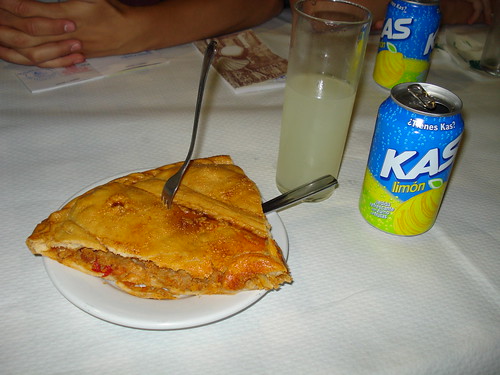
Oh, yes. Bread and meat and deliciousness, coming out looking like a stuffed pizza. Don't believe me? Take a gander:

Empanada and lemon soda. Photo by Wendy A F G Stengel; some rights reserved.


Not the most artistic of all possible photos, but look! That's my wedge o' empanada, proper Spanish empanada! Beats the heck out of a Taco Time anything, I don't mind telling you. (All due and right respect to Taco Time; you taught me to dip crispy burritos in ketchup...you taught me there could be crispy burritos.) Everyone else ordered pizza, so I'm betting that they used pizza dough for the empanada, too. If anyone feels a strong need for the puff pastry recipe referenced above, I'll post it, but, really: use some pizza dough. Speed up your process. Get to the good stuff. The pork. The pie. The pork pie (not a hat).

Tasty, hearty, filling without weighing you down. Trust me. And, yes, you really do serve up a full quarter as a serving. The Camino is a long, long walk.

Delicioso! The Regional Cooking of Spain: Alubias Rojas de Tolosa con Berza

Delicioso!I've been plotting out my course for the new year. See, like a lot of people, I make food-related resolutions, and money-related resolutions. This year, however, I'm making a food-AND-money-related resolution: I'm going to cut back on my food expenditures by planning ahead and actually bringing a home made breakfast and lunch to work with me, rather than going out. Even just walking to the grocer's near work to buy a frozen whatnot adds up, if not in pennies, then in healthfulness. I like to cook, I cook well, what I cook tastes better than what I'd pick up at the grocer's, and so, darn it, I should do it. I was going through old favorite recipes, and kept running smack up against ones that I'd written about here. So here we are, back at the good ol' blog!

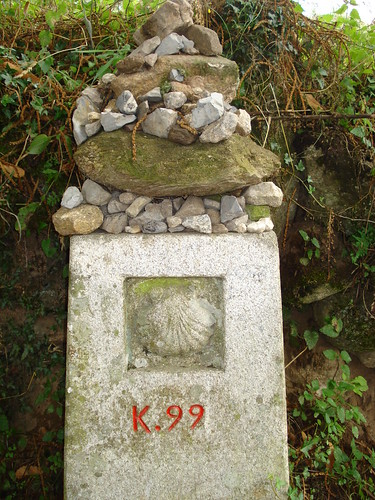
We're starting the new year celebration a touch early with a festive sort of cuisine in Delicioso! The Regional Cooking of Spain by Penelope Casas (Alfred A. Knofpf, New York; 1996). I was lucky enough to get to go to Spain a few years back and walk the pilgrim trail to Santiago; it was an amazing experience, and odds are I'll pepper these posts this week with pictures and stories from the Camino. Like... this one from kilometer 99...a little over 60 miles from Santiago.Pilgrims carry stones with them from their homes and place them along the route; I had one from my mother's yard in Oregon, and one from my yard in DC.

Camino de Santiago, kilometer 99. Photo by Wendy A F G Stengel, some rights reserved.


I ate amazing food in Spain, none of it fancy. Really, not fancy at all. Soups. Stews. Lentils. Cheese. Really filling and tasty. Today's recipe reminds me of that food.

Alubias Rojas de Tolosa con Berza
(Red Beans with Cabbage)


Start prepartion 1 day in advance.

A dollop of cabbage, placed in each bowl of beans, is a delicious complement to this bean stew based on the outstanding red beans that grow in Tolosa in the Basque province of Guipúzcoa along the banks of the Oria River. you can use any kind of red bean to make this dish, but the results will be best with Tolosa, Adzuki, or other dark red beans, sometimes available at food specialty shops.

Serves 4

1 pound small, deep-red dried beans
1 medium onion, peeled and cut in half crosswise
1 large carrot, scraped and cut in half crosswise
1 small leek, well washed
A 1/4-pound piece slab bacon, preferably fresh (otherwise cured)
1/4 pound sweet chorizo
2 tablespoons olive oil
1 medium onion, finely chopped
6 cloves garlic, minced
2 teaspoons imported sweet paprika

Sauteéd Cabbage
3 tablespoons olive oil
1/4 cup onion
2 cloves garlic, minced
1 small head cabbage, coarsely chopped
Salt
Freshly ground pepper

Soak the beans overnight in water to cover. Drain, then combine in a large pot with 6 cups fresh water and bring to a boil. Reduce the heat, add the onion, carrot, leek, bacon, and chorizo. cover and simmer 1 hour.

Meanwhile, heat the olive oil in a large skillet, add the chopped onion and garlic, and sauté slowly until the onion has wilted. Stir in the paprika, then add to the beans. Season with salt, cover, and continue cooking about 30 minutes more, or until the beans are just tender. Wipe out the skillet.

While the beans are cooking, prepare the cabbage. Heat the oil in the skillet and sauté the onion and garlic until the onion has wilted. Add the cabbage, salt, and pepper and stir-fry about 10 minutes. Cover and continue cooking until done to taste.

Serve the beans in soup bowls, accompanied by crusty country bread. Heat the cabbage, transfer to a serving bowl, and pass separately. Typically, a spoonful or two of cabbage is placed in the soup bowl, off to one side--not mixed into the beans.
Yes, please. This would be such a welcoming dish to find at a pilgrim's table after walking 30 kilometers (or even after 3). Hearty. Simple. Serve it with the bread (oh, the bread in Spain!) and a glass or two of wine. My thoughts on wine: stick with Spain, and stick with northern Spain. An Albariño would go great with this, and I know--Albariño is from the northwest of Spain, and Tolosa is in the northeast, but it'd still taste great. I'd go a bit off-local on red, too, and pour a Ribera del Duero.

I feel like going off for a bit on the wines I tasted along the Camino, but I suspect I'll be wandering through that topic a few times this week.

Sunday, June 27, 2010

Cooling Off Period: Crab, Jicama, and Mango Salad with Lemon-Curry Dressing

Heck, even I think it's crazy to contemplate turning on a cooking apparatus today. The heat index value is going to be up around 103° today, the air quality is poor, and there's just no. fricking. way. I'm turning on a heat-producing device. No. No.

No.

And I don't suggest you do, either. Thankfully, neither does The Wine Lover's Cookbook: Great Recipes for the Perfect Glass of Wine.
Crab, Jicama, and Mango Salad with Lemon-Curry Dressing (Classic Pairing)
Recommended Wine: Chardonnay
Alternative Wine: Viognier

This combination works because the richness of the succulent crab meat, the tropical fruit flavors of the mango, and the lightly curried citrus dressing help showcase the ripe tropical fruit and citrus flavors found in many chardonnays. The use of curry powder enlivens the dressing just enough to play into the spice character fhtat comes from the wine's barrel aging. Viognier, with its opulent texture, also marries well with this elegant appetizer.

1 pound crab meat, picked over for shells
3/4 cup diced fresh or frozen mango
2 1/2 tablespoons minced fresh chives
1 cup peeled and diced jicama

Dressing:
Juice of 1 lemon (Meyer lemon, if possible)
1 teaspoon minced lemon zest
1/2 tablespoon white-wine vinegar
1/3 cup sour cream
1 1/2 teaspoons curry powder
1/8 teaspoon fresh ground black pepper

12 leaves butter lettuce, rinsed and dried

Garnish: chopped chives, 6 lemon slices

In a medium nonreactive mixing bowl, combine crab meat, mango, chives, and jicama and mix well.

To make dressing, in a small mixing bowl, combine all ingredients and whisk thoroughly. Add dressing to crab mixture and combine thoroughly. Allow to sit, refrigerated, for at least 2 hours. Season to taste.

To serve, place 2 butter lettuce leaves side by side on each salad plate. Mix crab thoroughly. Spoon mixture equally onto lettuce leaves on each plate. Sprinkle with chopped chives and garnish with lemon slices.

Serves 6 as an appetizer
I had the great joy of spending yesterday evening on a boat in the South River, right where it feeds into the Chesapeake. That is to say, I was in crab country. When it looked like my carload of boat party people wouldn't arrive in time (there was a bit of a snafu that led to me, my car, and my passengers being about an hour south of where we were supposed to be...), I thought "well, at least we can get some crab." Summer and the mid-Atlantic practically scream out for the beautiful swimmer -- that's what the Latin name for blue crab means: Callinectes sapidus = beautiful swimmer...poetic, no?

Crab would normally be about $16 a pound at this time of year, Chefly Husband tells me. Instead, domestic crab is selling for about $24 a pound, thanks to the devastation in the Gulf. Depending on your budget and your food-as-politics leanings, you might want to file this recipe away until crab is more affordable, or you might want to hang the price and support domestic fisheries (perhaps I took the front matter in the Cook Book Presented by The Fishwives of Charleston Oregon a bit too much to heart).

I've been a stone's throw from the Chesapeake for two decades now (and I have the high school reunion invitation to prove it), but have to admit that, while blue crab is all well and good, it's not the real crab.

The real crab is Dungeness. No one can convince me otherwise. It's the best crab. It's the Master Crab! (Even its Latin name used to say so: Cancer magister.) Of course, I don't really ever think of using Dungeness in a recipe. There's no need. The stuff is perfection right out of the shell.

My devotion is shared by my family back in Oregon. When Dad was out to visit a while back, we went to eat at Chefly Husband's restaurant, and I had the crab cake. Now, Chefly Husband's restaurant does pretty much the best damned crab cake you'll ever have in your life. No lie. This is not spousal love talking, it's just plain fact.

Dad had a bite. Dad said, warmly, "that's the best crab cake that doesn't have Dungeness in it."

Can't really argue with that.

Thursday, June 24, 2010

You Don't Spell It, You Eat It: Fig and Raspberry Clafouti

It's brutally hot in DC today--we hit 100°F (37.7°C, for those of you who, you know, use metric). I had two hearty pasta dishes flagged as blog fodder, but couldn't bear to even think about boiling a big pot of ... no, don't make me say it. Nothing heavy, please. Nothing steamy. Something simple...

So, you'll think I'm crazy when I say that today's recipe from The Wine Lover's Cookbook: Great Recipes for the Perfect Glass of Wine involves....baking. Yes. I'm saying you should turn on your oven. Even though it's brutally hot out. You can scurry out of the kitchen when it's on, and place yourself in front of a fan or an air conditioner (or both); it'll be okay.
Fig and Raspberry Clafouti
Recommended Wine: Sauternes
Alternative Wine: Port

Clafouti is not a terribly well-known dessert. Its origins are in the south central part of France where a batter cake, typically made with black cherries, is a traditional and much loved delight. This version resonates with the lush, honeyed sweetness of late summer figs and slightly tart raspberries, a truly magical combination that wraps its flavors around the honey-like quality in aged sauternes. Port is a suitable alternative that works well with the fig flavors.

2 cups quartered figs
2 cups raspberries
1/2 cup sliced, blanched almonds
1 cup all-purpose flour
1/3 cup plus 2 tablespoons sugar
2 large eggs
1 cup milk
3 tablespoons port
2 tablespoons cold unsalted butter, cut into bits

Preheat the oven to 400°F. Arrange figs cut side up in buttered 8-by-8-by-2-inch baking dish and sprinkle in raspberries. In a blender or food processor, finely grind the almonds with the flour. Add 1/3 cup sugar, eggs, milk, and port and blend well. Stop occasionally to wipe down sides as necessary. Pour the custard over the fruit, dott with butter, and sprinkle with the remaining 2 tablespoons sugar.

Bake on the middle rack of the oven for 30 to 40 minutes, or until the top is golden and the custard is set. Let cool for 20 minutes. Serve with a dusting of powdered sugar.

Serves 6
I love figs, and no doubt the suitable-for-August heat has me thinking of late summer fruit instead of more seasonally appropriate choices (see: aforementioned black cherries). Usually, when I have figs, I rip off a hunk of bread, smear on some chevre, and then tear open a fig and smoooooooosh it in on top of the cheese. I eat. I repeat. Figs never seem to last long enough to end up in a cooked dish. Well, you know what I mean, figs keep, but they don't last near me. They are not safe; guard them if you want to have any share in them.

A few Sundays back, Chefly Husband and I went to some friends' house for grilled lamb and shiraz; dessert was clafouti. So I say with confidence: this is a good hot day dessert. Yes, your kitchen will heat up. Unless...

Do you have a yard of your own? With plenty of beautiful sunlight? You can give a solar oven a try. I've a friend (who I haven't seen in far too long) who has had great success with her solar cooking. Use that sun for something other than skin damage and keep your kitchen cool.

Since it's summer, I'd stick with the sauternes and leave the port for a cooler day. I also think that a nice ice wine would be good with this, like, oh... Argyle's Minus Five riesling. It's the wine so tasty, it's finally got my sister interested in tasting wine!

If you've no figs available, add more raspberries, or blackberries, or plums (pitted), or cherries (pitted or not, up to you and your estimation of your guests' ability to navigate around the pits gracefully), or... you get the idea. Clafouti is a friend of fruit; use what you can lay your hands on.

Tuesday, June 22, 2010

The Best Recipe In The Book: Coffee- and Spice-Rubbed Lamb with Coffee-Vanilla Sauce

If the title of today's post didn't scare you off, then you are my kind of people. Welcome, people, to the world of damned tasty lamb. This is the world wherein an eager lamb lover flits from table to table at the New Zealand embassy, snagging lollipop after lollipop after lollipop of lamb until she was blissfully full and her skin tasted of lamb for days. Oh, yes. It's a good world to be in. (And, yes, I really did do that. It was a Shiraz & Lamb tasting, and it was heavenly.)

One of the first recipes Chefly Husband ever made out of The Wine Lover's Cookbook: Great Recipes for the Perfect Glass of Wine was this initially strange sounding but utterly delicious lamb. It turned out to be phenomenal; heck, I'd say it's the best recipe in the book. Do not be scared off. Stay in lamb world.
Coffee- and Spice-Rubbed Lamb with Coffee-Vanilla Sauce
Recommended Wine: Pinot Noir
Alternative Wine: Cabernet Sauvignon

As pinot noir ages, it picks up some graceful, coffee-like notes. This dish was created to try to mirror this characteristic as well as accentuate the vanilla character that results from barrel aging. If the recipe sounds a little "over the top," don't be intimidated. It is quite flavorful and a wonderful way to heighten the character of almost any red wine, particularly those that have aged for a while.

Marinade:
2 teaspoons chopped garlic
1 1/2 tablespoons chopped fresh mint
1 tablespoon finely ground coffee
1/4 cup olive oil
1/3 cup red wine
1/4 teaspoon whole mixed peppercorns
1/4 teaspoon cumin seed
1/4 teaspoon mustard seed
1/4 teaspoon coriander seed
2 teaspoons chopped fresh rosemary (1 teaspoon dried)
1/4 teaspoon kosher salt

4 boneless, tied lamb sirloin rolls (about 2 pounds) or 8 double-thick lamb chops (about 6 pounds), trimmed of fat
2 tablespoons olive oil
1 cup coarsely chopped shiitake mushrooms
2 tablespoons minced shallots
1 1/2 cups red wine
1 6-inch vanilla bean, split lengthwise
1 tablespoon chopped fresh mint
2 cups lamb or chicken stock
1/4 cup freshly brewed coffee
1/2 teaspoon honey
1 teaspoon cornstarch mixed with 1 teaspoon cold water
1 tablespoon unsalted butter at room temperature (optional)
Kosher salt and freshly ground pepper
Garnish: mint springs

To make marinade, combine garlic, mint, coffee, olive oil, and wine in a small, nonreactive mixing bowl. Using a mortar and pestle (or electric coffee/spice grinder), grind peppercorns, seeds, rosemary, and salt. Add to coffee mixture and whisk thoroughly.

Place lamb in a large glass dish. Pour marinade over lamb and rub in thoroughly on all sides. Refrigerate, covered for 3 to 4 hours. Remove from marinade and wipe off most but not all of coffee mixture with paper towels.

In a large sauté pan or skillet over medium heat, sauté olive oil, mushrooms, and shallots for 4 to 5 minutes. Add red wine, vanilla bean, and mint and bring to a boil. Reduce heat to a simmer and reduce wine by half. Stir in stock, coffee, and honey and reduce by half. Remove vanilla bean. Stir in cornstarch mixture to thicken sauce. Remove from heat, swirl in butter, and season to taste. Keep warm.

Prepare a hot grill. Cook lamb for 7 to 8 minutes per side, or until medium-rare.

To serve, place lamb rolls on plates and top with sauce. Garnish with mint sprigs.

Serves 4 as an entreé
...yes, please.

I hope I don't need to say this, but the butter is not optional. It's just not. It's one measley tablespoon, spread out over 4 servings. It's the key for finishing this sauce (or, really, almost any sauce). Use the darned butter. And whatever you do, do not substitute butter.

I could put that paragraph in a macro, I could. I will stand by that paragraph until the day I die. The day I die in buttery, lamb-filled bliss.

You may not have a store of all those lovely seeds in your cupboard. Or, you might have some...in metal tins you got from your mom's cabinet when you went off to college. Those? Are not good anymore, folks. They're just not. Get your fingers flying over to Penzeys Spices and get yourself some spices like you've never had spices (unless, of course, you've already been to Penzeys).

See, even with dried spices, freshness is an issue. There are volatile oils in your spices (or there were, back when your mom bought that tin in 1973), and as the word volatile implies, they're not sticking around, stable as salt. They're fleeting. They're flying. They're gone. Restock your spices. You'll be glad you did.

I'd get on your case to make sure you're using a mortar and pestle for your spice grinding. It's really a spiffy fine way to go about spice bashing. So, by all means, use a mortar and pestle. Like I said, I'd get on your case...but I'd be a hypocrite. I don't own a mortar and pestle. I just don't. Somewhere in this crazy apartment of mine, I have my old coffee grinder, and I'll use that. It works.

If I'm feeling frustrated, though, I might put those seeds and spices in a zip-top bag, put the bag on the cutting board, and then bash it over and over with a heavy fry pan.

What? It's therapeutic.

As for the wine, go for the pinot. You'll be happy, you will. While you're cooking, you're going to use less than two cups of wine in the actual recipe. You've heard the old saw about never cooking with a wine you wouldn't drink; this is one of the very good reasons why. A 750-ml bottle of wine has about 3 1/4 cups in it. You have my permission to drink the rest of the wine as you prepare the dish. Open something else for the table.

That's how we do it in lamb world.