Showing posts with label sweets. Show all posts

Friday, April 13, 2012

Portland Punches: Selections from Portland Women's Exchange

One more punch post today -- this one is a round up of punch recipes from The Portland Woman's Exchange Cook Book. All these come in the chapter "Beverages for Invalids and Others." If you're feeling need of validation, pull up to the punch bowl.

Exchange Fruit Punch

1 doz. lemons.
3 oranges.
1/2 cup cherries.
1 1/2 cup sugar.
2 cups fruit juice (any kind).
Enough water to make 1 gallon.
Mrs. Gertrude Hall.
Just so you know, it was very hard to type periods at the end of each line there. I'm so used to the current convention of, well, no periods at the end of ingredients in recipes.

I'm pretty sure that this Gertrude Hall is the Gertrude Hall, who, at the ripe old age of 10, crossed the continent as a pioneer, and survived the Whitman massacre. If she is, she and her second husband, Owen Denny, were the people who introduced pheasants to Oregon. I say "if" because, well, they don't list her as Mrs. Gertrude Hall Denny, which is how most places reference her. Let's just imagine she's a survivor of the massacre...and that she makes a mean punch.
Fruit Punch
1 cup lemon juice.
2 cups sugar.
1 pt. fruit juice (made of currants, raspberries, strawberries--all sorts).
1 pineapple, grated.
2 quts. water (ice).
Mrs. Henry E. Jones
Also hard: typing "quts." instead of "qt".

I've never thought of grating a pineapple, but I'd imagine that is a handy way to get pineapple pulp. You know, if you can't just hop down to the store and buy a can of crushed pineapple.

I won't rat you out if you choose to go the crushed pineapple route. If you grate, though, I'd love to see pictures of the process.

There's a portrait of Mrs. Jones in the Smithsonian's collection. The inventory tag reads:
Mrs. Jones was the wife of Thomas A. Savier, an early Portland resident (1850), and after his death she married Dr. Henry E. Jones, an early Portland surgeon and first chief of staff of St. Vincent's Hospital.
And, just because we can, let's call her by her maiden name: she was born Mary Miller. Thanks for the recipe, Mary.

One more!
Laureate Mint Punch

Put into a punch bowl 1 cup granulated sugar; add the juice of 6 lemons and stir until the sugar is dissolved. Then add three lemons sliced very thin and set it in the ice chest until ready to serve. Then add 1 dozen sprays of mint and a quart or more of crushed ice. Stire well and pour from a height into it 2 or 3 bottles of imported ginger ale.
Mrs. H. D. Story.

That sounds refreshing! I'm not at all sure how big the bottles of ginger ale are, but I'm absolutely sure you don't have to splash out for imported stuff. How about we go with "add to taste" or "go for about a gallon of total volume"?

Thursday, September 3, 2009

Exiled No More: Hot Spicy Candy

The Midatlantic section of The County Fair Cookbook has more than its fair share of interesting-looking recipes. It made selecting just one very difficult. Finally, I got it narrowed down to Wickham Family Pickled Cherries, or Hot Spicy Candy. The candy won out, mostly because the recipe is longer, and, well, I'm a fool for candy, and the method seems less prone to error than others. If you've a hankering for easy preserving of sour cherries, however, drop a comment, and I'll post the cherries.
The Sussex County Farm & Horse Show takes place the first week of August, most years, in Augusta, New Jersey. It's one of the larger fairs in the Northeast, evidently. Jane Brodhecker raises lambs, and though I love me some lamb, it's her candy recipe that makes me go "ooo."
Hot Spicy Candy
"The recipe comes from my Indiana grandmother," says Jane. "We made this candy with our children, and now they make it with theirs. Before Christmas everybody comes to the farm and we make batches together in several flavors. We use red coloring for cinnamon candy, black for anise, and purple for spearmint. Then we mix them and put them in airtight containers for gifts. The procedure sounds complicated, but making this candy is really simple." Flavored oils -- cinnamon, anise, wintergreen and others -- can be found at many pharmacies and sometimes at specialty food shops. Intense fruit flavorings are good, too. Paste coloring agents are sold at bakers' supplies stores and craft shops.

Makes about 4 cups

3 1/4 cups granulated sugar
1 1/2 cups light corn syrup
1 cup water
Paste or liquid pure food coloring
1 dram (scant teaspoon) oil of cinnamon, clove or peppermint, or fruit flavoring
2 pounds confectioners' sugar (see Note

1. Place the sugar, syrup and water in a large saucepan. Bring slowly to the boil, with a candy thermometer attached to the side of the pan. Heat the mixture to exactly 290 degrees. (This will take 15 to 20 minutes.) Higher, the candy sets too hard; short of 290, it won't set up. Remove from the heat and add the desired color. Paste colors are intense; a dab on a toothpick should give a deep color. Be careful with liquid colors -- too much may dilute the candy mixture and impede setting.
2. Stir in the oil flavoring. Stand back! The mixture steams up and releases strong fumes.
3. Have ready 3 jelly roll pans on which you have places a 3/4-inch-thick fluffy layer of confectioners' sugar. With a finger, trace a large spiral trough in each pan.
4. Carefully pour the liquid into the troughs -- the little walls of confectioners' sugar keep it from spreading. When the candy has hardened and is cool enough to touch -- a matter of minutes -- take scissors and snip it into short pieces, or snap off pieces with your fingers. Roll them in the sugar. Sealed in containers, the candy lasts for months.
NOTE: You can reuse the confectioners' sugar. Between candy-making bouts, store the sugar in a self-sealing plastic bag.
...damn, that DOES sound easy! And far less apt to leave you with hard candy that tastes either of butter or vegetable oil, which always happens to me when I try to make lollipops and I have to grease the molds...

I wonder a bit at the order of the steps, and suggest that you make sure you do the prep for step 3 before you get anything else going. At least do it well before you've got a pot of fully molten sugar and oil ready.

I love old fashioned candy flavors. When I was in Salem, Massachusetts, I practically ran to Ye Olde Pepper Candy Companie to stock up on anise and clove candies. I'll admit: most people I know don't care for anise or clove candy. Poor souls! The spiciness combines with the sweet? Delightful! So much more interesting than sweet-on-sweet. Then again, I also love licorice (especially salted licorice), and absinthe, so I may just be a weirdo. And fennel! Love fennel.

After my buttered lollies failures, I'd pretty much sworn off hard candy making. The sugar trough method may bring me back from my candy land exile.

Sunday, May 31, 2009

Cooking the Books: Bacardi Rum Cake


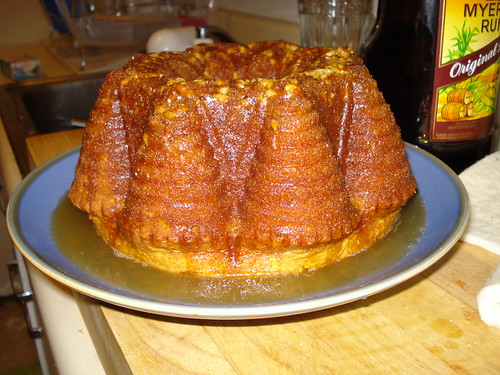
I said it was Cake Day, and Cake Day it is! I decided it was high time to make a Bacardi Rum Cake. I had all the ingredients in-house, including some lovely eggs from Washington's Green Grocer. Though I normally prefer to make a cake from scratch, I honored the original recipe and used a mix.

...Okay, I didn't honor it all the way...

I used half a cup of walnuts, not a full cup, and I'd feel free to omit them entirely if you have concerns about nut allergies (or if you don't know for absolutely sure that your cake audience is allergy-free).

I nabbed a box of cake mix that did have pudding included, and yet, rebel that I am, I added a box of pudding, used 4 eggs not 3, and had a full half cup of oil.

My oil was not Wesson.

My rum was not Bacardi.

And, believe it or no, I used a Bundt pan. I live in a 1937 apartment; my oven is TINY. As much as I love 9 x 13 inch pans, the narrower footprint of a Bundt just works better in my oven -- the heat can actually circulate.

The cake went together easy peasy. It filled the house with amazing scents. I had no problem getting the cake out (my Bundt is non-stick, and I buttered it liberally). And the glaze... well! I've never cooked a butter/sugar glaze before -- most cake glazes I do are water and confectioner's sugar. This took more time and stirring, but turned out beautifully. I poured it slowly over the cake, trying to let it all soak in, but there was still a pool of glaze when I was done -- you can see the pool in the picture above.

No worries. Just keep going back as it cools further, and use a spoon to, well, spoon the glaze from the pool over the cake. The glaze thickens as it cools; after a few times going back to lacquer the cake, there'll be nothing left to spoon.

The cake is gorgeous. It smells wonderful. And I can't wait to try it.

Cake Day!: Rhubarb Cake

It's Cake Day here chez Take One Cookbook. I've got a Bacardi Rum Cake baking away in the oven as we speak, and the scent is heavenly; it's distracted me utterly from all things non-cake. So, let's delve for the last time into the Spratt/Bachman & Mellberg/McKenzie Family Cookbook 2008, and go for something seasonal and cakey from Aunt Agnes:
Rhubarb Cake
Agnes Bachman Pengilly

1 1/2 c. packed brown sugar
1/2 c. butter
1 egg
1/2 tsp. salt
1 c. sour milk or buttermilk
1 tsp. soda
2 cups flour
2 cups rhubarb

Topping - 3/4 c. white sugar, 1 tsp. cinnamon. Put on top of cake. Bake 30-35 minutes.
Get the feeling that, in my family, one is just expected to know how the heck to bake? Let's break this down for the non-Spratts/Bachmans/Mellbergs/McKenzies out there:

Pan: Use a 9 x 13. Yes, I know.
Oven temp: 350°F
Method:
  • Cream the butter and sugar together.
  • Beat in eggs.
  • In a separate bowl, sift together dry ingredients.
  • Alternate adding flour mixture and sour milk or buttermilk to the butter/sugar/egg mixture.
  • Toss the cut up rhubarb in a bit of flour (so that it disperses nicely in the cake, or so my mother always told me).
  • Top as directed.
  • Bake as directed.
  • Cool in pan.
  • Serve hunks of cake topped with Cool Whip, whipped cream, or, heck, warmed up in a bowl and then topped with ice cream or whole milk.
Rhubarb cake...it's so darned moist, tangy, and tasty! I remember lots of rhubarb in the family, growing up. I never even thought to try buying it in the grocery store, though, as everyone back home seems to have it in their gardens -- well, assuming their house was built and garden established by someone in my Grandpa's generation. But, yes, it's purchase-able in grocery stores, and it's in season, so, get yourself some! Eat it raw, dipped in sugar; or make a compote, if cake-baking seems too much for you. Or, mmm, try it in a strawberry-rhubarb pie... I love late spring!

If you want to go the sour milk route, take 1 tablespoon of lemon juice or white vinegar, and put it in your 1 cup liquid measuring cup. Top off with enough milk to make 1 cup. Let stand for about 10 minutes, and voila! Soured milk. Don't just use milk that's past date in your fridge; you don't want spoiled milk. If this sounds too chemistry-class for you, just buy some buttermilk.

This cake is great warm, or at room temperature. It's, of course, a good dessert, but it's equally tasty for a homey breakfast. Go get a couple stalks of rhubarb (which is a vegetable, even though normally eaten as a fruit), and enjoy the tang.

Thursday, May 28, 2009

Attractive To The Eye and Soothing To The Smell: Poppy Seed Buns

When Mom got the Spratt/Bachman & Mellberg/McKenzie Family Cookbook 2008, she wanted to know if it had "her" recipes, the ones she remembered her grandmother and aunts making. It's all well and good to have a new-to-you Rice Krispies Brownie recipe on hand, but what makes a family cookbook really sing is to find the recipes you wish you'd snagged from your aunt's recipe box the last time you swung through North Dakota. Mom was very happy to find that the sweet poppy seed buns were included.
Poppy Seed Buns
Magdalena Berger Bachman

Dough:
2 cups warm milk
1/2 c. sugar
2 tsp. salt
2 cakes (pgks) yeast
2 eggs
1/2 c. soft shortening
7 - 7 1/2 c. flour

Dissolve yeast in 1/2 c. warm water. Mix well the milk, sugar and salt together with yeast. Add eggs and shortening. Add flour. Let rise. Punch down. Let rise again.

Filling:
Poppy seeds, raisins thickened with water and cornstarch. Add some sugar. Place small amount on circular shape of dough. Roll. Let rise. Bake.
Wow, we went from a standardized recipe to one a bit more ... trusting. Assume a 350°F oven, and think either "cinnamon roll" or "knish" when shaping your buns. Yes, I know they're different shapes, but either should yield good results. Personally, I'd go with "cinnamon roll" so that I get well distributed bits of bread and filling with every bite.

If you have a poppy seed grinder handy, by all means, grind those seeds! You could, of course, also buy pre-ground poppy seeds. The texture is lovely, and odds are, you don't have your own poppy seed grinder sitting about.

I know some folks are anti-raisin; feel free to substitute a dried fruit of your choice. Dates, apricots, or even apples would make a good substitution.

As for the sugar, add to taste -- I'm thinking a 1/4 cup is a good starting point. Mix up your filling, taste it, and add sugar if you think you need it.


I'm really liking digging through family food history; my grandfather passed away last month, and this is a ...non-maudlin... way to remember him and his. Speaking of his, the stern looking couple above are my great great grandparents, so were his grandparents (I have to double check if that makes this Magdalena-of-this-recipe, or Magdalena's mother-in-law). If any of the recipes in this book don't work out, well...we can probably pin the blame on them or their children. This will become important when I post the prune pie recipe.

Monday, May 25, 2009

Spratt/Bachman & Mellberg/McKenzie Family Cookbook 2008: German Twists

When I was a kid, every summer we'd have a big family picnic. My mom's one of 7 kids, and her parents were each one of several, and there were cousins, aunts, uncles, third cousins twice removed, kids, ancients, games, silliness, and fabulous food. The picnic sort of fell into memory when my generation hit their 20s, but now that we're older and have families of our own, it's come back with a vengeance. At the 2008 picnic, there were even representatives from the heartland -- North Dakota, where both Grandma and Grandpa came from. These relations brought with them a fabulous surprise: a family cookbook. The Spratt/Bachman & Mellberg/McKenzie Family Cookbook 2008, to be precise. Lots of family recipes, some of which I remember from picnics, some of which Mom remembers from visiting the family farm as a little girl. There's also stories, some of which made Mom laugh outloud. This week, we'll delve into the family. First, a note from the compiler:
The cover of this cookbook was a special find, thanks to Marjorie Pengilly Mostad for bringing it to our attention. It is taken from an actual Betty Crocker magazine with Grandpa Andrew Bachman's address on the address label, and a hand written note explaining that these twists were made by Grandma Bachman. I don't remember ever eating the twists, but the recipe is in this book, and I am told they were delicious.
Well, the compiler may never have had 'em, but my mom remembers them well. The good folk at Betty Crocker may have called them Cinnamon Twists, but along the way, the name changed.
German Twists (Cover Photo)
Magdalena Berger Bachman

1 c. lard or butter
1 c. sour cream
1 cake yeast
2 beaten eggs
3-1/2 c. flour
dash of salt

Mix shortening and flour until crumbly. Beat eggs, add cream and yeast. Add to flour mixtures and knead a little. Put in fridge overnight with wet cloth on top. Take little pieces (about handful) of dough sprinkle board with sugar and put some on top of dough. Roll out and then fold over and over until dough is small. Put more sugar on board and on top of dough as you roll. Cut in strips 1 inch wide and 3 or 4 inches long. Twist and put on greased pan. Bake until real light brown at 375 degrees. Very good and flaky.
I'm sure this tastes just fine. I'm not sure where the heck the sugar comes from, nor how this is supposed to be a cinnamon twist when there's no cinnamon. Frankly, I think there's missing information between "dough" and "sprinkle," and I'm going to go out on a limb and say that the sugar in question is cinnamon sugar. There was always cinnamon sugar about the house as I was growing up, so I'm guessing that a common enough thing in our family. I think that if you want to try this out, you're going to have to be patient as all heck with it, and/or find some other instructions for yeast-raised pastry dough and use them as a crib sheet. Try it. What the heck. Worst thing that happens is you have just okay pastry as opposed to stellar pastry.


AMENDMENT:

Whatever this recipe is, it is not the cinnamon twist on the front of the cookbook. Here's another German Twist recipe, from the glorious internet, such that you can see how it should actually be rolled and handled:
GERMAN SOUR CREAM TWISTS

3 1/2 c. flour
1 tsp. salt
1 c. shortening (part butter)
1 pkg. yeast
1/4 c. warm water
3/4 c. sour cream
1 whole egg and 2 egg yolks, well beaten
1 tsp. vanilla

Refrigerate 2 hours. Using half of dough, roll into 8x16 inch rectangle. Sprinkle with sugar and fold each end into the middle and roll out again in rectangle and sprinkle with sugar. Do this 3 times using 1/2 cup sugar for each half.

After the third time, roll out in a rectangle and cut in 1x4 inch strips and twist. Bake at 375 degrees for 15 minutes. Makes about 5 dozen.
There are TONS of recipes out there for German Sour Cream Twists, and clearly, that's what Magdalena Bachman's recipe is for. Don't use cinnamon sugar (or, heck, do, but know you'll be concocting a different sort of beast). And plan on a whole cup of sugar for your rolling and twisting.

Saturday, May 23, 2009

Setting A Man Trap: Blueberry Boy Bait

Okay, okay, once you see the size of the pan required, you may not believe that I chose this recipe based on the name and not the pan. But, really, when I found "Blueberry Boy Bait" in The Fruit of the Spirit: 100th Anniversary of Bittinger Lutheran Parish, I first started giggling madly, then started thinking that I hadn't watched Gidget or Tammy and The Bachelor in far too long, and then that I really needed to post this recipe.
Blueberry Boy Bait
Ethel Buckel

2 c. all-purpose flour
1 1/2 c. sugar
2 tsp. baking powder
1 tsp. salt
3/4 tsp. nutmeg
2/3 c. softened butter
1 c. milk
2 eggs
1 c. blueberries
1/4 c. sugar
1/2 tsp nutmeg

Cream butter and 1 1/2 cups sugar. Add eggs. Combine flour, baking powder, salt and nutmeg in a separate bowl. Add milk, alternately, with combined dry ingredients. Pour into 9 x 13-inch pan. Top with blueberries, 1/4 cup sugar and 1/2 teaspoon nutmeg. Bake at 350° for 40-50 minutes.
Despite the off-putting lack of serial commas, this is just a delightful recipe! I particularly like that instead of saying "1 3/4 c. sugar, divided" in the initial recipe list, they break it out for you, in order and volume of use. Some folks may prefer it the other way, but for me, a serial ingredient list is as important as a serial comma.

Serial commas: they're good enough for the U.S. G.P.O., they're good enough for you.

Back to the title. It seems like this is going to hav eto be something simple enough for a novice cook to whip together on her own (yes, "her"... I think it's safe to say that whomever came up with this recipe was pretty much trying to help a girl get her boy, though I wholeheartedly support boys using it to bait girls and girls using it to bait girls and so and so and so forth) without much supervision from her mother (yes, "mother" ... for the sake of the rest of this post, let's just role play and think that Mrs. Lawrence is trying to help Francie/Gidget to ensnare Jeffrey/Moondoggie -- embrace your 1959 teen romance). It should also be incredibly tasty. I'm surprised there's no vanilla or cinnamon to up the smell of the bait, but nutmeg -- so linked with pumpkin pie -- is going to bring a lot of good baking spice to the man trap.

We're in season for blueberries in the US, and I've seen some great buy-one-get-one-free specials at the grocery store. The pick-your-own farms around DC aren't open for blueberries yet; maybe later this summer I can cook the book on this one, with freshly-picked local (false) berries.

Even if you've already sprung a perfectly serviceable trap, why not try out the boy bait when next you need a 9 x 13 baked good? At the very least, file it away for Independence Day, where the blue will play nicely with some cut strawberries and vanilla ice cream.

Friday, May 22, 2009

Only Enough To Act As A Preservative: Bacardi Rum Cake

Yesterday, I shared my love of the 9 x 13-inch pan. Growing up, all cakes were made in this venerable dish. My sister's must-have birthday cake (Lemon Jell-O Cake, which I'll post when I do the Fishwives cookbook) was always the friendly rectangle. It was only much later in life that I read the full recipe and realized that the cake was supposed to be baked in a Bundt pan. Today's recipe from The Fruit of the Spirit: 100th Anniversary of Bittinger Lutheran Parish says to use a Bundt, too -- but out of cakely familial loyalty, I'd be tempted to use the tried and true 9 x 13.
Bacardi Rum Cake
Linda Thomas

Cake:

1 c. chopped pecans or walnuts
1 pkg. yellow cake mix
1 sm. pkg. vanilla instant pudding
4 eggs
1/2 c. cold water
1/2 c. Wesson oil
1/2 c. Bacardi rum

Glaze:

1/4 lb. butter
1/4 c. water
1 c. white sugar
1/2 c. rum

Preheat oven to 325°. Grease and flour tube or bundt pan. Sprinkle nuts over bottom of pan. Mix all cake ingredients together over nuts. Pour batter over nuts. Bake 1 hour. Cool. Invert on serving plate. Prick top. Spoon or brush glaze evenly over top, allowing cake to absorb glaze. Glaze: Melt butter in saucepan. Stir in water and sugar. Boil 5 minutes, stirring constantly. Remove from heat. Stir in rum. *If using cake mix with pudding already in the mix, omit instant pudding, use 3 eggs instead of 4, use 1/3 cup oil instead of 1/2 cup.
Pudding: the great moisturizer of cake. I like the substitution hints here, as I bet they can be used for lots of other cake-doctoring recipes.

Some of you may not keep rum around the house. If you're one of those people, you might want to know how much, really, you need to buy. Well, a fifth of rum is 750 ml, which is about 25 ounces, or just over three cups. So, one regular-sized bottle of Bacardi is going to get you through this cake and two others (or this cake and several Cuba Libres). Should you go for a light rum, or a dark rum? I leave it to your personal tastes. If you don't think you have personal tastes when it comes to rum, then I suggest going for a light rum, so that your cake color is still light and lovely. You can up the amount of rum you use in the glaze (1/4 cup of rum brings more flavor to the cake than 1/4 cup of water, after all) if you want to have really rummy cake.

I remember my first rum cake (eating, not making). I was over at the Schrader's house, and Martha had made an apple rum cake. It was delicious, and I probably ate too much of it, especially considering that I was a kid. Remember: alcohol can cook out of dishes, and probably does cook out of the cake. However, it's NOT cooking out of the glaze. There's active, boozy rum here; do not serve to those who have medical, religious, or other reasons to avoid, well, Demon Rum.

Not to sound like a complete lush, but a rum cake (be it in a 9 x 13 or a Bundt) would be a great dish to take to your Memorial Day barbeque/picnic/potluck/what have you, if you're going to be around mostly-grown-ups. The pudding guarantees a moist cake, the Bacardi guarantees a delicious one.

Friday, December 12, 2008

Diane's Ultimate Thumbprints; a.k.a. Sonja Henie Cookies

When it comes to cookies, donuts, or sponge cake, I think the best can only be made better by adding jelly. Oh, for a jelly roll! Or a donut gushing with raspberry jam. Or, come Christmas time, a thumbprint cookie. They're delicious to eat, and fun to make (I mean, come on, any recipe that involves smooshing stuff is fun). This recipe Christmas 101 is a riff on the classic thumbprint:
Diane's Ultimate Thumbprints

Makes about 5 dozen cookies

Make Ahead: The cookies can be prepared up to 1 week ahead, stored in an airtight container at room temperature.

1 cup (2 sticks) unsalted butter, at room temperature
1/2 cup packed light or dark brown sugar
2 large eggs, separated
1/2 teaspoon vanilla extract
2 cups all-purpose flour
1 1/2 cups (6 ounces) walnuts
1/4 cup granulated sugar
Pinch of salt
2/3 cup fruit preserves, such as raspberry or apricot (see Note)

1. Position the racks in the top and bottom thirds of the oven and preheat to 350°F.

2. In a large bowl, using a hand-held electric mixer on medium-high speed, beat the butter until creamy, about 1 minute. Add the brown sugar and beat until light in color and texture, about 2 minutes. Beat in the egg yolks, then the vanilla. Using a wooden spoon, gradually mix in the flour to make a soft dough. Using a scant tablespoon for each, roll the dough into 1-inch balls. Place the balls on a baking sheet and let stand in a cool place (near an open window in cold weather or in the refrigerator) until slightly chilled and firmed, about 10 minutes. (Don't skip this step -- the dough must be slightly chilled to make the holes in the dough that hold the preserve filling.)

3. In a food processor, pulse the walnuts and the granulated sugar until the walnuts are finely chopped. Set aside.

4. In a small bowl, beat the egg whites with the pinch of salt until foamy. Pour about one-third of the chopped walnut mixture into a shallow bowl. Dip each ball of dough in the egg whites, roll in the walnut mixture to coat, and place 1 inch apart on nonstick cookie sheets. Holding a ball of dough on the sheet with one hand, use the tip of your little finger of the other hand to press a 1/4-inch wide hole into the center, about 1/4 inch deep. (If you have long fingernails, use the inverted tip of a 1/4 inch-wide wooden spoon handle or a dowel.) If the ball cracks, just press the crack together to smooth. Repeat with the other balls of dough, gradually adding more of the walnut mixture to the shallow bowl as needed. (It is important to use the walnut mixture in batches, as it will collect moisture from the egg whites, and if used all at once, it will get so wet it won't adhere properly. You will probably have leftover chopped walnuts, but that's better than running out of them.)

5. Bake until the cookies feel set but not completely baked, about 10 minutes. Meanwhile, place the preserves in a small, self-sealing plastic bag and squeeze the preserves into one corner of the bag. Using scissors, snip off the corner of the bag to make an opening about 1/4 inch wide. When the cookies are set, remove them from the oven. Use the bag to pipe the preserves into the hole in each cookie. Return the cookies to the oven, switching the positions of the cookies from top to bottom and from front to back. Bake until the cookies are lightly browned, 5 to 8 more minutes. Cool on the baking sheets for 2 minutes. Transfer to wire cooling racks to cool completely. (The cookies can be prepared up to 1 week ahead, stored in an airtight container at room temperature.)

Note: Be sure to use preserves for the filling; jellies and jams are too thin and will melt into the cookies. If your preserves are especially chunky, chop up the fruit pieces in a bowl with a knife before using to avoid clogging the hole in the bag as you fill the cookies.
Do not be afraid of the long recipe, of all the detailed steps. These are cookies, the most forgiving of the baked goods! Chill your dough when you're told to, and the rest will all work out. And even if your fruity goodness does melt into your delicate dough... it's a cookie. It's going to taste great.

The author notes that the original recipe card for these calls them "Sonja Henies," but he doesn't think that name resonated with modern cookie makers or eaters. Sonja Henie was an Olympic gold medalist AND a Hollywood box-office smash. ....okay, she was also considered a Quisling... a Nazi collaborator. Certainly, she was friendly with Hitler. It does take the gleam off her stardom, that. It's easy to forget when she's playing the earnest, lovable, sweetly conniving skater in "Iceland" or "Sun Valley Serenade"... So, fine, we can call them Diane's Ultimate Thumbprints; they'll still taste good, and look delightful on your cookie tray.

One last Henie-related note: she had a romance with Van Johnson, who passed away today at the age of 92. I feel a memorial film festival coming on.

Thursday, December 11, 2008

Deep Dark Stout Gingerbread

Chefly Husband and I went to Ireland several years ago, and, while in Dublin, went to the Guinness museum. One of the exhibits was meant to give you the sensation that you were in a ginormous pint glass that then got filled with the dark, fabulous stout.

This recipe from Christmas 101 is as close as you can get to that outside of Dublin, on your holiday table.
Deep Dark Stout Gingerbread

Makes 12 servings

Make Ahead: The gingerbread can be prepared up to 2 days, covered tightly with plastic wrap and stored at room temperature.

2 1/2 cups all-purpose flour
2 teaspoons ground ginger
2 teaspoons ground cinnamon
1 1/2 teaspoon baking powder
1/2 teaspoon baking soda
1/2 teaspoon salt
1 cup (2 sticks) unsalted butter, at room temperature
1 1/4 cups packed light brown sugar
2 large eggs plus 1 large egg yolk
1 cup unsulfured molasses
3/4 cup flat stout, at room temperature
Confectioners' sugar, for garnish

1. Position a rack in the center of the oven and preheat to 350°F. Lightly butter and flour the in side of a 12-cup fluted tube pan, tapping out the excess flour.

2. Sift the flour, ginger, cinnamon, baking powder, baking soda, and salt onto a piece on wax paper. Set aside.

3. In a large bowl, using a hand-held electric mixer at high speed, beat the butter until creamy, about 1 minute. Add the brown sugar and beat until the mixture is light in texture and color, about 2 minutes. One at a time, beat in the eggs, then the yolk. Beat in the molasses.

4. Reduce the mixer speed to low. In three additions, beat in the flour mixture, alternating with the stout, scraping down the sides of the bowl as needed, until the batter is smooth. Scrape into the prepared pan and smooth the top.

5. Bake until a toothpick inserted in the center of the cake comes out clean, 50 to 60 minutes. Cool on a wire cake rack for 10 minutes. Invert the cake onto the cake rack. Transfer to a serving platter, sift confectioners' sugar over the top, and serve warm. Or cool completely and serve at room temperature. (The gingerbread can be prepared up to 2 days ahead, covered tightly with plastic wrap and stored at room temperature.)
Don't have a 12-cup fluted tube pan? Don't worry. Use a Bundt-pan. Use a 9x13 pan. Use any cake-cooking vessel that can hold 12 cups. Not sure of the volume? Really, this is easy: get out your liquid measuring cups. Fill 'em up. Pour into the pan you want to use. Count how many cups it takes to fill the pan.

...yeah, it really is that easy. When I first read that, I slapped my face down into my hands, wondering why I'd never thought of that. It's so much easier than measuring the pan and doing math. I save my math for increasing or reducing recipes, not for calculating volume in fancy Bundt pans.

The author of Christmas 101 suggests that you open the stout an hour before making the cake so that you can encourage the beer to go flat. Stir it, too, every once and a while. That's all good advice. However, when he starts talking about what to do with the left over beer, and his first tip is to cover the top with plastic wrap and stick it in the fridge? I call foul. Drink that stout. Unless you can't for health or religious reasons, there's just no reason to leave perfectly good stout to go flat in the fridge.

Yes, you can use stout in your beef stew. Or plum pudding. Or many other yummy things. But, for the love of all things holy, don't just chuck it in the fridge to go flat and vaguely fridge-y.

This is the first near-duplicate recipe on Take One Cookbook; back in September, we looked at Kentish Gingerbread; if anyone has the inkling to try them both, I'd love side-by-side comparison notes.

Monday, December 8, 2008

Candied Citrus Peel

What do the lebkuchen and brandied fruitcake drops have in common? Besides both being from Christmas 101, that is.

The use of candied citrus peels.

In fact, a lot of holiday recipes call for candied citrus peel of one kind or another (or, heck, in combination). Moreover, you can dip candied citrus peel (I'd call it CCP, but that's just one C short of the Soviet Union, and I'd have weird cognitive issues with that) in melted chocolate and give it out as presents to your neighbors, coworkers, and holiday hosts and hostesses. Yes, really! Honestly! Homemade goodies are a great thing to bring to parties, and this one doesn't take long at all.
Candied Citrus Peels

Makes about 3/4 pound

Make ahead: The candied peels must stand overnight before rolling in sugar. They can then be stored, in an airtight container at room temperature, for up to 1 month.

2 medium grapefruits
1 1/2 cups granulated sugar plus additional for coating
1/3 cup light corn syrup

1. Using a sharp knife, cut off the tops and bottoms of the grapefruits so they can stand. Cut off the rinds in thick, wide strips where the rind meets the fruit. Cut the rind into long strips about 1/2 inch wide. Place in a medium saucepan and cover with cold water. Bring to a boil over high heat, then reduce the heat to medium and cook at a gentle boil for 5 minutes. Drain and rinse under cold running water. Return to the pan, cover with water, and repeat the procedure.

2. In a medium saucepan, bring the sugar, corn syrup, and 1 1/4 cups water to a boil, stirring to dissolve the sugar. Add the peels and reduce the heat to medium-low. Simmer until the peels are translucent and tender, 20 to 30 minutes. Drain the peels. Arrange the peels, not touching each other, on a wire cake rack set over a baking sheet. Let stand at room temperature overnight. Roll the peels in additional sugar to coat. (The candied peels can be prepared up to 1 month ahead, stored in an airtight container at room temperature.)
Do you hate grapefruit? I do. Oh, don't get me wrong... give me a nice can of Fresca, with its chemically wonderfulness, and "grapefruit flavor" will be okay. But when it comes to citrus, grapefruit just isn't my thing.

If you're like me, you can substitute 3 oranges, or 4 lemons for the grapefruit. The peels for either of these fruits will need longer simmering times -- 30 to 40 minutes.

And, heck, if you're feeling frolicsome, you can substitute other citrus, too. Try lime. Try... bergamot. Try whatever floats your candying boat. Just remember to simmer until translucent and tender.

Dollars to donuts, what ever you try, it's going to end up tasting a damned sight better than the mass-processed crud you can get in the supermarket.

Sunday, December 7, 2008

Brandied Fruitcake Drops

I love fruitcake. I never understood the gags about people passing around fruitcake year after year, because, well, my grandma made good fruitcake. And I love the dried fruits. I love the spices. I love the whiff of booziness past. I love the colors! It's like all of Christmas in a dense, sweet, crumbly cake. Oh, yes.

Some people say they hate fruitcake. To them, Rick Rodgers says, "these moist and chewy cookies have been gobbled by many an unsuspecting professed fruitcake hater." So, let's get to the conversion (it's nigh on religious) to fruitcake love, via Christmas 101:
Brandied Fruitcake Drops
Makes 3 dozen.

Make Ahead: The cookies can be baked up to 1 week ahead, stored in an airtight container at room temperature.

8 tablespoons (1 stick) unsalted butter, at room temperature
1 cup packed light brown sugar
1 large egg
1/2 cup buttermilk
1/4 cup brandy or bourbon
1 teaspoon vanilla extract
2 cups all-purpose flour
1/2 teaspoon baking soda
1/4 teaspoon salt
1 cup chopped candied fruit for fruitcakes (a combination of candied orange and lemon peels, candied cherries, pineapple and citron) or any dried or candied fruit you prefer
3/4 cup coarsely chopped walnuts

34 walnut halves, for decoration

1. Position the racks in the center and top third of the oven and preheat to 350°F.

2. In a medium bowl, using a hand-held electric mixer at high speed, beat the butter and brown sugar until light in color, about 2 minutes. Beat in the egg. Add the buttermilk, brandy, and vanilla, and beat until the mixture is fluffy, about 1 minute. Using a wooden spoon, add the flour, baking soda, and salt, and mix to make a soft dough. Stir in the chopped candied fruit and walnuts.

3. Using about 1 tablespoon for each cookie, drop the mixture about 1 inch apart onto nonstick baking sheets. Press a walnut half into the center of each cookie. Bake, switching the positions of the cookie sheets from top to bottom and front to back halfway through baking time, until the edges of the cookies are lightly browned, about 20 minutes. Transfer the cookies to a wire cake rack and cool completely. (The cookies can be baked up to 1 week ahead, stored in an airtight container at room temperature.)
Ever feel like a recipe is repeating itself? The Make Ahead slug at the top of ever recipe is repeated at the end, in a quieter, gentler parenthetical aside. No italics. No special fonts. Just a reassurance.

If you like fruitcake, but have never made your own, start with this. It's not that fruitcake is hard to make, it just takes quite a while. There's the soaking, the straining, the brushing, the whole rigamarole.

And, yes, you can put together your own blend of dried and candied fruits to make this (or to make full-on fruitcake). Do not just buy a tub of "fruitcake blend" at the grocers... it's going to be cloying and strange. If you don't want to assemble your own, then order fruitcake fruits pre-blended from King Arthur's Flour. When I make fruitcake, that's what I get. I also tend to get the wee small disposable baking pans from King Arthur's; they work, they work well, they make for nice gift giving.

It may be time to thaw another fruitcake, come to think of it. I've three from the last baking round stashed away, well wrapped and waiting to convert another person to the church of fruitcake love.

Saturday, December 6, 2008

Christmas 101, by Rick Rodgers; Lebkuchen

Happy St. Nicholas's Day, folks! Chefly Husband and I woke up to find our boots stuffed with goodies. Wine! Chocolate! Maple sugar Santas! Jelly beans!

And most important of all: lebkuchen.

I'd never had lebkuchen before meeting Chefly Husband; though my mom's side of the family is as German as it is Icelandic, the holiday baked goods tended to be more Icelandic than German. And lebkuchen? It very, very German. It can be a bit hard to describe lebkuchen, but... think of it as a cross between a soft gingerbread cookie and a hard gingerbread cake. Picture it glazed, or coated in chocolate. Pair it with marzipan. Or jelly. Or both. (That one? Yeah, that was breakfast this morning.) It's also got a touch of spice cake to it, or fruit cake. It's... it's lebkuchen. It's yummy.

And it's one of the recipes featured in Christmas 101: Celebrate the Holiday Season from Christmas to New Year's, by Rick Rodgers (my first edition copy is © 1999, but it's had several printings since, and you'll see different cover art if you go to buy a copy for yourself). The book will march you through recipes enough for any holiday feast, but also spends a lot of time on cookies (and gift-able candies), and with a bit over a fortnight left before Christmas, it's about time to be thinking of baking cookies. Let's start off with the right cookie for St. Nicholas:
Lebkuchen
Makes about 40 cookies

Make ahead: The dough must be chilled for at least 4 hours or overnight. The cookies can be baked up to 2 months ahead, stored in airtight containers at room temperature. If possible, store the cookies for at least 3 days before serving.

3 cups all-purpose flour
1 teaspoon baking soda
1 teaspoon ground cinnamon
1/2 teaspoon freshly grated nutmeg
1/2 teaspoon ground cloves
1/2 teaspoon salt
1 cup honey
3/4 cup packed light brown sugar
1 large egg
Zest of 1 lemon
1 tablespoon fresh lemon juice
1 cup (4 ounces) very finely chopped walnuts
1/2 cup very finely chopped Candied Orange Peel (page 93) or store-bought candied orange peel

Icing
1 cup confectioners' sugar
1 teaspoon fresh lemon juice
1/2 teaspoon almond extract

1. Sift the flour, baking soda, cinnamon, nutmeg, cloves, and salt into a medium bowl, and set aside. In a large bowl, whisk the honey, brown sugar, egg, lemon zest and juice, and 2 tablespoons water. Gradually stir in the flour mixture, then the walnuts and candied orange peel. If the dough seems too dry, sprinkle with water; 1 tablespoon at a time, and mix with your hands until moistened. Gather up the dough. Divide the dough into two flat disks and wrap in plastic wrap. Refrigerate until firm and chilled, at least 4 hours or overnight. (If chilled overnight, allow the dough to stand at room temperature for 30 minutes before rolling out. The dough will crack if it is too cold.)

2. Position the racks in the center and top third of the oven and preheat to 375°F.

3. On a lightly floured work surface, roll out one disk of dough into a 1/2-inch rectangle, about 12 x 8 inches. Using a sharp knife, trim the dough to a 7 1/2 x 10-inch rectangle, discarding the trimmings. Cut the dough into 20 bars. Place the bars on nonstick cooking sheets, about 1 inch apart. Repeat the procedure with the remaining dough.

4. Bake, switching the positions of the cookies from top to bottom and back to front halfway through baking, until the edges of the cookies are beginning to brown, about 15 minutes. Transfer to wire cake racks and cool completely.

5. To make the icing, sift the confectioners' sugar into a small bowl. Add the lemon juice and almond extract. Stir in 2 tablespoons water to make a thin, spreadable icing. Using a small metal spatula, spread the icing over the tops of the cookies, and let stand until the icing is dry. (The cookies can be baked up to 2 months ahead, stored in airtight containers at room temperature. If possible, store the cookies for at least 3 days before serving.)
Don't be scared off by all the steps; nothing is very difficult in and of itself, and you can spread out the work over a couple of days.

Eating lebkuchen always makes me think of Chefly Husband. The tins some lebkuchen comes in, though, reminds me of Momma. See, she has this big tin, with a hinged lid, and various old German scenes embossed on it. It was our breadbox when I was growing up, and it remains her breadbox still. She figured out that it had been a cookie tin, but couldn't figure out anything more (we none of us speak German). Lo and behold, I meet Chefly Husband, he gets me seasonally addicted to lebkuchen, and I start noticing the tins they come in. They look...an awful lot like the breadbox. Sure enough, the next time I was home with Mom, I took a closer look at the breadbox and discovered it had, in fact, held lebkuchen in a past life.

And, hey, that Candied Orange Peel reference in the ingredients list? I'll be posting that recipe this week. Good for gift giving, good for lebkuchen!

Friday, December 5, 2008

Divinity

Filbert brittle makes me think of Grandma G. But divinity? Divinity makes me think of Grandma B. I don't have many memories of Grandma B. that come from just-me, as opposed to other people's stories. See, she died when I was just about 3 years old, and the times we'd gone up to Portland to visit, I'd been going to doctor's appointments. My sister got to stay with Grandma, and so has many more direct memories of her. I do remember her holiday candy tray, though, and, especially, the divinity.

The Farm Journal's Homemade Candy offers up the following basic divinity recipe (and several variations that make buying the book well worth your $2):
Divinity
Sells fast at food bazaars

2 1/4 c. sugar
1/3 c. white corn syrup
1/4 tsp. salt
1/3 c. water
2 egg whites
1 tsp. vanilla
2/3 c. chopped pecans or walnuts

Place sugar, corn syrup, and water in a 2-qt. heavy saucepan; cook and stir over high heat until sugar is dissolved. Continue cooking without stirring over medium heat until syrup reaches the hard ball stage (255°). Wipe off any sugar crystals that form on sides of pan.

Meanwhile, beat egg whites until stiff. Pour hot syrup slowly over egg whites and beat on medium speed of mixer until candy fluffs up. Add vanilla and continue beating on medium speed, or by hand, until mixture begins to lose its gloss and a small amount dropped from a spoon holds soft peaks. (If the candy gets too stiff for the mixer, complete the beating with a wooden spoon.) Fold in nuts.

Working quickly, drop candy by teaspoonfuls onto waxed paper or turn into lightly buttered 8" square pan. If divinity becomes too stiff, stir in a few drops of hot water. Makes about 24 pieces or 1 pound.
Have I mentioned this week that you really, really, truly need to have a decent candy thermometer? You do. Cooking with sugar is all about the temperature, and though you could technically figure out what stage you're at by dropping bits into cold water and then manipulating it, that takes time, and isn't as accurate. Get a candy thermometer. It will make this much easier.

My mom gave me a Betty Crocker cookbook (which I'm sure to feature on Take One Cookbook at some point) when I went off to college. She wrote on the divinity page "do not make on a rainy day." Divinity and humidity do not go well together. Homemade Candy suggests that if you beat the divinity enough, you'll manage just fine. And by "enough," I mean that it could take up to 15 minutes. No, really. If you thought about trying this without a mechanized mixer, the time to rethink that is now.

If you want to do dropped-from-spoons divinity, have a partner, or it's going to set up on you. I remember divinity cut into squares, so I'm guessing that Grandma B. always poured it into a pan. She didn't lack for helpers, mind you; Mom is one of 7 children. But, still, if you've got hot sugar and 7 kids under foot, the quicker path is probably the wiser one.

Unless you're dealing with a taffy pull. Homemade Candy will walk you through that, too. Pick up a copy, and let me know how your creations turn out.

I feel like I should say that, growing up, I always assumed that the Turkish Delight that the White Witch fed Edmund was, in fact, divinity. What else would lead a child to betray his family? It's that good.

Thursday, December 4, 2008

Homemade Marshmallows

Nowadays, nearly every culinary or family magazine will give you a recipe for homemade marshmallows, but back in 1970, when The Farm Journal's Homemade Candy came out, marshmallows in the U.S. came in a plastic bag at the grocers. They were meant to be put in fruit salad, or melted on top of sweet potatoes, or really really melted in with margarine to coat Rice Krispies for a Treat. I adore marshmallows (even the mass produced kind), and encourage you to give 'em a go in your own kitchen.
Homemade Marshmallows
Light, delicate and delicious

2 tblsp. unflavored gelatin
3/4 c. cold water
2 c. sugar
1/8 tsp. salt
3/4 c. boiling water
1 tblsp. vanilla
Chopped nuts or toasted flaked coconut for coating

Soften gelatin in cold water 5 minutes; then dissolve by stirring over hot water.

Combine sugar, salt and boiling water in 2-qt. heavy saucepan; cook, stirring utnil sugar dissolves, to the soft crack stage (280°).

Pour into mixing bowl along with the gelatin mixture and beat at low speed for 3 minutes; continue beating at medium speed for 10 minutes or until mixture is fluffy and creamy. Add vanilla and pour into an 8" square pan dusted with confectioners sugar.

Cool 1/2 hour or until set, then cut in 36 squares with knife moistened in water. Roll in nuts or coconut. Place in airtight container and put in refrigerator, freezer or other cold place until ready to use. Makes about 1 pound.

Note: Tint the gelatin mixture while heating -- pale green, pink, or yellow -- if you wish. Roll green candy in chopped nuts, pink in flaked coconut, yellow in toasted coconut and white in nuts or coconut. You can vary the flavorings if you wish. Instead of vanilla use almound, peppermint, orange or lemon extract.
In case it's not 100% clear, do NOT use these magnificent beasties for your Rice Krispie Treat needs. These are to be savored on their own.

I'm generally pro-nut, but don't think that nuts really pair well with an otherwise unadorned marshmallow. If you're going to enrobe the nut-crusted 'mallow with chocolate, well, ... maybe. But otherwise, please keep them plain, or dusted in confectioner's sugar, or, yes, use that coconut. Personally, I'd tint the coconut and leave the marshmallows white.

Instead of using a knife to cut the marshmallow into pieces, try using kitchen shears. You'll manage the task much more quickly, and with greater precision.

What are your favorite uses for marshmallows?

Right about now, I can see plopping a big marshmallow into a cup of hot cocoa, watching it swell, and then nibbling my way to the beverage. Mmmm...marshmallows remind me of childhood.

Wednesday, December 3, 2008

Filbert Brittle

Though plates of fudge and cookies make me go back in my mind to my mom's family home, there are a few things that make me leap, mentally, to Dad's mom's house. Ribbon candy. Scotch and soda. Dill pickles. Brittle. And nuts.

Grandma always had a wooden bowl filled with nuts in their shells, sitting out on the coffee table. There were nut picks and a nut cracker (which looks surprisingly like what I've seen folks out here use for cracking crab). We would crack and eat nuts all visit long. My favorites were always the filberts.

Mmmm, filberts. For, lo, it was Oregon, and it was the 70s, and they were filberts. The rest of the world might call 'em "hazelnuts," but we knew better. Filbert orchards everywhere, and tasty, tasty filberts, too.

Imagine my surprise when I went to an Oregon wine tasting here in DC, and met the heads of the Oregon HAZELNUT Growers Association. They begged me to not call them filberts anymore. Seems that properly named filberts don't command the same price on the international marked as identical-except-in-name hazelnuts. A bit of me died that night.

Back to Grandma, and memories. The Farm Journal's Homemade Candy has a recipe that combines two of the tastes that make me think of Grandma G.
Unsurpassable Filbert Brittle

Filberts grow in Oregon and candy makers there believe that confections featuring them can't be surpassed. They have a right to be proud of this brittle. If you can't find filberts in your markets, you can use either raw Spanish peanuts or salted peanuts as a substitute in the recipe for Filbert Brittle.

As with all brittle recipes, the trick is to prevent scorching and the formation of sugar crystals during the cooking. This recipe shows the way a home economics teacher controls these problems. All her friends recognize her as an expert candy maker.

She likes to pour the cooked brittle onto a warm marble slab, brushed with mineral oil, but you can use heavy duty foil, well oiled or buttered. To warm the marble, she lays her electric pad on it and turns on the electricity -- an original idea.

Filbert Brittle

A holiday treat in the Northwest -- it's worth adoption across country

4 c. whole or halved filberts
3 c. sugar
1 14/ c. light corn syrup
1 c. boiling water
2 tblsp. butter
1/2 tsp. salt
1 tsp. baking soda
1 tsp. vanilla

Remove any excess or loose fibers from filberts, but do not remove skins.

Combine sugar, corn syrup, and boiling water in 3-qt. heavy saucepan. Stir until sugar is dissolved, then cover and place over medium heat until syrup boils. Remove lid; insert candy termometer and cook at medium boil to the soft ball stage (240°).

Add filberts all at once. Do not stir until mixture again boils (it might start a crystal). Then stir with a wooden spoon to keep nuts from scorching, using care not to touch sides of pan above surface of syrup, for the friction of spoon may cause crystals to fall into syrup and cause a coarse-grain candy.

Cook to the hard crack stage (310°), or even beyond it to 320°, at which stage sugar caramelizes and turns a dark golden color. Add butter; remove from heat at once. Then add salt, soda and vanilla, stirring in well.

Pour onto warm marble slab, brushed with mineral oil or butter, or onto buttered heavy duty foil. Pour brittle so it spreads out as thinly as possible. Work a buttered or oiled spatula under one side of brittle and turn it over. Pull the brittle as thin as possible. (A heatproof mit is helpful in turning and pulling brittle.)

Let cool; then break in pieces of eating size. Store in airtight containers. Place in freezer, refrigerator or other cold place. Makes 3 pounds.
Do take it to the 320°F point, please, and get the darker, yummier, caramelized sugar. It's so worth it.

I can taste it now. The butter. The burnt sugar. The crisp nuts. How, on a humid day (and, hello, it was Oregon...rainy rainy humid), it would be a bit softer, a bit grainier. Still tasty as all get out.

Tuesday, December 2, 2008

Butterscotch Haystacks

It's not very often I feature a recipe on Take One Cookbook that I know my sister would not only eat, but also enjoy. She's a very particular eater, and perhaps in a long-standing fit of rebellion ("I CAN be different than my sister!"), I eat pretty much anything. Not eel. Never eel. I have eel issues. Eel... :shudder:

But we're not here to talk about eel. Today or ever.

No, today we're here to talk about Farm Journal's Homemade Candy confection section, and specifically, and easy, adaptable, tasty treat that even my sister will eat.
Butterscotch Haystacks
Crisp and sweet and so easy to make

2 (6 oz.) pkgs. butterscotch-flavored morsels
1 1/2 c. salted cashew nuts
1 (5 oz.) can chow mein noodles

Melt butterscotch bits in top of double boiler, stirring occasionally to blend.

Meanwhile, combine nuts and chow mein noodles; place in preheated low oven (200°). Add warmed nuts and noodles to melted butterscotch and stir until all are coated.

Quickly drop with a dessert spoon onto waxed paper-lined baking sheet to form little haystacks. If nuts and noodles are warmed, butterscotch will not set until all the stacks are spooned out. Makes 48 haystacks, or about 1 pound.

Note: You can substitute 1 1/2 c. salted peanuts for the cashews, if you wish.
I'm here to tell you, you can do this without nuts altogether. Nuts are fine and all, but there's nothing saying they need to be here. Other than the recipe, mind you. But we're all about informed substitution (and deletion) here at Take One Cookbook. You could also use walnuts, or pecans, or whatever nut you like. Here's my suggestion: A big ol' spoonful of peanut butter, put in with the butterscotch chips when you melt them. Mmmm, nutty taste and no nut chunks to distract from the texture of the chow mein. (I may have been influenced by my big sister in some food preferences, after all.)

Here's an informed substitution I recommend you make whichever side of the nut equation you land on: lose the double boiler. Melt in a microwave-safe glass bowl, 1 minute at first and then in 15 second bursts, stirring between, until all melted. So. much. easier. than using a double boiler.

Besides putting something sweet, nutty, crunchy, and easy on your cookie and candy plate for the holidays, this post is also an introduction to my big sister, Kelly, who has guest blogger credentials for Take One Cookbook. Sometime in the near future, she'll be mining the West Coast family library of cookbooks; I hear she'll start with a boozy book, which makes us all very, very happy, indeed.

Monday, December 1, 2008

Sauerkraut Candy

Be not afraid.

There is no actual sauerkraut in this candy. (Though, let it be known, sauerkraut goes great in sweets, especially in chocolately sauerkraut cake. No, really.)

Trust me. Trust the editors of the Farm Journal's Homemade Candy. This is good stuff.
Sauerkraut Candy Comes Back

Most youngsters never heard of Sauerkraut Candy, but oldsters know it well. The "sauerkraut" is shredded coconut and you team it with penuche. Many grocery stores throughout the Midwest sold it from barrels during the Gay Nineties. It held its place in the sun until World War I. Then for some reason it almost disappeared. Make it once and you may stage a revival, for the candy tastes extra-good.

Sauerkraut Candy
You can't miss with this combination of lots of coconut in penuche

2 c. light brown sugar, firmly packed
2 c. white sugar
1/4 c. light corn syrup
1 1/3 c. dairy half-and-half
1/4 c. butter (1/2 stick)
1/4 tsp. salt
1 tsp. vanilla
1 1/2 c. shredded coconut

Combine sugars, corn syrup and half-and-half in a 3-qt. heavy saucepan with buttered sides. Cooked over medium-high heat, stirring until sugar is dissolved. Continue cooking to the soft ball stage (238 to 240°).

Remove from heat; add butter and salt without stirring. Cool to lukewarm (110°). Add vanilla and beat until creamy; mixture loses gloss and becomes opaque.

Fold in coconut all at once. Pour onto buttered and chilled platter or into an 8" square pan. Cut in slices if thick or in 49 squares if molded in pan. Makes about 2 1/4 pounds.
You may be wondering what the heck penuche is. I'd never heard the word before. Turns out, it's a brown-sugar fudge. I know, I know... fudge overload. But it's more caramel-y than the average fudge; Wikipedia describes some uses:
Penuche is also used as a boiled icing flavor. It was once very popular in Hawaii where the name was localized as Panocha or Panuche. "Panocha" is said to come from the Spanish word for raw sugar. Hawaiian cooks often reminisce about both panocha fudge and icing. As an icing, it was common as topping for prune cake. Other names for Penuche include Noochie and creamy praline fudge.
Ooooo. Oooo, I like the idea of a prune cake, and of a brown sugar fudge-tastic icing. This appeals to my inner Icelandic self, which believes that all winter holidays should have pastries made from prunes (see: family recipe for vinaterta, which I should really post here at some point).

I was stopped in my tracks by the phrase "Gay Nineties"; when did we stop giving decades cute monikers? The Roaring Twenties is the last one that springs easily to mind. Surely we could come up with some more.

I think the author of the recipe pulls a few punches, or is willfully ignoring the obvious. If "for some reason" a recipe with a Germanic name drops from public usage sometime within the lifetime of folks who ate it during the Gay Nineties, it's not a big mystery. It's called The War. Even sauerkraut wasn't called sauerkraut anymore; it became Liberty cabbage.

Coconut is one of those things that I adore, that I know many people loathe, and that I can't understand anyone disliking. It's so mild. So tasty. So delightful. Chefly Husband, thankfully, adores it, even though his father twitches at the mere thought of the shredded horror.

Sunday, November 30, 2008

Cheddar Cheese Fudge; No, really.... cheddar cheese fudge!

You've heard about the cookbooks that are all about sneaking something healthy into food for kids. A spoonful of peas in a plate of brownies, or a tablespoon of grated beetroot in a quart of strawberry milkshakes. Those cookbooks just aren't trying hard enough.

The editors of the Food Journal's Homemade Candy manage to get two cups of nutrition into this recipe. Okay, okay, it's not vegetably nutrition, but still. If you have a picky eater in your house or family, or a wealth of cheese, give it a try.
Popular Cheddar Cheese Fudge

Cheese fudge proves the inaccuracy of the old saying that there is nothing new under the sun. When a state supervisor of the school lunch program made some of this candy for one of our food editors, she moved any question there might have been about why the sweet was so popular with youngsters.

One of the splendid features of the candy, loaded with Cheddar cheese and dry milk powder, flavored with butter, vanilla and cocoa, is that the electric mixer does almost all the work. You do not even cook the fudge. It's ideal for serving to a crowed of youngsters. But pass it to grownups, too, for they'll like its creaminess, sweet chocolate flavor and the way it serves as a snack to satisfy appetites.

Cheddar Cheese Fudge

Cheese flavor is subtle in this creamy, no-cook, protein-rich candy

2 c. shredded Cheddar cheese (1/2 lb)
1 c. butter (2 sticks)
1/2 c. cocoa
1 1/2 lbs. confectioners sugar
1 1/2 c. nonfat dry milk powder (1/2 lb.)
1/2 tblsp. vanilla

Have all ingredients at room temperature; combine in large mixer bowl. Beat until creamy (it may be necessary to moisten mixture with 1/4 c. whole milk).

Put in buttered 9" square pan; chill. When firm, cut candy in 64 squares. Makes about 3 1/2 pounds.

Note: Drained maraschino cherries, flaked coconut, miniature marshmallows or chopped nuts may be added.
...I'm fascinated and appalled, all at once. That's a heck of a lot of cheese, and anything with that much cheese is appealing. Part of me wants to try it out with my 5 year old niece. She's not a cheese eater (the shame!), but she's a great kitchen helper. If you ever need anything added to your mixer bowl, call on Meg. I think she'd enjoy making this, and might even (gasp) eat it, too. At the very least, she could make a plate to give to her fudge-loving grandpa.

Most of my fudge memories are from family celebrations when I was a kid in the 70s. There were always plates of sweets, and the little squares of homemade fudge were my favorites (right up there with thumbprint cookies). Normally, I wouldn't do two such similar recipes from one book, but ... fudge! Fudge for the holidays! There's time enough for sauerkraut candy, divinity, brittles and the like later on this week.

Saturday, November 29, 2008

Homemade Candy, Farm Journal Editors; Kneaded Chocolate Fudge

"How long has it been since you've cut creamy-smooth squares of chocolate fudge to pass on a plate to guests?" asks Nell B. Nichols, food editor of the Farm Journal and editor of Homemade Candy (copyright 1970). The introduction to the book is titled "Everyone Likes Candy!" and this enthusiasm carries throughout. I could come up with some poetic claptrap to talk about why I'm featuring this book now, at the start of Advent, but Ms. Nichols provides a handy reminder:
With the approach of Christmas, when you "deck your halls with holly" and decide on the most prominent spot for your tinseled tree, candy also moves to stage center -- indeed, it becomes a kitchen campaign! The candy treats you make before the holidays are a friendly greeting to relatives and neighbors who stop by to nibble while they talk. Homemade candy also is something special to share with people far away. Packages holding coffee cans, stuffed with love and candy, travel from home kitchens to servicemen and students around the earth."
So, if you're ready to start your kitchen campaign (or if you just share my abnormal curiosity about transforming sugar into candy), let's get started. The book is divided into two uneven sections: a large section on candy, and a much smaller one on confections, "first cousins of candy." Before the recipes come, there's an extended and somewhat tortured metaphor about candy making as theater, but the general tips about what kinds of sugars and other ingredients are used are sound. The biggest thing to remember when making candy that requires heat is this: hot sugar is very very very very very very very very hot. Do not underestimate it. If you get it on you, you will be very very very sorry. Let's avoid the sorts of tears that can come from a kitchen failure and an E.R. visit.
Kneaded Chocolate Fudge

Ideal candy for mailing -- pack unsliced rolls into cans or mailing tubes

2 squares unsweetened chocolate, cut into pieces
1 c. milk
3 c. sugar
1/4 c. light corn syrup
1/8 tsp. salt
1 tsp. vinegar
2 tblsp. butter or margarine
1 tsp. vanilla
1/2 c. chopped nuts

Combine chocolate and milk in 3-qt. heavy saucepan. Cook over low heat, stirring constantly, until milk is scalded and chocolate is melted. Stir in sugar, corn syrup, and salt.

Place over medium heat and stir until sugar dissolves. If sugar crystals form on sides of pan, wipe them off. Cook at a steady, fairly low boil without stirring to the soft ball stage (238°F). Remove from heat. Very gently stir in vinegar. Add butter without stirring. Cool until lukewarm (110°).

Add vanilla and beat until candy loses its gloss and starts to thicken. Stir in nuts.

Pour into lightly buttered pan or large platter. Let stand until cool enough to knead. Knead with fingers about 5 minutes.

Shape into 2 rolls, each about 2" in diameter and about 5" long. Wrap in waxed paper or foil and store in refrigerator or other cool place until ready to use. Slice slightly on diagonal in 1/2" slices, wiping knife during cutting if fudge sticks to its blade. Makes 20 to 22 slices, or about 2 pounds.

Candy Christmas Trees From an Iowa farm kitchen comes this suggestion: Knead fudge and mold in lightly oiled or buttered Christmas tree gelatin salad molds (3 1/2" long and 3" wide in broadest part is a good size). Cool and unmold. With a little encouragement from a knife at the base, the "trees" slip out easily. Decorate simply with white or tinted Ornamental Icing (see Index). Include at least one "fudge tree" in each gift box and one in the center of a plate of candy to promote conversations and compliments.
By all means, let's promote conversations and compliments! I used to make fudge using nothing as precise as this recipe. I remember little about it other than all the cooking was done in the microwave, and it didn't need any kneading. It was no where near as good as proper candy shop fudge, but here's the thing you should know: even bad fudge is better than no fudge. If you try your hand at making fudge, even if it doesn't come out perfectly the first time, it'll be tasty. A lot of people have candy-making fear, thinking it's some sort of old granny magic. Abandon that thinking, and think of it as a chemistry experiment. Temperature and time are important; follow the recipe to the letter in those respects, and you'll do just fine.

Homemade Candy says that the two mistakes people make with fudge is beating it too early, and too little. Wait. Wait. Wait until it's lukewarm. Keep that candy thermometer in the pot, and do not jump the gun. And then, beat, beat, beat. You could beat it by hand. You could. I'd suggest that powered appliances are your better bet here, though.

This week, we'll get lots of homemade goodies you can give to coworkers, neighbors, friends and family. Impress the heck out of them, save money over store bought, and avoid the Chia Pet problem -- no one has to wonder what to do with a plate of candy, after all. We'll also be seeing more goodies from guest blogger John, with the Women's Institute cookbook he's pilfered from his mother's shelf!