Showing posts with label women's institute book of 650 favourite recipes. Show all posts

Sunday, November 30, 2008

Paradise Cakes

Today with the The Women's Institute of 650 Favourite Recipes, we enter the Prizewinner's section. Happily, we skip past "Kate's Surprise", which contains (surprise!) gelatine, anchovy essence, prawns and cottage cheese. We also miss out on "Secret Salad", which will alas remain a mystery, and we hastily hasten past "Hasty Fish Pie", which appears to actually take about an hour and a half. Hasty, no; tasty, perhaps not given the addition of 600ml/1 pint parsley sauce, AKA Tasteless White Goo With Green Bits In.

No, today our rural repast will be Paradise Cakes, with apologies to John Milton.

First, though, a glossary, because the fruit of that forbidden tree is probably called something different where you live, because the words for ingredients, clothed in reason's garb as they are, differ across the world.

Sultanas are dried white grapes: white raisins. Glacé cherries are crystallized. Currants are not red- or blackcurrants, but are small raisins. (Incidentally, did you know that the currant is named for Corinth, the Greek isthmus and city-state?) If you can't find the precise dried fruit, do just use whatever you have, although plain raisins won't taste of much. Caster sugar you may not be able to find; superfine should do it if you can't. Oh, and I never use margarine for cakes, so butter is fine. And a Swiss roll tin looks like this.

On to the recipe, sadly unaccompanied by a picture today because the cats are both outside and unwilling to assist.

Paradise Cakes

Makes 25-30

175g/6 oz margarine
150g/5 oz caster sugar
3 eggs, beaten
100g/4 oz ground rice
75g/3 oz ground almonds
50g/2 oz sultanas
50g/2 oz glacé cherries
75g/3 oz currants
shortcrust pastry, made with 100g/4 oz flour
caster sugar to dredge

Cream the margarine and sugar together until pale and fluffy. Gradually beat in the eggs, then mix in the ground rice and almonds. Fold in the fruit.

Roll out the dough and use to line a Swiss roll tin. Spread the fruit mixture over the dough. Bake in a preheated moderate oven (180°C/350°F, Gas Mark 4) for 45 minutes.

Cool, then cut into fingers and dredge with caster sugar.

The thing I love about the sound of this recipe — and the way it fits into our gift-giving theme — is that I'd imagine that one could easily cut them into festive shapes (trees, stars, crescents, bright consummate flowers, Flying Spaghetti Monsters) and decorate the tops as desired. I'd imagine that a good stiff Christmas Cake icing would be particularly delicious with a layer of marzipan. Plus, the shortcrust pastry and the adhesive effect of the baked dried fruits will almost certainly make it shippable.

Quaff immortality, or perhaps tea, and enjoy!
On a personal note, sharing a WI cookbook is particularly poignant for me today, because my dear Great-auntie Helen, a lifelong member and keen blancmange-maker, died this morning. So long, Auntie Helen, and thanks for all the cake.

Saturday, November 29, 2008

Dark Thick Marmalade

Greetings again from the wilds of Cornwall, where it got so chilly last night that we had an actual frost! The daffodils are starting to come up in the front garden, though, so we're not entirely despairing.

Today with the The Women's Institute of 650 Favourite Recipes we skip past "Gooseberry Swansdown" (a molded jelly, of which there are many), "Sussex Pond Pudding" (a dried fruit and suet steamed pudding that contains precisely 0% pond) and "Pwdin Watcyn Wynne", which is Welsh for "Watcyn Wynne Pudding", because vowels are English, and appears to consist of a similar pudding made of mainly breadcrumbs and suet. Delicious, all of them, I'm certain, and I do so enjoy making a pudding.


(Today's lovely assistant/prop is Ashley the Six-Claw'd Menace, who has had to be forcibly separated from the yarn on the table.)

Whenever I think about cakes, I remember a broadcast of the famous British radio comedy programme I'm Sorry I Haven't A Clue, where the regulars are impersonating members of the Women's Institute being asked about cake. To paraphrase:
Questioner: Have you been concerned about the recent salmonella scares?
WI Lady 1: Oh, no, dear, we rarely use salmon or any other fish in our cakes.
WI Lady 2: Although we did make a very nice sea-bass meringue pie one year.

We end up on page 262 with Dark Thick Marmalade. Now, I'm very lucky because a Mrs Dingle brings her marmalade to the weekly WI market in the village, and Mrs Dingle's marmalade is possibly the best I have ever tasted, so I've never felt the need to make my own. Of course, as we run up to Advent, a jar of homemade marmalade would make an equally good Christmas present as the fudge Wendy posted about today. That said, for Christmas you can't go wrong with a nice pot of chutney or cranberry relish for the Twelve Days of Leftovers.
Dark Thick Marmalade

1 kg/2 lb Seville Oranges
1 small lemon
2.75 to 4 litres/5 to 7 pints water
2.75 kg/6 lb sugar
25g/1 oz dark treacle (which Google tells me is blackstrap molasses in the US)
225g/8 oz crystallized ginger, chopped (optional)

I rather like the sound of adding the ginger here. This would make great marmalade for having a cold. Hmm, perhaps adding some hot chilis to it as well for a real kick?
Scrub the fruit, then cut it in half and squeeze out the juice into a preserving pan. Remove the pips and fibrous membranes and tie these in a piece of muslin.
You do have a piece of muslin hanging around your kitchen for just such an occurrence, right?

Add to the pan. Finely shred the peel without removing any of the white pith and add to the pan with the water. Bring to the boil and simmer gently for about 2 hours or until the peel is very soft and the contents of the pan are well reduced. Remove the muslin bag, squeezing out the juice against the side of the pan.

Add the sugar and treacle and stir to dissolve, then return to the boil and boil until setting point is reached. Add the ginger, if using. Skim off the scum and leave to stand for 4 to 5 minutes for the peel to settle. Pot as usual.

Clearly, the WI expects the cook to be familiar with things like preserving pans and setting points and how to safely and hygienically pot preserves. (Either that or the brownies later on in the chapter are not your granny's brownies, if you know what I mean.) I'll leave you to research that one on your own.

Friday, November 28, 2008

The Women's Institute Book of 650 Favourite Recipes, ed. Norma MacMillan; Faggots

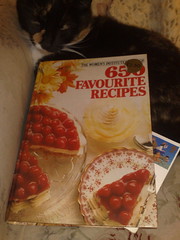
Greetings, Take One Cookbookers! I'm John, your British contributor, and I am house- and cat-sitting this weekend for my parents, so I offered to work through some cookbooks of my mother's for you. Here's the first: The Women's Institute of 650 Favourite Recipes. I have no idea why 650; I suspect a Marketing Ploy.


(My lovely feline assistant/prop, Rotunda the Munificent, is a fan of the blog.)

The Women's Institute is a quintessentially British institution. In American terms, it is a Ladies' Auxiliary to, well, Britain. The movie Calendar Girls is a rather good introduction, if you have access to it. As an extra special treat, one gets to see Helen Mirren's baps. (Yes, that means what you think it does.)

Gastronomically renowned for its cakes, biscuits, jams and marmalades, which are displayed in annual summer fêtes inevitably involving contests and rain, this 1980 edition of the WI's 650 Favourite Recipes does provide some spectacular fail in the very best Lileks tradition:


The "Brackenhurst Iced Prawn Curry" sounds utterly foul: a chilled mayonnaise-prawn-curry-powder concoction over rice, all chilled, no actual south Asian affiliation in the slightest.

"Fish Flan" sounds as grim as it is likely dentally unchallenging, and the "Canapés Diane" instructs one to remove fat from streaky (i.e., American-style) bacon. It doesn't specify how one is supposed to do that, nor what it expects to be left of the streaky bacon afterwards.

The Prizewinners (sic) category includes the likely "Low Calorie Tomato and Lettuce Soup", which carries the ever-useful note, "over-ripe tomatoes and mis-shapen lettuce leaves may be used". The recipe itself is, essentially: boil lettuce, tomatoes and onions with stock cubes and marjoram. Serve. Despair. (I may have made the last instruction up.)

I refuse to even look at the Pasta & Rice section, because I grew up mainly in New York with two years in Rome and a year in Beijing, and I would probably cry.

That said, there is much good contained amongst the stomach-churningly dire, and I would use this book as a starting point for any traditional recipe I wished to adulterate in the very best Modern British fashion.

Now, as one might expect given that the British Empire was built on beatings, buggery and organ meats, the Meats section is resplendent with offerings of offal. There's a Gilbert and Sullivan joke in here somewhere, I'm certain. As far as the offerings go, perhaps Brains au Beurre? Fried Tripe? Baked Stuffed Hearts? That's only pages 96-97, of course. Freakout food apart, if I were wondering how to prepare sweetbreads, or any other organ meats I would turn to the WI in the first instance.

So, the third pillar of Empire dismissed, I shall provide a recipe speaking to the second: Faggots. No epithet they: rather, a sort of offal meatball to be eaten with gravy. You may well have seen the Internet picture of "Mr Brain's 4 Pork Faggots in a rich Westcountry Sauce" floating around in joke emails. One can certainly procure a box of faggots (11% pork!) in my local supermarket. (Really, America, you can stop laughing now.)

Instructions for WI faggots, which should serve four, appear on page 97 as follows:

Faggots
450g/1lb pig's fry (which a careful Google search tells me are sweetbreads, heart, liver and lungs)
3 small onions chopped
75g/3oz fresh breadcrumbs
1/2 teaspoon chopped fresh sage
1/2 teaspoon chopped fresh thyme
salt
pepper
1 pig's caul or veil, soaked in warm water (a caul is the thin, fatty lining of a pig's stomach, while a veil appears to be the same thing).

Ah, a recipe with two offal terms even the Brit has to look up. Marvellous. And it does rather seem to be continuing the British aversion to seasoning, because a total of one teaspoon of fresh herbs seems awfully light for strongly flavoured meat like offal. I would use a good two teaspoons of each if fresh, one of each if dried.

Anyway, apparently one puts the meat and onions in a saucepan, covers with water and brings to a boil, simmering for 45 minutes. Drain the liquid, reserving a little to moisten the breadcrumbs. Mince the fry and onions, then mix in the moistened breadcrumbs, herbs, salt and pepper.

Drain the caul and cut into 2.5 or 5cm/1 or 2 inch squares. Divide the mixture between the squares and shape into balls. Pack the balls closely into a greased roasting tin. Bake in a preheated moderately hot oven (190°C/375°F/Gas Mark 5) for 45 minutes or until well browned. Serve with a good gravy and creamed potatoes.

I'm sure it's wonderfully flavourless like much British cooking is to modern palates. It's because of wartime rationing, I should imagine, that we have kept dishes like this in our national consciousness. That said, the key to modern palatability is almost certainly to use half and half ground pork and half and half liver. The caul or veil one can leave out thanks to the exciting modern invention of Teflon and tinfoil (aluminum foil for those of you in the Colonies, and yes, look how I spelt aluminium there!). As I said, I would boost the herbs too, and probably replace the breadcrumbs with oats for texture. I might even increase the levels of oats depending on how tender my faggots turned out. And you can bet your Aunt Nelly (or your nelly uncle) that I'd make proper gravy and skin-on mashed potatoes, rather than "creamed". Oh, yes, and also something green like curly kale or spring greens or even some tiny brussels sprouts. Ah, and almost certainly a good beer — brown stuff you can't see through, none of the yellow rubbish with bubbles.

Next time, we move to cake. Or death. Wait, cake!