Showing posts with label fish. Show all posts

Monday, January 6, 2014

Oven Fried Oysters: Cooking the Books

Every winter, my husband an I get together wtih two of our friends and we eat approximately a million oysters. We shuck one, we top it with some sauce (or not), and we slurp it down. Then we repeat it. A lot. There is wine, and for the pretense of virtue, there's water and bread. It is...Oyster Fest.

Yesterday, we had our sixth annual Oyster Fest. And, breaking with tradition somewhat, we actually planned to (gasp) cook some of the oysters. I know. I know. It's a strange course of action, but when one is staring down at hundreds of bivalves, one has to start thinking outside the boundaries of tradition. So, what's a wayward cookbook blogger to do? That's right: reach for Cook Book Presented by The Fishwives of Charleston Oregon.

Oven Fried Oysters

Drain oysters and dry thoroughly. Roll in buttered crumbs. Sprinkle with bacon fat and diced bacon (cooked until soft but not browned). Bake in hot oven (400) 15 to 20 minutes until nicely browned. Serve with lemon.

Millie Henkle

Well, okay then.

I did two batches of about 20 oysters each. There was no draining needed, as they were coming out of the shell not a can -- though I did reserve the liquor. I mixed up about a cup of seasoned breadcrumbs (to which I added a hearty amount of freshly ground black pepper and a big pinch of salt) with the melted fat rendered from the bacon (I had about a quarter cup). I figure this: why use butter when you've got bacon fat at hand? I mixed in fat until the crumbs were moistened and the mixture seemed uniformly sandy. One at a time, I patted oysters dry and chucked them in the bowl with the crumbs. I tossed them in the crumbs, and then spaced them out in a 9 x 13 baking dish. Then, I actually did sprinkled bacon over the top, trying to get at least a few pieces on each oyster. Since I'd used up the bacon fat, I saw no need to sprinkle on more bacon fat (though, hey, if you've got it, might as well).

15 minutes at 400°F got them nice and hot and not a bit rubbery. They likely could have gone a full 20, but I'm really opposed to rubbery oysters (which is why I never cook them in the first place). As they came out of the oven, I sprinkled on a big pinch of salt, even though more salt on oysters might seem like coals to Newcastle.

Friends, I'm here to tell you, these are good. We scarfed them down right quick -- eat them when they're hot. They are dreamy with a squeeze of lemon. They're also pretty darned amazing with a drop of chipotle Tabasco.

This recipe is a keeper. But really, did you expect the fishwives would steer us wrong?

Sunday, August 28, 2011

A Little Something, by Susan Epstein: Baked Clam Dip Loaf

A Little SomethingToday, we move to a more modern cookbook: A Little Something: More Than 150 Snacks, Appetizers, And Hors D'oeuvres For Every Craving And Occasion by Susan Epstein (William and Morrow Company, New York; 1998). Epstein has the 150+ recipes, sure, but also puts them together in menus for every kind of party, every kind of budget.

So, a cookbook from the late 90s, with party food. I don't know quite what I was expecting, but "everything old is new again" wasn't at the top of the list. And yet...the modern recipes show more than a little bit of nodding to some of the more curious mid-century recipes. Case in point:
Baked Clam Dip Loaf

Surround this impressive dip with crudités, breadsticks, and the leftover bread cubes.

Makes 6 to 8 servings

1 large (1 1/2 pounds) unsliced round sourdough or black bread
4 containers (4 ounces each) herb or garlic cream cheese spread
1 cup mayonnaise
3 cans (6 1/2 ounces) minced clams, drained
4 green onions, finely chopped
  1. Preheat the oven to 350°F.
  2. Cut a slice off the top of the bread, about 2 inches down. Reserve the lid. Remove the insides of the bread, leaving a 1-inch shell. Cut the insides into cubes, and set aside.
  3. Using an electric mixer, beat the cream cheese spread and mayonnaise until blended. Stir in the clams and onions.
  4. Spoon the mixture into the bread shell and cover with reserved lid. Wrap tightly in aluminum foil.
  5. Bake about 1 1/2 hours, until the filling is very hot and bread is crusty.
If you prefer, you can substitute canned lump crabmeat for the clams.
Ah, there we go, I remember what I was expecting: fine-quality ingredients, and a bit more froofiness when it comes to preparation. The idea that we're using canned goods and containers of pre-seasoned cheese product is a bit disappointing. How about this instead: Soften 16 ounces of cream cheese, beat until fluffy, mix in minced garlic and/or chives. Use that instead of the pre-done stuff. And, hey, I understand that canned clams are convenient. I do. You can use them. If you happen to have fresh clams about, though, promise me you'll use those.

If you're thinking of serving this at a party, I'd stay away from the crab variant option. Why? Well, hot crab dip is something you can get on nearly every bar menu, and people will wonder why there's no artichoke in your crab-and-... dip. Subvert their expectations. Embrace the retro clambakiness.

Embrace, also, the knowledge that there are lots of folks out there with shellfish allergies. Put a sign with your dish letting people know that here there be clams. Of course, if you used fresh clams, you could just garnish with a scrubbed-clean clam shell--it's pretty darned unambiguous a statement.

Saturday, August 20, 2011

Bonus Post: Ceviche Costa Rica Style

My hands smell like limes, and I don't have a cocktail in front of me. Astute observers might conclude that I've been making something else with lime juice. And, it's true. I've been making ceviche, but if you're used to having ceviche at your local tex-mex place, you might be a little cautious when you see mine.
Ceviche, Costa Rica Style
1 lb bay scallops (sea scallops work, too, but are more expensive, and
need to be cut into bite-sized bits)
4 limes
1/2 bunch cilantro
1/2 red onion (or, you know, any other onion you have around)
1-2 glugs olive oil
salt
saltine crackers
mayo
ketchup

Place scallops in a clean, non-reactive bowl or jar. Cover with the juice of 4 limes -- the scallops need to be covered in the juice. Add cilantro and onion, both finely chopped, salt, and olive oil. Let marinate in the fridge overnight -- it helps to put plastic wrap over the bowl, letting the plastic rest on the surface of the ceviche to make sure there's no air getting in. Serve on crackers, garnished with a mixture of mayo and ketchup.
I say the recipe is mine; it's not. It's really my dad's (that's him in the picture above..handsome devil, no?). See, way back in the 80s, Dad went on sabbatical to Costa Rica, and he ambitiously took my sister and I along. I look back at that and have to realize: I am now two (nearly three) years older now than my dad was when we went. It is a weird feeling. Anyway, long digression short, my grandma came down to stay with us for several months, and with the anniversary of her death this month, I'm all sorts of nostalgic for all things family.

Back to the fish. My dad fell in love with ceviche down there, and when we got back to the States, he worked and worked to recreate it. He had the darnedest time finding cilantro (this was Oregon, in the early/mid-80s, after all), and no one had heard of ceviche. He prevailed, and this is how I know ceviche.

Dad and I would stand around the kitchen counter, spooning the fish out of a tall jar onto a saltine, and then dolloping on a ketchup/mayo sauce (mix 1 part to 1 part).

I know that sounds strange. I know that we're conditioned now to think only of tortilla chips and maybe some salsa when eating ceviche.

The saltines and Marie Rose are authentically 1984 Costa Rica. I will vouch for it. Give it a try. Throw caution cautiously to the wind. If you end up hating it -- and I've never met anyone who does -- you can always rip open a bag of Tostitos and uncap a jar of Jardine's.

I've got a bowl of ceviche tucked into the fridge, and tomorrow evening, I'll be eating it with friends.

Costa Rica style.

Friday, August 19, 2011

Bagdad Hash: Classic Scary Casserole

Favorite Recipes from Caldwell, IdahoThanks to you all who voted on Facebook, today's Favorite Recipes from Caldwell, Idaho recipe is....a scary casserole!
Bagdad Hash
Laura Hadley
Star, Idaho


1 c. diced celery
1 c. diced onion
1 can cream of mushroom soup
1 can water
1 (5 1/2 oz.) can chow mein noodles
3 or 4 oz. cashews
1 can tuna
Crushed potato chips on top

Bake for 1 hour at 350° in 2-quart dish.
This, folks, is what I think of when I think of a casserole. Heck, it's what I think of when I think of chow mein noodles, too (though butterscotch haystacks come swiftly afterwards). Cans of stuff, mixed with fried crunchy things. I particularly appreciate the fact that we get two fried crunchy things in this recipe (the noodles and the chips).

You could fancy this up if you want. Two cups of your own homemade cream of mushroom soup (or cream of celery soup, or cream of chicken soup, or what have you) would be lovely. Softening up the onion and celery before putting it in the gloop would be nice. Buttered and herbed breadcrumbs instead of potato chips would add an air of cassoulet.

But sometimes, you're just in the mood for simple, comforting, slightly scary casseroles, and Laura Hadley has you covered.

Not sure why Bagdad is spelled Bagdad and not Baghdad here. Moreover, I'm not sure why I'm at all surprised by the fact that a dish that clearly has nothing whatsoever to do with Baghdad is spelled differently.

This wraps up our tour through Favorite Recipes from Caldwell, Idaho -- starting tomorrow, we'll dive into one of these cookbooks:You can vote over in the Facebook poll if we're friends there, or you can leave a comment with your preference here in the comments. If you're bummed out that we didn't get to Norwegian meatballs this week, you should know: NAHC has a venison Norwegian meatball recipe. It also has moose pot roast.

Sunday, August 14, 2011

Smelting on the Sandy: Pickled Smelt

Favorite Recipes from Caldwell, IdahoI am a notoriously bad fisherwoman. I've been abysmal on lakes, rivers, and in the mighty Pacific. I suck at fishing.

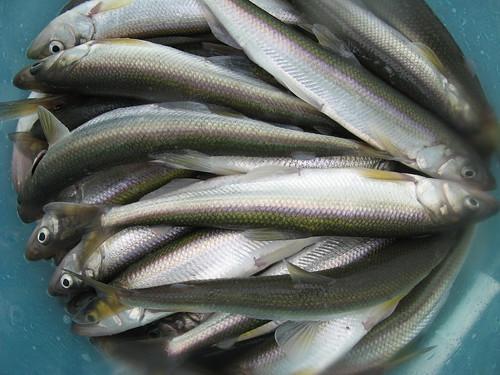
I do remember, though, the one time I couldn't help but be successful. When the smelt run, if you go smelting, you will get smelt. The smelt were running up the Sandy River, and we smelted, by gum.

I don't remember eating the little fish -- I'm sure they were eaten, and I'm sure I sort of avoided them -- but I'm still fascinated with the shiny things, in part because they're eaten whole. Heads, guts, and all. Let's see how the Jay-C-Ettes prepare their smelt in Favorite Recipes from Caldwell, Idaho:
Kuskokwim Smelt
"Kuskokwim Smelt," by Andrea Pokrzywinski
Licensed under Creative Commons.
Pickled Smelt
Claudia Pugsley


Cut fish into bite-sized pieces. Add 1/2 cup salt to 2 quarts fish. Cover in white vinegar and let stand in refrigerator for 5 days.

Drain vinegar. Rinse and soak 1/2 hour in water and drain again. Add onion slices to fish and cover with 2 parts vinegar to 1 part sugar and 1/2 ounce pickling spices. Let stand 5 days and it's ready to serve.
...I'm pretty sure that's not what happened to the smelt we pulled from the Sandy River. Seriously, I've only ever heard of frying these things up en masse before. But, no. This is pickled fish. Good for keeping large quantities of food fresh for when there aren't large quantities to be had, but... pickled chunks of uncleaned fish. A quarter of a gallon of fish chunks, and a lot of waiting around.

This is advanced stuff, folks.

Since Ms. Pugsley makes no mention of processing the pickled smelt for canning, I'm guessing that this is so darned delectable that we're to eat them all fairly quickly.

I'll leave you to it.

Sunday, June 27, 2010

Cooling Off Period: Crab, Jicama, and Mango Salad with Lemon-Curry Dressing

Heck, even I think it's crazy to contemplate turning on a cooking apparatus today. The heat index value is going to be up around 103° today, the air quality is poor, and there's just no. fricking. way. I'm turning on a heat-producing device. No. No.

No.

And I don't suggest you do, either. Thankfully, neither does The Wine Lover's Cookbook: Great Recipes for the Perfect Glass of Wine.
Crab, Jicama, and Mango Salad with Lemon-Curry Dressing (Classic Pairing)
Recommended Wine: Chardonnay
Alternative Wine: Viognier

This combination works because the richness of the succulent crab meat, the tropical fruit flavors of the mango, and the lightly curried citrus dressing help showcase the ripe tropical fruit and citrus flavors found in many chardonnays. The use of curry powder enlivens the dressing just enough to play into the spice character fhtat comes from the wine's barrel aging. Viognier, with its opulent texture, also marries well with this elegant appetizer.

1 pound crab meat, picked over for shells
3/4 cup diced fresh or frozen mango
2 1/2 tablespoons minced fresh chives
1 cup peeled and diced jicama

Dressing:
Juice of 1 lemon (Meyer lemon, if possible)
1 teaspoon minced lemon zest
1/2 tablespoon white-wine vinegar
1/3 cup sour cream
1 1/2 teaspoons curry powder
1/8 teaspoon fresh ground black pepper

12 leaves butter lettuce, rinsed and dried

Garnish: chopped chives, 6 lemon slices

In a medium nonreactive mixing bowl, combine crab meat, mango, chives, and jicama and mix well.

To make dressing, in a small mixing bowl, combine all ingredients and whisk thoroughly. Add dressing to crab mixture and combine thoroughly. Allow to sit, refrigerated, for at least 2 hours. Season to taste.

To serve, place 2 butter lettuce leaves side by side on each salad plate. Mix crab thoroughly. Spoon mixture equally onto lettuce leaves on each plate. Sprinkle with chopped chives and garnish with lemon slices.

Serves 6 as an appetizer
I had the great joy of spending yesterday evening on a boat in the South River, right where it feeds into the Chesapeake. That is to say, I was in crab country. When it looked like my carload of boat party people wouldn't arrive in time (there was a bit of a snafu that led to me, my car, and my passengers being about an hour south of where we were supposed to be...), I thought "well, at least we can get some crab." Summer and the mid-Atlantic practically scream out for the beautiful swimmer -- that's what the Latin name for blue crab means: Callinectes sapidus = beautiful swimmer...poetic, no?

Crab would normally be about $16 a pound at this time of year, Chefly Husband tells me. Instead, domestic crab is selling for about $24 a pound, thanks to the devastation in the Gulf. Depending on your budget and your food-as-politics leanings, you might want to file this recipe away until crab is more affordable, or you might want to hang the price and support domestic fisheries (perhaps I took the front matter in the Cook Book Presented by The Fishwives of Charleston Oregon a bit too much to heart).

I've been a stone's throw from the Chesapeake for two decades now (and I have the high school reunion invitation to prove it), but have to admit that, while blue crab is all well and good, it's not the real crab.

The real crab is Dungeness. No one can convince me otherwise. It's the best crab. It's the Master Crab! (Even its Latin name used to say so: Cancer magister.) Of course, I don't really ever think of using Dungeness in a recipe. There's no need. The stuff is perfection right out of the shell.

My devotion is shared by my family back in Oregon. When Dad was out to visit a while back, we went to eat at Chefly Husband's restaurant, and I had the crab cake. Now, Chefly Husband's restaurant does pretty much the best damned crab cake you'll ever have in your life. No lie. This is not spousal love talking, it's just plain fact.

Dad had a bite. Dad said, warmly, "that's the best crab cake that doesn't have Dungeness in it."

Can't really argue with that.

Monday, May 31, 2010

For Doors and Sardines: Sardine Dip

Think of the first night as the dress rehearsal. If we can just get through the play once tonight - for doors and sardines. That's what it's all about, doors and sardines. Getting on, getting off. Getting the sardines on, getting the sardines off. That's farce. That's - that's the theatre. That's life.
--Noises Off
For the last recipe (at least this time 'round) from the Cook Book Presented by The Fishwives of Charleston Oregon, I figured I really did have to feature fish. Well over half of the cookbook is dedicated to fish recipes, as well it should be; after all, how many cookbooks do you have on your shelves that kick off with an exhortation to call your Congressmen, and a prayer that they and the State Department will speak up for our country? "The Soviet Union and Japan pose a threat to the economy of our nation" is just not a phrase normally found next to a Brandy Alexander recipe, nor official resolutions from national professional federations. (If you're curious, the resolution recommends that the U.S. recognize a serious conservation problem, and kill all foreign fishery operations off the U.S. coast.)

It's certainly my only cookbook with such content. Moreover, I think it's my only cookbook with a sardine section. Not just a sardine recipe--a section! Sardine Submarine Sandwich. Sardine Rarebit. Marinated Sardines. Sardine Caesar Salad. Sardines with Sauce. Crispy Fried Sardines. Sardine 'n' Bacon Snacks. Sardine Cheese Toastwich. And, our recipe for today, Sardine Dip:
Sardine Dip

1 can sardines
1 pkg. cream cheese
1 tbsp. McKay's milk
2 tbsp. parsley, chopped
1 1/2 tbsp. lemon juice
2 tsp. grated onion
1 tsp. steak sauce
1 tsp. Worcestershire sauce
1/4 tsp. hot pepper sauce
Chopped parsley
Assorted chips, crackers or raw vegetables

Drain sardines and flake. Cream the cheese and milk. Add remaining ingredients except parsley and chips. Add sardines and mix thoroughly. Chill. Sprinkle with parsley. Serve with chips, crackers or vegetables.
I....I have no words. I don't think I ever had a sardine until sometime in the last decade, and even then, it's a stretch for this formerly-fish-adverse gal. And this is sardines mixed with dairy.

I've done smoked salmon spread, of course, and even tuna spread, so this shouldn't throw me so much. It just does. I can't say I think I'll ever make this (no, nor any of the other eight sardine recipes). Heck, I'm hard-pressed to think I'd ever follow the footnote advice on page 128: "For a quick snack use sardines, cracker and cheese." I'm fascinated. I'm appalled. I'm willing to hear how this recipe turns out...from someone else.

Let's close out our week with the Fishwives of Charleston with a bit from the foreward:
This is a unique cook book filled with memories and illustrated with pictures of some of our won fishing fleet.

When next you visit Charleston, stroll along the docks and you are sure to see some of the boats pictured in our cook book. We are proud of this cook book. It has taken the concentrated efforts of many Charleston area residents to compile it. Many of them are no members of the fishing industry, but have joined with us in this endeavor to raise funds for what they also believe is a good cause.

--The Editor, Kay Wells

Wednesday, June 3, 2009

Outdoor Dining, Margaret O'Sullivan; Miniature Frittatas

I am a sucker for impulse purchases. Interstingish looking things, attractively displayed near a line I'm apt to be standing in for a while? I'll pick them up. I'll peruse. And I may well buy. For a lot of folks, this is how magazines, chewing gum, and odd pastry items end up in the house. For me? It's cookbooks. And so it happened that I was standing in a Williams Sonoma, flipping through Outdoor Dining, by Margaret O'Sullivan (Lansdowne Publishing Pty Ltd, 1995). The cover shows miniature smoked salmon frittatas, and every page inside hints at the sort of life where finely crafted picnics just sort of happen.

I had to buy it.

And a good thing I am such a light touch for the marketers! This is a great cookbook; I've prepared lots of the dishes, and keep meaning to try more. They all turn out. They're all tasty. And, as we're officially in Summer (Observed) now that Memorial Day has passed, and I've my first outdoor concert of the season to go to next week, it seems time to take out this old favorite.
Miniature Frittatas

4 oz (125 g) smoked salmon, finely chopped
3 oz (90 g) goat cheese, crumbled
fresh chives, chopped
6 eggs
1/4 cup (2 fl oz/60 ml) single (light) cream

These miniature frittatas make a great picnic starter -- serve them with chilled champagne. You can vary the fillings: chopped artichoke hearts, prosciutto, asparagus tips, Ratatouille (page 23), sautéed mushrooms or leek, or smoked salmon and goat cheese as combined here.

Grease a 12 cup cake (patty cake) pan. Divide the smoked salmon, goat cheese, and chives between the cups.

Lightly beat the eggs with the cream and pour into the cups.

Bake in a moderately hot oven (400°F/200°C/Gas Mark 6) for 8-10 minutes until golden brown.

Turn onto a cake cooler and serve at room temperature.

Serves 4-6
I use a mini muffin tin when I make these; depending on your pan and how much stuff you stuff into your frittatas, your baking time will vary, so keep an eye on them. As the recipe suggests, these work with just about anything. Don't like goat cheese? Plop in some other cheese that does suit. Try cooked, peeled baby shrimp instead of the salmon. Whatever you have just a bit of left in the fridge is fair game.

I tend to prefer dry-smoked smoked salmon to wet, so I go for some nice, thick, crumbly reminds-me-of-Oregon salmon as opposed to more elegant thin slices of fish. Use that which makes you happy.

I've made these for brunches -- they're a star of my traditional Thanksgiving parade-is-on-TV breakfast -- and for dinner parties. They're always a hit. The only time they've come close to failing is when I was working with an unfamiliar oven and insufficiently prepped my pans. Grease them well, folks.

Many of the recipes in Outdoor Dining have menu suggestions in the sidebar -- this one is no exception:
Menu

Miniature Fritattas
Barbecued Double Lamb Cutlets with Ratatouille (page 23)
Honey Wafers (page 51)
One could do worse.

In a quasi-related note, I evidently can't type "miniature" without first mistyping it as "minature."

Saturday, October 25, 2008

Smoked Salmon Salsa

Part of the fun of this blog for me is looking for recipes I never would have imagined in my life. Moose bologna. Beef pancake pie. Hell balls. Odd ingredients, strange transformation, head scratchers, they're all good for a laugh and a lark. Better, though, are the recipes that take ingredients I love and combine them for presentations and uses I'd never thought of, like this recipe from The Great Salsa Book:
Smoked Salmon Salsa

4 ounces smoked salmon, finely diced
3 tablespoons finely diced sun-dried tomatoes (in oil)
3/4 cup finely diced fennel bulb
3 tablespoons chopped fennel tops
2 tablespoons fresh lemon juice
3/4 teaspoon freshly ground black pepper
1/4 teaspoon cayenne powder

Thoroughly combine all the ingredients together in a mixing bowl.

Serving suggestions: On top of eggs, as a soup garnish (for tomato soup in particular), or with pasta.
Yield: About 1 3/4 cups.
Heat: 3-4.

So simple! So... well, so obvious, once someone says it the first time... why wouldn't you make a salsa with these ingredients?

I can totally see this, with tomato soup, at an elegant brunch or tea. A thick tomato soup would hold up a nice mound of this, and it would add so much, visually and taste-wise. And, yes, toss what ever is left over in with some pasta for dinner after you clean up. Mmmm. Champagne with both!

I would use a dry-smoked salmon, not a wet-cured. So, no lox, folks. My Oregonian roots are showing when I say this: Try your darnedest to get alder-smoked fish; the smokiness will play nicely with the sun-dried tomatoes and fennel.

Monday, September 8, 2008

It's Not Fried Cucumbers: Tomatoes Portland

End of summer means tomatoes. For me, it always sends me back to Grandpa's garden, and stealing tomatoes, warm from the sun, right off the vine. The Portland Woman's Exchange Cook Book has a suitably Oregonian way to enjoy the season's tomatoes:
Tomatoes Portland

Select some small tomatoes about the size of walnuts and cut a slice from each in the region of the stalk. Squeeze out all their water and seeds, and marinate them for 10 minutes. Prepare a mince of crab legs with oil, salt, paprika and tarragon vinegar, and add thereto per 2 ounces of the crab 1/2 a tablespoon of chopped parsley, chervil and tarragon and a small hard-boiled egg, also chopped. Thicken the whole with 1 tablespoon of thick mayonnaise, put it into a bag fitted with smallest tube, using enough of mayonnaise to form a kind of dome upon each tomato.

By courtesy Chef of Portland Hotel.
I have never used the word "thereto" in writing a recipe, myself. I'm completely charmed by describing tomatoes as "the size of walnuts" -- I think we're safe substituting cherry tomatoes, aren't you?

For the crab, use Dungeness if you can get it. It's an Oregonian recipe, after all -- Dungeness is the only way to go. I know that, having spent more than half my life a stone's throw from the Chesapeake means I should be a blue crab devotée, but... I'm just not. There's nothing like the sweet wonderfulness of Dungeness. It is the crab.

The last recipe on the page is for fried cucumbers. As in: cut one in half, dredge it in eggs, roll it in cracker crumbs, and fry. ...I swear, that's not really Oregon food. Honest.

Thursday, August 28, 2008

Hoppety: Frog Legs In Wine

Wine rejoices the heart of man, and joy is the mother of all virtue.
-- J. W. Goethe


One more froggy recipe from Adventures in Wine Cookery
Frog Legs in Wine

(4 servings)
Mrs. Alvin Ehrhardt, United Vintners' Community Wineries, Lodi


12 pairs frog legs (small)
2 tablespoons butter
2 tablespoons flour
1/2 cup California white table wine
2 tablespoons minced watercress
2 tablespoons minced scallions
Salt
Freshly ground pepper
1 egg yolk
1 tablespoon cold water
Cayenne

Soak frog legs in cold water for 3 hours; drain on cloth. Melt butter in top pan of chafing dish over medium flame. Add frog legs; sauté 3 minutes on each side. Sprinkle with flour, mixing constantly. Add wine, watercress and scallions; season with salt and pepper. Simmer 15 minutes. Remove frog legs to a warm platter. Whip egg yolk with cold water. Spoon a bit of wine mixture into egg and beat well. Remove wine mixture from heat; add egg mixture and stir well. Return pan over flame. Stir sauce constantly until thickened to desired consistency. Pour over frog legs and sprinkle with cayenne.

My choice of wine to accompany this dish: California Chablis or Dry Sauterne, Chilled


So, what do you do if you don't have frozen froggie legs, or your legs are small instead of large? Use this recipe instead of the previous one! Nothing out there in 'net-land on Mrs. Alvin Ehrhardt, and precious little just on United Vintners... once you take into account their take-over by Allied Grape Growers, though, you can find out a lot. For example, did you know that 1968 was the last year in the wine industry in which the sales of Dessert Wine exceeded the sales of Table Wine? So, Adventures in Wine Cookery is sort of a harbinger of the future of California wine... far more time is spent on table wine recipes than dessert wine recipes. And yet, it's also the end of an era for some. United Vintners was sold in 1969.

I've never had frog legs. Doc Hopper would be ashamed.

Hippety: Frog Legs Pinot Blanc

I drink to the general joy of the whole table.
-- William Shakespeare


As promised, today we'll have two, two, two posts from Adventures in Wine Cookery. Moreover, we'll have a Theme Ingredient... Frog Legs!
Frog Legs Pinot Blanc

Norbert C. Mirassou, Mirassou Vineyards, San Jose

As far as we know, this is an original recipe.

1/4 cup butter
1 teaspoon minced garlic
4 pairs frozen frog legs (large)
1/2 cup chopped parsley
1 cup California Pinot BLanc or other white table wine

Preheat electric skillet to 320°; add butter and garlic. When butter is melted, add frog legs. Cover and cook at 320° with vent open for 10 minutes. Sprinkle parsley over frog legs; add wine. Recover pan, with vent closed, and lower heat to 280°; cook until tender, about 15 to 20 minutes. Place frog legs in serving dish and pour over remaining pan juices. Serve with rice, squash cooked with mushrooms and tomatoes, and heart of lettuce salad.

My choice of wine to accompany this dish: California Pinot Blanc


Mirassou claims to have the oldest wine family in California, dating back to 1854. Norbert and his brother Edmund ran the winery together several generations in, and "Mr. Norb" is credited with developing the first overhead sprinklers for vine irrigation. Why was that extra super duper important? Well, seems that if you wanted to grow vines in Monterrey, you needed better irrigation, and you really, really wanted to be able to grow vines in Monterrey, because Monterrey was Phylloxera-free.

Thank you, Mr. Norb! Also, thanks for championing Pinot Blanc, in this recipe and in the state. I really recommend following the link to the oral history I linked to above; after the obituaries for both brothers, there's a transcript of an interview with them, talking about their lives, work, etc. I can't even begin to sum it all up for you (beyond, "mmm, wine!"). One thing that stands out for me: talking about when "the market broke." Not "crashed"...broke. Also, ever wonder how delicate produce got from California to New York in the 20s? You can find out...

Tuesday, August 19, 2008

Bad Titles Work, Too: Valdez Clam and Onion Soup

Sometimes, recipe choice is all about a good title. Sometimes, though, it's the really bad title that wins the day. My sister told me that if I focused on an Alaskan cookbook, I'd have to post a salmon dish; I knew I needed to post a fish dish of some sort, and went hunting. Alaska "Sourdough" Cookin' has plenty of salmon dishes, it's true, but nothing quite to compare with this:
Valdez Clam and Onion Soup

2 cans (7 ozs.) minced clams (1 pint)
4 slices bacon, sliced
3 cups onion rings
3 cups milk
1/2 tsp. celery salt
1/2 tsp. salt
6 slices hard toast
1/4 cup grated Parmesan cheese (optional)

Fry bacon; add onion and cook until tender. Combine milk, seasonings and clams; heat. Place toast in 6 individual, heated soup bowls. Cover with onion rings and top with clam mixture. Sprinkle with cheese and serve immediately. Serves 6.


Now, Alaska "Sourdough" Cookin' was printed 13 years before the Exxon Valdez spilled oil all over the Prince William Sound, but I'm here to tell you, there's no way I can hear "Valdez" and not think "horrible oil spill." Combine "Valdez" with "bivalve shell fish" and I'm going to think it's all a horrible, twisted joke. Who'd want to eat a filter-feeder named after pollution gone wild?

...the recipe itself sounds tasty, though.

edit So, it was pointed out to me that my trying to puzzle out the "what kind of onion rings do they mean" issue was pretty pointless -- use raw, as you're cooking them up in bacon fat. That being said, let's use canned, crispy, fried onion products as a garnish, like you'd put on top of a green bean casserole if you were any of the hordes of community cookbook contributors whose efforts line my shelves./edit

Looks like an easy recipe to cut in half (in some cases, thirds -- take only 2 pieces of hard toast, not 3) to make 2 large meal-sized servings.

Friday, August 8, 2008

Salmon Soufflé

It's a Friday, and I have enough latent Catholicism in me to think that Fridays mean fish. Casserole Cookery: One-Dish Meals for the Busy Gourmet indulges my association with a pantry cooking dish.
Salmon Soufflé

Time: 1 hour

Ingredients:
1 No. 1 can salmon
2 tablespoons butter
3 tablespoons flour
1 cup milk
4 eggs
1/4 teaspoon thyme
1/2 teaspoon curry powder
salt and pepper

Make cream sauce, melting butter, blending flour, and adding milk and seasoning. Cook for 2-3 minutes, remove from the stove, add yolks of eggs and salmon. Stir well and fold in stiffly beaten whites of eggs. Put in buttered casserole with straight sides and bake in slow oven (375°) for 35 minutes. Serves 4.

Menu
Salmon soufflé
Salad: Lettuce, tomatoes, radishes, cucumber and French dressing (2 parts olive oil, 1 part garlic vinegar,
Drop biscuits
Coffee

Story
For that unexpected (uninvited?) guest. All from materials that should always be on your shelves.


Ooo, a typographical error? An omission? What comes after the 1 part garlic oil? Other than the missing stuff (salt and pepper, I'd wager, and maybe some mustard), the salad and dressing sound remarkably like what I thought salad and dressing were as a kid. Those ingredients. Presented the same way. Over and over.

Until, of course, the Kraft Catalina Dressing taco salad came into our lives... :swoon: It's trashy, it's kitschy, it's so very good.

But this is about the salmon soufflé...

I like the assumption that everyone's going to have a soup-can-sized can of salmon on her shelf (and, yes, the assumption is that the cook is a woman; the drawing on the page shows a woman walking by a window overlooking a station where the train has just pulled away; there are two men's hats on the sideboard, and it's 5 minutes to 7... a whole story in a little picture). I think I actually do have one up in my cupboards... I've butter and flour, milk, ... heck, I might even still have 4 eggs.

Dang. I could actually throw together this pantry cooking recipe right now.

...huh.

Remember, I've linked to a can size number cheat sheet in the past; a No. 1 can is the same size as a Campbell's condensed soup can.

Tomorrow, a bonus post, and a new cookbook. Should the bonus post be Egyptian Eggplant, or Celery Au Gratin?

(Yes, "Celery Au Gratin.")