Showing posts with label stew. Show all posts

Saturday, December 18, 2010

Delicioso! The Regional Cooking of Spain: Alubias Rojas de Tolosa con Berza

Delicioso!I've been plotting out my course for the new year. See, like a lot of people, I make food-related resolutions, and money-related resolutions. This year, however, I'm making a food-AND-money-related resolution: I'm going to cut back on my food expenditures by planning ahead and actually bringing a home made breakfast and lunch to work with me, rather than going out. Even just walking to the grocer's near work to buy a frozen whatnot adds up, if not in pennies, then in healthfulness. I like to cook, I cook well, what I cook tastes better than what I'd pick up at the grocer's, and so, darn it, I should do it. I was going through old favorite recipes, and kept running smack up against ones that I'd written about here. So here we are, back at the good ol' blog!

We're starting the new year celebration a touch early with a festive sort of cuisine in Delicioso! The Regional Cooking of Spain by Penelope Casas (Alfred A. Knofpf, New York; 1996). I was lucky enough to get to go to Spain a few years back and walk the pilgrim trail to Santiago; it was an amazing experience, and odds are I'll pepper these posts this week with pictures and stories from the Camino. Like... this one from kilometer 99...a little over 60 miles from Santiago.Pilgrims carry stones with them from their homes and place them along the route; I had one from my mother's yard in Oregon, and one from my yard in DC.
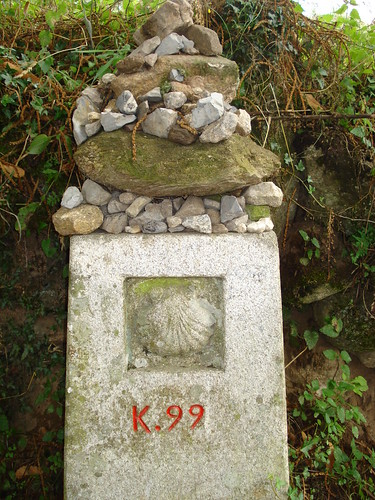
Camino de Santiago, kilometer 99. Photo by Wendy A F G Stengel, some rights reserved.


I ate amazing food in Spain, none of it fancy. Really, not fancy at all. Soups. Stews. Lentils. Cheese. Really filling and tasty. Today's recipe reminds me of that food.

Alubias Rojas de Tolosa con Berza
(Red Beans with Cabbage)


Start prepartion 1 day in advance.

A dollop of cabbage, placed in each bowl of beans, is a delicious complement to this bean stew based on the outstanding red beans that grow in Tolosa in the Basque province of Guipúzcoa along the banks of the Oria River. you can use any kind of red bean to make this dish, but the results will be best with Tolosa, Adzuki, or other dark red beans, sometimes available at food specialty shops.

Serves 4

1 pound small, deep-red dried beans
1 medium onion, peeled and cut in half crosswise
1 large carrot, scraped and cut in half crosswise
1 small leek, well washed
A 1/4-pound piece slab bacon, preferably fresh (otherwise cured)
1/4 pound sweet chorizo
2 tablespoons olive oil
1 medium onion, finely chopped
6 cloves garlic, minced
2 teaspoons imported sweet paprika

Sauteéd Cabbage
3 tablespoons olive oil
1/4 cup onion
2 cloves garlic, minced
1 small head cabbage, coarsely chopped
Salt
Freshly ground pepper

Soak the beans overnight in water to cover. Drain, then combine in a large pot with 6 cups fresh water and bring to a boil. Reduce the heat, add the onion, carrot, leek, bacon, and chorizo. cover and simmer 1 hour.

Meanwhile, heat the olive oil in a large skillet, add the chopped onion and garlic, and sauté slowly until the onion has wilted. Stir in the paprika, then add to the beans. Season with salt, cover, and continue cooking about 30 minutes more, or until the beans are just tender. Wipe out the skillet.

While the beans are cooking, prepare the cabbage. Heat the oil in the skillet and sauté the onion and garlic until the onion has wilted. Add the cabbage, salt, and pepper and stir-fry about 10 minutes. Cover and continue cooking until done to taste.

Serve the beans in soup bowls, accompanied by crusty country bread. Heat the cabbage, transfer to a serving bowl, and pass separately. Typically, a spoonful or two of cabbage is placed in the soup bowl, off to one side--not mixed into the beans.
Yes, please. This would be such a welcoming dish to find at a pilgrim's table after walking 30 kilometers (or even after 3). Hearty. Simple. Serve it with the bread (oh, the bread in Spain!) and a glass or two of wine. My thoughts on wine: stick with Spain, and stick with northern Spain. An AlbariƱo would go great with this, and I know--AlbariƱo is from the northwest of Spain, and Tolosa is in the northeast, but it'd still taste great. I'd go a bit off-local on red, too, and pour a Ribera del Duero.

I feel like going off for a bit on the wines I tasted along the Camino, but I suspect I'll be wandering through that topic a few times this week.

Sunday, September 7, 2008

Take Two Nice Mallards; Duck Salmi

Today's recipe is yet another one chosen on the basis of name. I'd never heard of "salmi" before, nor had Chefly Husband. Turns out, salmis are heavily spiced wine-based stews with minced game. Mushrooms and/or truffles are common.

Clearly, this is a Take One Cookbook... kind of recipe.

Oh, and if anyone tries to tell you that the California wine business is a relatively new business, laugh in their faces. Then, show them this recipe from The Portland Woman's Exchange Cook Book.
Duck Salmi

Take two nice mallards, draw and wash them, and wipe inside and out with a dry cloth. Cut 1/4 pound of bacon into dice, and fry till brown in an iron kettle. Then add 1/4 pound of butter, and fry the ducks till will browned in this. Add 2 or 3 chopped onions, and stir until they are browned. Add salt, pepper, 6 cloves, 2 or 3 bay leaves, a little celery seed, and enough water to cover the ducks. Let all simmer very slowly for 1 hour. Then add 1 pint white wine (California Riesling is excellent), skim off the fat, and let all cook slowly an hour. Add 1 or 2 cans of mushrooms, sliced, and cook slowly for 20 minutes. Serve the ducks on a platter, surrounded by wedges of toast, with the mushrooms and gravy poured over the toast.

Mrs. Lavinia T. Whalley.


I don't know why Lavinia T. Whalley saw fit to serve this on toast. Duck on a Shingle doesn't sound anywhere near as elegant as a nice Pasta with Duck Ragout. Maybe it was her earthy pioneer self coming to the front.

For, lo, Mrs. Lavinia T. Whalley was a pioneer. She crossed over the Oregon Trail (well, only as far as to the crossroads to go to California... and then she took the wrong turn) at the ripe old age of five, with her parents. At 20, she married John William Whalley, who'd come West to hunt gold, and eventually worked his way up to Oregon, read law with several folks, and eventually became a Big Name in Law in Oregon. Lavinia (why don't people name their daughters Lavinia anymore?) outlived her husband, which we could pretty much tell by the way she's referenced in this cookbook. So, the widow Whalley, and her duck-laden sauce on toast.

The "T." stands for Talitha. I'm pretty sure I can guess why people don't name their daughters Talitha much any more.

We didn't eat duck much, if at all, growing up. My mom was convinced that duck was fatty, greasy and gross until after Chefly Husband became a cook. I don't remember if it was a duck breast dish he made for her, or duck confit, but she loved it, and is firmly converted to the church of duck yumminess.

Thursday, August 7, 2008

Brunswick Stew

There's a certain lack of squeamishness in Casserole Cookery: One-Dish Meals for the Busy Gourmet that I find utterly refreshing (or, occasionally, intriguingly off-putting). Meat comes from animals, and those animals come from somewhere, and that somewhere used to have fur or feathers or fins. Usually. So, here's to acknowledging the little critters that make some tasty dishes.
Brunswick Stew

Time: 1 3/4 hours

Ingredients:
1 squirrel or rabbit, cut at joints
2 cups canned tomatoes
1 No. 1 can niblet corn
1 package frozen cut green beans
3 spring onions, tops and bulbs chopped
1 No. 2 can tiny new potatoes drained
1 cup red wine
bay leaf
1/2 teaspoon thyme
salt and 8 peppercorns

Brown the squirrel or rabbit and onion in olive oil. Place in casserole, add vegetables, wine, and seasoning. Brown new potatoes in skillet used for squirrel and add to casserole. Cover and simmer gently in medium oven of 350° for 1 1/2 hours or until meat is tender. Serves 4.

Menu
Brunswick stew
Salad: Celery curls, radishes, egg, tomatoes, and lettuce with French dressing (2 parts olive oil, 1 part vinegar, salt and pepper, and a pinch of dry mustard)
Cornbread
Coffee

Story
You hunters (both the field and market varieties) should go big for this. However, if for no other reason than to start an argument, try chicken now and then instead of rabbit or squirrel.


Now, I don't think I'm going to find squirrel in the supermarket, and, recent Supreme Court decisions aside, I doubt the folks of DC are going to take too kindly to me taking a bead on the wildlife in Glover Archibald Park. Whole Foods usually has rabbit in the freezer case, so I could go that route.

When I was a 4-H-er, I raised rabbits. Yes, for showing, but yes, also for eating. I do have a fondness for rabbit as a result.

For your other ingredients, remember the cheat sheet for can sizes: No. 2 cans are about 2 1/2 cups, and No. 1 cans, about 1 1/4 cups. I'd assume the green beans should be of the "frozen into a block 4"x6" to 5"x7"" variety, not a big 1- or 2-lb. package. And your thyme should be dried, not fresh.

I know, I know. Fresh would be lovely. But then again, wouldn't fresh corn be lovely here? Fresh potatoes? Onions with a bit more flavor? A salad that didn't sound like a bit of a nightmare? Part of this project is staying true to the recipe... what you do in your own kitchen when you try to make it for human consumption is entirely up to you.

:cough: :cough: :use fresh where possible: :cough: :cough:

Sunday, August 3, 2008

Veal Curry.

My copy of Casserole Cookery: One-Dish Meals for the Busy Gourmet was originally owned by one Anna Van Blarcom. Googling her name takes me down several rabbit holes, including one great one that would have Anna Van Blarcom marrying into the MacCutcheon family. This tickles me because my friend Jeannette's grandma, Jean MacCutcheon gave me the cookbook; odds of it being the same Anna are slim, as she'd have been 80 by the time the cookbook came out. Regardless! This book had a history. It was owned by Anna Van Blarcom; she put her name in it, and she ticked off recipes of interest. Veal with Squash. Salmon Steaks with Lima Beans. Kidney Beans and Red Wine. Zucchini with Italian Meat Sauce. Curried Veal with Brasil Nuts. Veal Curry.

There's only one page where Anna availed herself of the "Cook's Comments" lines. On page 21, for the recipe for Veal Curry, Anna wrote "10 min in Pressure Cooker." 10 minutes beats 1 1/4 hours, when trying to cook for... whatever her household situation was like.

I was going to steer clear of the more controversial meats, but I have to say, Anna was particularly fond of this recipe, and so, for Anna's sake, I'm chucking delicate sensibilities to the wind. Also, once I get to the Alaska and Montana cookbooks, there'll be no avoiding more exotic meats (the bear fat pie crust comes to mind).
Veal Curry

Time: 1 1/4 hours

Ingredients:
1 1/2 lbs. veal cut into 2-inch squares
1 1/2 cups raw rice
6 tart apples, peeled and cubed
1 package seedless raisins
4 spring onions, tops and bottoms chopped
1/4 lb. butter
1 1/2 teaspoons curry powder
1/2 teaspoon powdered ginger
salt and pepper

Sauté the veal in olive oil in skillet. Transfer to a low buttered casserole. Add all the other ingredients: rice, apples, raisins, onions, curry powder, ginger, salt and pepper. Pour in 4 cups water. Cover and simmer in a medium oven (350°) for 1/14 hours. Serves 4 or more.

Menu
Veal curry
Salad: Mixed greens (escarole, lettuce, cress) with French dressing (2 parts olive oil, 1 part wine vinegar, salt and pepper)
Vienna bread
Coffee

Story
The beauty of this curry is that it takes only one boy to serve it.


I have no idea what to make of that story. The cartoon accompanying the recipe is a turbaned, wild-eyed man with a big bowl of steaming curry. I see references to "12 boy curry" and "20 boy curry" and the like, where the "boys" are add-ins to curry dishes, and I hope that's what they were trying to get to here...

Vienna bread is baked in a steamy oven, like a baguette. So, crisp crust, fine crumb. I think the point is "bread suitable for sopping up curry," which is always fine with me. Take One Cookbook... is decidedly pro-sopping.

Sunday, July 20, 2008

On Buying "Sea Food" From Hucksters, and Mrs. Habersham's Terrapin Stew

The Savannah Cook Book aims to make its readers feel like they could be locals. As we saw yesterday, one of the techniques for that is "get 'em drunk, hard and fast," which will actually be quite a theme in the upcoming weeks. (Where there are punch recipes, I will bring them to you.) Other tips come in methods of service, and in sourcing ingredients. Our excerpt today comes from the start of the "Sea Food" section (linguistic squee: it's two separate words at this point, not "seafood" as we'd see it today):
Although the fish stalls in the City market are filled with crabs and shrimp brought in fresh daily, the majority of Savannah housekeepers prefer to buy their see foods from the negro hucksters who come in from the neighboring watering places, and peddle their wares from door to door--carrying on their heads great baskets of shrimp and crabs and oysters, and filling the morning air with their familiar cry:

"Craby by'er! Yeh Swimps! Yeh Oshta!"

Many efforts have been made by the City fathers to put an end to this street peddling, and many righteous and sanitary-minded officials have stepped in and enfolded the poor hucksters in such a maze of up-to-date methods for icing and standardizing their wares, that the poor things have not known what it was all about. But the plea of the housewife has carried the day, and the presence of the gayly dressed vendors with their buckets of oysters, their baskets of bright shrimp and crabs, and in the spring with swamp lilies, wild honeysuckle and bay flowers, still lends a picturesque touch to streets that are fast losing their charm in the march of progress.

When you plan a crab or shrimp menu for your party, however, it is always just as well to have a reserve dish or two up your sleeve, since the weather man has to be reckoned with, and crabs and shrimp and hucksters are all rather temperamental, and may be conspicuous by their absence on the great day, if the wind comes out from the wrong direction or nature has frowned in some other unforeseen fashion.

Golly. So much to mull over there. I think I'll stick with pondering over the phrase "neighboring watering places." From my perspective, a "watering place" is not a place one fishes, but rather, where one drinks. Is there a meaning shift going on, over time and distance, or... well, was Ms. Colquitt making a not-so-sly reference to the "negro hucksters" coming only when they were done drinking? It's not for nothing that she lists the hucksters after the crab and shrimp when talking about how temperamental (and hence, unreliable) they are.

And I'll admit having a secondary squee to seeing "sea foods." Also, ongoing problems accurately transcribing the placement of commas from the original.

I thought after that excerpt, I should include a shrimp, crab, or oyster recipe, but those included in this book are... basic? They assume that you already know what you're doing, so don't go into detail. There aren't even ingredient lists, which can be interesting in and of itself, but isn't as fun as this little gem:

Mrs. Habersham's Terrapin Stew

3 large terrapin, boiled and picked
6 hard boiled eggs
3 heaping tablespoons flour
1/2 grated nutmeg
1 onion
1/2 pound best butter
juice and rind 1 lemon
1 pint sweet cream
1 tumbler good wine, or 1/2 pint sherry
red pepper -- salt -- 1 tablespoon Worcestershire sauce

Rub yolks of eggs and butter and flour together. Put on jelly or stock to cook, and as soon as it boils, add egg mixture, also lemon and nutmeg. Then put in terrapin eggs and meat, and last of all, the cream and wine, and be careful not to let curdle or burn. Add chopped whites of eggs. Always have enough hot milk to thin out if it is too thick.

But to prepare the terrapin before making the soup is another story. In case you have to do it yourself -- here is the approved method. Cut off heads, dip in boiling water for a short time, and carefully pull of outer skin from feet, and all that will come off the back. With a sharp hatchet cut open the terrapin, and take out the eggs, and put aside in cold water. Throw away entrails and gall bags, saving the livers which are very much liked. Leave all the legs on the back and put on to boil. Put into about three pints of water, with salt and onion, and let simmer and steam (not boil) about forty-five minutes. When tender take meat from back, and remove bones. Cook meat a little more if not tender enough. Cut up meat -- across the grain to prevent stringing -- and set stock aside to jelly. Then forget it for a few hours (if you can) and when the party is imminent, proceed as above.
I've never considered a hatchet a vital kitchen implement. Heck, I've never eaten terrapin, green turtle, or any other such creature. I've never had turtle soup, mock or otherwise. But this gives me heaps of respect for how it comes about.

Note that it is, in fact, half of a nutmeg, not 1/2 of some measure of nutmeg. Half a nutmeg. Go to town.

A tumbler is a measure used often throughout The Savannah Cook Book. I think we're safe in seeing it as 8 oz., though I'm not quite sure why the wine is measured in tumblerfuls and the sherry in pints.

Later on in the book, it will be assumed that you will have "colored men" around to assist guests in opening their roasted oysters. Here? The reader is expected to be able to dispatch terrapin -- I think the first is nostalgic longing and class pretension showing through, and the second is more aware of the then-current times (Great Depression, whee).

Also later in the book, Ms. Colquitt strenuously points out that there is a difference between terrapin stew and stewed terrapin. If anyone finds herself with a surfeit of terrapin, and wants to have the recipe for stewed terrapin to go along with this one, drop a comment and I'll oblige. There's also a recipe for Biscuits To Go With Terrapin Stew, which is frightfully proud for containing no baking powder whatsoever.