Saturday, June 18, 2011

Mother's Fruit Cake: Boozeless (Mostly) Fruit Cake

I love a good fruit cake. I even like a mediocre fruit cake. The fact that so many people mock fruit cake makes me sad, mostly because I really would love to start getting fruit cakes as gifts again as folks did in days of whatnot. We've already covered one fruit cake option (Brandied Fruitcake Drops) here, but Presbyterian Palate Pleasers gives us a proper, mostly-full-on recipe.

Mother's Fruit Cake

1 lb. brown sugar
6 eggs
1/2 lb. butter
1-1/2 lb. flour (6 c.)
1/2 tsp. cloves
1/2 tsp. nutmeg
3 tsp. baking powder
1/2 c. milk
1 c. wine
1 lb. currants
1 c. black walnuts
1 lb. raisins
1/2 lb. dates
1/4 lb. citron
1 lb. English Walnuts
1/4 lb. cherries
1/2 lb. figs
1/4 lb. lemon peel
1/4 lb. orange peel
1 c. flour to dredge fruit

Mix ingredients. Grease and flour one large tube pan and one 9x3" loaf pan. Fill each pan 2/3 full and bake at 275° until a toothpick inserted in center comes out clean. Serves about 25. Old recipe.

Anne Hinkle
Oh, Anne. We had such high hopes, seeing as how your churchly volunteering led you to take a bartending course. One cup of wine hardly seems properly boozy for such a lot of cake. Especially seeing as how the wine is baked with the cake, and so much of the alcohol goes away.

To fix this, I'd suggest basting the finished cake in rum, and then soaking cheesecloth in rum and wrapping the cake up with the cheesecloth and basting it every few days/weeks for a good long time.

My mother, however, prefers her fruitcake boozeless. No, really. She has many other fine qualities, I assure you.

Though the recipe doesn't specify, I'm betting all the fruit in this recipe should be dried and/or candied/glaceed. The cloves should be ground. The nuts can be swapped with other nuts if you're anti-walnut. The wine can be whatever you have -- knowing that it will lend color to the cake if you use red wine. I'd go for a sherry, or a tawny port, likely.

My favorite thing about this recipe has got to be the fact that there are two cake pans in use here. One gives you a big, pretty, take-it-to-the-church-pot-luck sort of cake. The other one is what you keep for yourself, to nibble on next to a cup of tea or a glass of sherry or port.

Friday, June 17, 2011

Ham Loaf, Redux: Presbyterian Ham Loaf

It's been a while since we contemplated on how fun it is to say "Sheboygan." Presbyterian Palate Pleasers has brought it back for me, for, lo, there's a ham loaf. Not Ethel Holbrook's Ham Loaf, but the less-eponymous more-institutional Presbyterian Ham Loaf.

Presbyterian Ham Loaf

1 lb. ground ham
1 lb. ground pork
1 c. bread crumbs
1 c. milk
2 eggs, slightly beaten

Thoroughly combine all ingredients. Shape into a loaf by packing mixture into a 5"x10" loaf pan. Then, invert on a shallow baking pan. Score loaf with a knife. Boil ingredients below into a syrup to make the following:

Brown Sugar Glaze:
3/4 c. brown sugar
1/4 c. water
1/4 c. vinegar
2 tsp. dry mustard

Spread loaf with glaze and bake at 350° for 1-1/2 hours. (This loaf will burn easily. Do NOT bake longer than 2 hours.) Baste frequently while baking.

Variations:
To form loaf, use 1-1/2 lbs. of ground pork, 1 lb. of ground smoked ham and salt and pepper to taste. Double the glaze recipe ingredients and substitute 1/2 c. pineapple juice for the water.

To form loaf, reduce breadcrumbs to 1/2 c., leave out the milk, and add 1/3 c. Ketchup, drop of Worcestershire sauce and 2 Tbsp. dry mustard.

Optional Glaze:
Make a mixture of brown sugar, mustard and sweet pickle juice.

Zoe Bowen
Claudia Strite
Anne Hinkle
Claudia's back! Zoe is harder to pin down -- who knew there'd be so many Zoe Bowens out there? -- but Anne Hinkle proves to be an easy find.
Anne Hinkle, 90, makes volunteering her full-time job.

She moved to Washington County in 1938 and has volunteered "since the first Sunday I was in church," she said.

She served as a deacon and an elder and worked with the Sunday school for her Presbyterian church, she said.

Her volunteer efforts recently prompted Hinkle to take a bartending class.
Oh, she seems like our kind of people! I'm hoping she's the one who added the optional glaze with the pickle juice.

But I promised a head-to-head of a sort. First off, and this wigs me out a bit, Ethel uses ground beef in her ham loaf.

Beef is not ham.

Beef is a good and tasty thing, but it's not a pork product.

I'm anti-loaf pan for my own meatloaves (meatloafs?), and while I respect the Presbyterians for not baking their meat in the loaf pan I must wonder at why they use a loaf pan in the first place.

Gentle readers, you do not need a loaf pan to help you shape your loaf. Use your hands. Mound it up in a pleasing loafy shape. Go to town with it. You don't need to dirty yet another pan.

Ethel's glaze is going to be less sweet than the Presbyterians'. I grew up glazing ham and Spam (yes, Spam -- I love it. No shame!) with brown sugar dissolved in white vinegar, so I lean towards thinking Hagerstown has it all over Sheboygan.

Except Sheboygan is more fun to say.

Savory Snacks: Bacon & Cheese Paste, and Scotch Eggs

Presbyterian Palate Pleasers's second recipe sealed the deal on this twelve-and-a-half cent purchase.
C.&.B.'s (Sandwich Filling)

1-1/2 lb. cheddar cheese
2 to 3 slices bacon (uncooked)
1 small onion
Green pepper (as desired)

Place all ingredients into a food grinder and mix well. To serve, spread on slices of party rye or English muffin and place under broiler to toast. Serve warm. Mixture may be kepet in refrigerator in a tight container for a week or two. The above amounts may be varied according to personal taste.

Marie Lockwood
It's bacon paste. Bacon & cheddar paste. You take raw bacon, and you grind it up with cheese, and you call it macaroni. (No, you don't. You call it "C & B.") Me, though, I'm calling it bacon paste.

And there's nothing at all wrong with that.

Okay, there's one thing wrong with this -- odds are, it looks like other processed cheese products one might have in one's fridge, but THIS one has raw pork fat in it. So, put a little warning on your crock of cheesy bacon paste, so that no one confuses Ms. Lockwood's masterpiece with some port wine cheese spread.

There is nothing about that recipe that wouldn't make me want to buy this cookbook. But, just turn the page, and there's another classic savory snack recipe!

Scotch Eggs

4 hard-boiled eggs, cooled and shelled.
Roll lightly in flour.
1 beaten egg with little milk for dipping in before coating.
Fine bread crumbs
8-oz. sausage meat, with herbs added, if desired.
Deep-fat or oil to fry.

Divide sausage into 4 equal parts and smooth over eggs. (Try to cover egg all around.) Coat these with egg and milk mixture and roll firmly in bread crumbs. Deep fry and drain on paper. Remember, the sausage must cook through, so don't rush the frying process. Serve hot or cold. May be cut in half or in large slices. Excellent as an appetizer or on a picnic. This recipe was received from Jenny Cannon, who is from England.

Carol Alphin

First, I must say, the typesetter left out the period after "Fine bread crumbs," not me. Diligently capturing typos makes me twitch.

Now, I love me some Scotch eggs. They remind me of Chefly Husband, who has made them for children's menus and called them "dinosaur eggs." They remind me of the Maryland Renaissance Festival, where, I swear, a day without a Scotch egg is as close to a sad day as one can have at the RennFest.

A bit of hyperbole goes a long way on a blog. The statement above is not hyperbole.

I think it's sweet that Ms. Alphin doesn't claim the recipe as her own, but rather credits a Brit. Does it add authenticity to the Scotch-ness of the recipe?

Ms. Alphin's from the great Pacific Northwest, originally -- even went to Pacific Lutheran College. I don't know what brought her out to Hagerstown, but in Hagerstown she was and in Hagerstown she is. My crazy little brain likes to make up stories to fill in the details and connections, so in that c.l.b., somehow this recipe for Scotch eggs is what inspired the RennFest to have Scotch eggs, and...

It's not at all a likely scenario. But it stars yummy, savory snacks.

Wednesday, June 15, 2011

PUNCH!!!! No, Seriously. Punch. With Actual Booze.

Presbyterian Palate Pleasers has a metric buttload of punches.

Well... it SAYS it does. It has shockingly few punches with any punch. Thank God the Presbyterians give us at least one punch with some booze in it.

Punch

1 qt. ginger ale
1 can Hawaiian Punch
1 box frozen strawberries
Whiskey (optional)
1 pt. orange sherbet
1 pt. pineapple sherbet

Mix all of the above ingredients, add ice cubes to make cold. Foat orange and lemon slices on top. Serves 12 to 15.

Joyce Stephens

Bless Ms. Stephens's heart, but...no.

First off, for a proper punch, the booze is not optional. I'll admit that the last time I made a punch, it was 2 gallons or more of non-alcoholic beverage, but... it lacked booze, so it wasn't a proper punch.

We of Take One Cookbook... never think that cheese is optional, that bacon is optional, or that booze is optional.

We trust you love us anyway.

Let's look at this and realize this is making 12 servings that are really, really, really small. Like, teacup size, not even coffee mug size. Certainly not Solo cup sized, and when was the last time you were at a punch-worthy occasion that called for less than Solo cup sized servings of anything?

I've never made a sherbet/HawaiianPunch/soda punch with whiskey. I tend to use cheap bubbly. Prosecco, American "champagne," whatever is less than $13 and has bubbles and booze in it.

But, really, let's again look at that size... This is not enough punch for real people. Here's how I'd do it:

4 liters ginger ale or other clear soda
2 liters of Hawaiian Punch or other fruit punch (not a can of concentrate)
1/2 gallon of rainbow sherbet
1-2 bottles inexpensive toasty/yeasty fizzy booze

Plop sherbet in large (I mean LARGE) vessel. Pour non-fizzy liquid over top. Pour non-alcoholic fizzy stuff over top. Pour fizzy booze over top. Serve.

Wendy A F G Stengel

This punch will do sans alcohol if you have a baby shower and a pregnant woman lurking. It does taste good virginized.

But the boozy bubbles make a punch.

Trust me.

Monday, June 13, 2011

Grasshopper Pie & Rhubarb Pie: Pies for Peace

Sometimes, when it seems the whole world is sliding into a cesspit, JJ, Heather and I declare Pies for Peace. Basically, this means we get together and bake pie after pie after pie. Somehow, filling the kitchen with yummy smells makes the world at large seem a bit more cheerful and manageable.

Pies for Peace shouldn't be confused with Piepocalypse, our yearly Thanksgiving glut of pie. One is all about peace and the other is all about topping last year's number & variety.

Like any self-respecting church cookbook, Presbyterian Palate Pleasers has a lot of pie recipes. Today, we'll look at two of them: Grasshopper and Rhubarb.

Grasshopper Pie

Crust:
16 Oreo cookies (crushed)
3 Tbsp. melted butter

Mix and press into a pie pan.

Filling:
24 marshmallows
3/4 c. milk
2 oz. creme de menthe
1 drop green food coloring
1 oz. creme de cacao
1 c. whipped cream

Melt marshmallows in double boiler. Add milk, blend and cool. Add creme de menthe and creme de cacao. Fold in whipped cream; add food coloring. Pour into cookie crust and chill.

Ann Bean

How much do I love grasshopper pie? It was one of my favorites growing up -- the other was coconut impossible pie, which I should really dig up and post here, because...yum. Anyway, I am not quite sure how such a boozy pie became the favorite of a wee child. I suppose it's possible my mom used mint extract and chocolate syrup or some such, but really, I doubt it.

This is one of the easier grasshopper pie recipes you'll see out there. No fiddling about with gelatin, no whipped egg whites. One thing to note: It's 24 big marshmallows, not mini. I advise you to toss the double boiler; you can melt the marshmallows in the microwave. "Less fussy" is usually the way to go.

For the ultimate in reduced fussiness, you could always buy your chocolate crumb crust pre-made. Your pie will lack a certain rustic beauty, though, and you'll miss out on the fabulous catharsis one can find when bashing Oreos into dust.

Rhubarb Pie

3 large c. rhubarb
1 egg
1-1/2 c. sugar
Butter size of walnut

Pour boiling water over rhubarb and let stand 5 minutes; drain. Mix all ingredients well and fill unbaked crust. Dust with flour and put on top crust. Bake at 350°F for 40-50 minutes.

Mrs. George S. Lehner

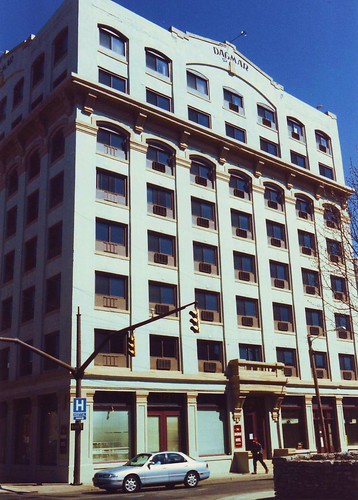
(Mrs. Lehner and her husband owned and operated the Dagmar Hotel for years.)

Go, Mrs. Lehner! Here's her hotel:

Hagerstown Dagmar Hotel
Dagmar Hotel, Hagerstown, MD,
by Mr. T in DC, under Creative Commons license.


The Dagmar Hotel was also the headquarters of the M.P Moller Motor Car Company for a good stretch of time. They made custom cars (called Dagmars, naturally).

Now, I dig that cooks of yore often assumed you knew without being told that you'd need crust for a double crust pie, and that you would know how to make it. I know how to make a really good pie crust.

Confession time: I usually just buy the Pillsbury crust from the refrigerator case. What can I say? It's not as good as homemade, but it's only marginally less good, and it's so fricking easy. So, you can do as I do, and there's no judgement coming at you from this corner. You can rustic it up with your crimping technique, or by being less than anal with straight lines for your lattice strips.

Never done a lattice crust? Don't fret -- it's easy, and there are lots of tutorials on how to make a lattice crust out there.

I will insist upon you having a lattice crust. It's rhubarb pie. I can't imagine a rhubarb pie without a lattice crust. Save your regular top crust for your apple pies, your blackberry pies, your peach pies. Go lattice for rhubarb.

Three cups of rhubarb is about one pound, for what it's worth. Yes, you could buy a pound of chunked up frozen rhubarb -- if you do, thaw it before using -- but it's still rhubarb season. Go buy a pound.

Sunday, June 12, 2011

Three Jell-O Salads; Presbyterian Palate Pleasers, The Presbyterian Church, Hagerstown, MD

Chefly Husband and I are headed out to Wolf Trap today to hear the Indigo Girls perform, and to hang out with friends, and to picnic, picnic, picnic. There's lots of cooking going on, and not a little bit of assembly. It's all very summery.

Yesterday, we hit St. Alban's annual sidewalk book sale. I am constitutionally unable to restrain myself at such things. There shall be cookbooks! Oh, yes. There shall. I did show some restraint -- we left with only four new-to-us cookbook treasures. One is a great single-color comb-spined church cookbook from the Presbyterian Church up in Hagerstown, MD. It cost me all of twelve and a half cents. Half a quarter. You can't beat it! So, this week, before I head out to the wilds of Taiwan for a fortnight, we'll be exploring Presbyterian Palate Pleasers. Ya can't beat that title, either.

Going through the cookbook last night with my trusty Post-it flags, I found far too many cool recipes for one week, so on some days, we're going to have multiples. Like...today! Today, you get three -- three! -- molded salads, of varying difficulty.

Cherry-Coke Salad

1-lb. jar red bing cherries
1-8-oz. can crushed pineapple
1 small pkg. orange jello
1 small pkg. cherry jello
2-6-1/2 oz. bottles Coke

Drain juice from cherries and pineapple. Add enough water to make 2 c. liquid. Heat and bring to boil, then add 2 pkgs. of jello. Stir, dissolve and let cool. Add pitted cherries and pineapple. Add Coke and mix well. Refrigerate at least 3-4 hours. Serves 8.

Floyd Bingaman

Now, I like to do a little Google stalking of people who contribute to these great old cookbooks, and I was a bit surprised to see how many Floyd Bingaman hits I got. I mean...it seemed an odd sort of name. Seems that it's a family name in Hagerstown, MD. I'm suspecting that the Cherry-Coke Salad Floyd is the father or grandpa of the unfortunate Floyd who was sentenced for a terrible crime not so very long ago. (What is it with these old cookbooks and the connections with the unsavory? The Maine islanders were all linked to stories of arson and abuse, and now child murder. :shudder:)

I didn't choose this recipe for lurid tales. No, I chose it because it reminded me of a recipe from the Jell-o (let's use the preferred brand spelling, shall we?) cookbook I had as a kid. I remember making a streamlined version of this years ago, with Coke replacing water while making cherry Jell-o. Tasty stuff, and the bubbles seemed sophisticated.

Odds are, you can actually find tiny bottles of Coke at the grocer's these days. I won't think poorly of you, though, if you use the cheaper 12 oz. can. Honest.
Bloody Mary Aspic

1-24-oz. can cocktail vegetable juice
1/3 c. vodka
1-1/2 tsp. Worcestershire sauce
Hot pepper sauce
2 envelopes unflavored gelatin
2 tsp. lemon juice
1/4 tsp. garlic salt
Salad greens

In a 1-1/2 qt. saucepan, over 1 cup cold cocktail vegetable juice, sprinkle gelatin. Cook over low heat, stirring constantly until gelatin is completely dissolved. Remove from heat; stir in remaining vegetable juice and other ingredients, including a dash of hot pepper sauce. Do not add greens. Pour into a 1 qt. mold. Refrigerate until set. To serve, unmold on salad greens. A delicious salad for luncheons and dinners. Serves 6.

Frances Machen

I ran across a chilled tomato and vodka soup recipe the other day, and yelled "Just call it a Bloody Mary In A Bowl and stop with the soup pretense!" No pretense here, though Frances does stop before calling this "big Bloody Mary Jell-o shots." She also gives the helpful advice to not gunk up the salad by putting the veg IN the salad. Trust that this sort of guidance is vital in old cookbooks. You never know what someone is going to tell you to put in there; it's nice to be told to hold something back.

It seems Ms. Machen died a year ago at age 78. She had a music store, and was known as Aunt Fran to her friends' children.

See, that's the happier kind of story I like to associate with cookbooks and Jell-o.

All in all, the Bloody Mary Aspic sounds pretty tasty. You have your V8, your Tabasco...all clean bright colors. But, where is the fearful sort of molded salad we all love to read about and fear will land on our plates? Never ever think the Presbyterians are going to let you down!
Presbyterian Jello Salad

1 can tomato soup
1 box lemon jello
1/3 c. chopped celery
1/3 c. chopped green pepper
1/3 c. chopped onions
1 c. mayonnaise
2 c. cottage cheese

Melt soup and jello together over low heat, stir constantly. Add the celery, green pepper, onions, mayonnaise and cottage cheese. Chill until firm. Serves 6.

Claudia Strite

Oh, Claudia. I suspect this serves a lot more than 6.

Claudia had a big, big heart, from an early age. This, from a 1937 slave narrative:
Henry killed a man in anger and was sent to Parchman. Friends in Pontotoc intervened when they saw Emmeline's tears. Henry was made a trusty, then transferred to Jackson as a chauffer and house-boy to Governor Earl Brewer. Henry became the especial friend of the Governor's youngest daughter, Claudia, former society editor of the Daily News, now Mrs. Samuel C. Strite, of Hagerstown, Maryland.

One day Claudia, a very young miss, stuck a note under her father's plate, 'Please set Henry free.' Governor Brewer when he left office gave Henry a pardon, and the freed negro was hired as strawboss on a delta plantation, 'but I guess he was too biggety by then,' his whitehaired mother says, 'because it wasn't long until he got into another scrape and got killed.' Henry's grave in the delta is marked by a tombstone that Claudia placed there.

Okay, I just teared up. Not ashamed to say it. Much of that tale is sad, too, but the fact that the governor of Mississippi's little daughter was concerned about Henry, and years later still cared enough to place the tombstone? It's touching. And I'm a sap.

This is what this blog is about: scary recipes, warm hearts, and a generosity of spirit that shines across the years.

Saturday, June 11, 2011

Strawberry-Rhubarb Puff: A Reminder About Altering Recipes All You Want

Betty Crocker's Outdoor Cook BookIt's time for our semi-regular reminder about how most recipes are more about method and less about specific implementations. The Betty Crocker's Outdoor Cook Book has more than its fair share of brand-specific recipes, and relies a bit more on canned/tinned/processed foods than modern sensibilities tend to allow (in public, at least -- in private, even Chefly Husband eats ravioli right out of the can sometimes).

Thing is, all the glorious 1960s short cuts? Can be slowed down. And, really, if you're picnicking, sometimes it's all about reclaiming an older, slower, simpler something.

Illustration by Tom Funk.

Strawberry-Rhubarb Puff
Ideal to carry to picnic site and reheat.

1 pkg. (16 oz.) frozen rhubarb, thawed
1 pkg. (10 oz.) frozen strawberries, thawed
1/2 cup sugar
1 can Betty Crocker Bisquick Refrigerated Biscuits
1/4 cup butter
1/4 cup sugar
1 tsp. cinnamon

Heat oven to 375°F (quick mod.). Mix rhubarb, strawberries, and 1/2 cup sugar in sq. pan, 9x9x1 3/4". Cook 5 min. over medium low heat. Place biscuits on top of hot fruit. Make hole in each biscuit and put a little butter and mixture of sugar and cinnamon in each hole. Bake 25 to 30 min. Cool. Cover top of pan with aluminum foil; place pan on outdoor grill. Heat until aluminum foil feels hot. Uncover and serve with cream or whipped cream, if desired. 8 to 10 servings.

Let's give a bit of thanks that the temperature is given in degrees, and not just with the guidance of "quick moderate." Even "hot" and "very hot" temperatures vary depending on who's judging. I trust that it's good to know how long one can put one's hand in an oven of a certain temperature, but as I don't cook in a wood stove, and don't intent to, I'm happy with °F.

I've not seen refrigerated Bisquick biscuits before. If you want to be a recipe purist, your best bet is going to be "can o' biscuits" -- choose your favorite brand.

If we're slowing down this recipe, though, how's about making your own biscuit dough? Use your favorite recipe that makes 8 or so big biscuits. No need to worry about cutting the dough into rounds; you can cobble the top with little bits of dough you tear off.

Did I say "cobble"? Well, sure. The recipe may say "puff," and I'm not going to say the dough won't puff, but it's a cobbler. Cobble away.

Other ways to slow this down: don't use packaged frozen fruit. Go to the store. Rhubarb's in right now, as are strawberries. Get a pound of one, and a pint or quart of the other, and slice up into nice even-ish chunks. If there's no rhubarb, you can choose some other fruit. Or, if you're not a strawberry person, how's about some nectarines, or blueberries?

I'm not opposed to frozen fruit. I have lots in my freezer right now. But it takes only a smidge longer to use in season fruit and feel a touch more connected.

Stuffed Acorn Squash, or Every Vegetable Is Even Better With Butter And Sugar

Betty Crocker's Outdoor Cook BookBarbequeing isn't all about the dead beasties. Sometimes, you need something more vegetal. Betty Crocker's Outdoor Cook Book gives several options, including this recipe that makes me think of Halloween and Thanksgiving more than Memorial Day or the Fourth of July.

Stuffed Acorn Squash
Apple and brown sugar caramelize as squash bakes. Good with pork or baked turkey, as pictured on pages 34-35.

Select 3 medium acorn squash. Cut into halves; remove seeds. Place each half on a double thickness of heavy-duty aluminum foil. Put 1 tsp. butter and 2 tbsp. brown sugar in each half, add mixture of 3/4 cup chopped apple and 2 tsp. chopped walnuts. Dot with 2 tsp. butter and wrap securely in foil. Barbecue on briquets 40 to 50 min., or on grill about 1 hr., turning once. Squash is done when it feels soft when touched with an asbestos-gloved thumb. 6 servings.

Please tell me you're not actually having an asbestos-anythinged anything in or near your food. Use a heat-proof glove. It could be an Ove' Glove or something your great-aunt crocheted for you, as long as it's thick enough to keep you from burning yourself and, oh, yes, not carcinogenic.

I know that I said that barbeques weren't all about the dead beasties, but you know how we are around here at Take One Cookbook... we love the dead beasties, and really think that this would be even better with a good crumble over of crisp bacon. If you're not adverse to pork products (yummy, yummy pork products), I highly suggest crisping some up and adding it in here.

Butter and brown sugar and orange squooshy vegetable goodness reminds me of candied yams. This makes me want to add mini marshmallows to the squash.

Yes, even with the bacon.

Ooo.

Especially with the bacon.

I was going to prattle on about the fact that there's no list of ingredients for this recipe, but then I got distracted by the spelling of "barbecue." I nearly typed "misspelling" there, because to me, "barbecue" is spelled "barbeque." A little Googling shows me, though, that I have evidently embraced a "popular spelling variant." I say, it's abbreviated "BBQ" not "BBC," so I'm sticking to my popular variant.

I'll save the BBC for my Doctor Who needs.

Tuesday, May 31, 2011

Gender at the Grill: Rumaki on the Hibachi

Betty Crocker's Outdoor Cook BookI'm pretty much assuming that anyone reading a rather-colloquial English-language blog in 2011 knows what a barbeque is, and doesn't need a history lesson about the word's French roots or a detailed description of what a kettle grill is. Betty Crocker's Outdoor Cook Book makes no such assumptions, coming as it does from that time before blogs and ubiquitous suburban Webers.
The barbecue at home is the aristocrat of outdoor meals. though its mood is informal, food often is as sophisticated and service is as elegant as in a dining room--but much less trouble if plans are carefully made.

This is where women, experienced in the day-to-day organizing of menus and meals, shine. They know the importance of the complete shopping list; of cleaning, or peeling, or otherwise preparing vegetables in advance; of having tools sharp and handy; and of not asking one burner or one oven to produce a whole meal at the same time. There is plenty for everyone to do before and during a big cookout. Most women I know are quite content to concentrate on advance preparations and the duties of a hostess, and leave the more dazzling duties over that hot bed of coals to the males.

...I don't quite know where to begin with this pretty little insight into women's happy role of prep cook. No, really, I don't, because as much as I like to rail against outdated sexist gender role expectations, I have to admit: when it comes time to slap the meat on the grill, I'm usually handing the tongs off to Chefly Husband. So, boo on the gender role expectation that I fully embrace in real life!

If there's a broiler around, though, I'll reclaim the same dishes that otherwise I'd get all Donna Reed-y about outside.


Rumaki on the Hibachi
A delectable do-it-yourself chicken liver appetizer for guests to prepare while host or hostess finishes dinner preparation. Pictured on page 139.

6 chicken livers
6 strips of bacon
water chestnuts
brown sugar

Cut chicken livers in half; slice water chestnuts (about 3 slices per nut). Marinate in Teriyaki Sauce (p. 94) for 4 hr. Drain; cut 6 bacon strips in half. Wrap chicken liver pieces and water chestnut in bacon strip. Fasten with toothpick and roll in brown sugar. Arrange appetizers on hibachi over hot coals. Grill until bacon and liver are tender, 15 to 20 min. Turn often. Makes 12.

Variation: Appetizers may also be baked in the oven. Place on a wire rack over a shallow roasting pan. Bake at 400° (mod. hot) 20 min., or until bacon is crisp. Turn occasionally for even browning.

I remember the first time I had rumaki. It was in a tiny rowhouse on Capitol Hill, in a teeny kitchen that, frankly, looked a bit scary. But my friend Nancy was working magic with water chestnuts and teriyaki sauce, and bacon. Bacon! She popped her liver-less rumaki under the broiler and I was hooked. So tasty. So salty. So sweet. So crunchy.

I like chicken liver, but have never had rumaki with chicken livers. I did find out that some of our good friends are chicken liver fans--Chefly Husband was talking about making a strawberry risotto with grilled chicken livers, and they swooned--so maybe this recipe will come out and play soon.

Cooking the Books: Tomato & Buttermilk Soup and Hard Cooked Eggs

I don't know what's got me on a buttermilk kick lately, but a kick I am on. It's also hotter than heck in DC right now. So, I decided it was time to try Tomato & Buttermilk Soup. Last night, I pulled out two Mason jars. I poured buttermilk in one, up about 1/3 of the way. Then, I topped the jar off with tomato juice. I screwed the cap on, gave it a shake, and put it in the fridge. I remembered it this morning while leaving work -- small miracle, that -- and popped it in the work fridge until lunch.

It was cold. It was delicious. I didn't add salt -- the tomato juice is plenty salty -- or pepper or any such thing. That being said, I can see a couple dashes of Tabasco working nicely here, or a sprinkle of dill, or fennel fronds, or grated cuke, or... really, whatever you have handy that is tomato-friendly.

I drank my soup right out of the jar. I shall do so again tomorrow. It doesn't look like much in this picture here -- if you want a more-vivid color, then use more tomato juice, or try some paprika (ooo, paprika would be good in here...).

The only lunch prep I did for this week that required a stove was boiling up a bunch of hard cooked eggs. Followed the recipe (with mother in law alteration) and once again, ended up with perfect, perfect eggs.

As to the second jar I mentioned up there in the first paragraph, I filled it 1/3 of the way with steel cut oats, and then poured in buttermilk until the jar was 1/3 full. Screwed on the cap. Set it in the fridge overnight. Opened it this morning to fill the jar the rest of the way with fresh blueberries (frozen fruit works, too), and took it off to work where it made one heck of a hearty breakfast. Texture: like Grape-Nuts. And we all know how much I like Grape-Nuts.

Monday, May 30, 2011

7 Rules for Grilling: Controlling Kibitzers & Fire

Betty Crocker's Outdoor Cook BookWhile I love the recipes in old cookbooks, I really love the non-recipe content. Odd illustrations, weird apostrophes (figure of speech, there, not punctuation) (though there's strange punctuation, too), and tons of tables, tips, and rules to keep you from killing yourself or others in your quest for keeping folk fed.

It's 95°F here in Washington, DC today, so there's no way in heck I'll be standing over a fire. So, it's virtual barbeque time for me. The steak on coals method isn't for me, but Betty Crocker's Outdoor Cook Book has lots of other tidbits to try, and tons of info to help you along the way. This afternoon, let's look into Betty Crocker's fire rules, kicking off with one of Tom Funk's illustrations -- he doesn't exactly put the funk in funky, but his midcentury drawings appeal.


The basic rules for fire building and control that follow will give you a fast start in the right direction, but only by firsthand experience does anyone develop that second sense that tells the expert how to make the outdoor grill produce reliable results.

Rule One: Before you light your fire, collect or have easily at hand all of the fuel you expect to use--and a little more!

Rule Two: Once your pilot fire is kindled and burning well, add as readily as possible all of the rest of the fuel so that it can burn down all at once to an even bed of coals.

Rule Three: Use a little more fuel than actually necessary. Nothing is a wider open invitation to trouble than a fire that is too small.

Rule Four: When necessary to add fuel to a well-established fire--as it sometimes is during a long cooking period--add it at the edges and rake it in when well kindled. Never put the fresh fuel in the center as this reduces heat rapidly.

Rule Five:Allow plenty of time for the fire to reach its proper cooking heat. Half an hour is the minimum for charcoal briquets, and 45 minutes to an hour is safer.

Rule Six: Once your fire is well under way, disturb it as little as possible. Constant poking and raking breaks up pockets of heat and lowers temperature.

Rule Seven: Develop some stern method of kibitzer control. People who would not dream of regulating your kitchen oven seem unable to resist "helping" the oudoor chef by stirring up his fire. They mean well. Indeed, such activity usually shows the first gleam of determination to try outdoor cooking for themselves. But threaten them off with the tongs, if necessary. two firemasters is one too many.
So, the first four rules are Do This; Seriously, Do This; No, Really, Do This; So You Didn't Do What We Told You To....Here's How To Fix. Then, two rules covering Leave Well Enough Alone, Already.

I don't know that I've ever had a small fire be a wide open invitation to trouble before. Large fires, sure. There was a fire pit in Northern Ireland, and that was a wide open invitation to some contemplation. Well, for me, contemplation. For Alex, a teen pilgrim and firebug, I suppose a small fire is in fact a wide open invitation to, if not trouble, at least to a bigger fire.

DSC04139


Here at Take One Cookbook... we like to think thoughts of peace and not of affliction, so I would like you to disregard Betty Crocker's advise to threaten people with tongs. It's not very civil. Plus, you use those tongs on food -- don't muck 'em up on overly eager "firemasters."

Steak on the Coals; Meat Marinade: Impressing At The Grill

Betty Crocker's Outdoor Cook BookHappy Memorial Day, folks. We had a huge, beautiful meal of pork with cabbage & white beans last night, followed by strawberry shortcake (the strawberries were macerated with sugar, fig balsamic, and fresh thyme), so we've no immediate grilling plans for today, but my mind goes to the grill nonetheless.

I like cooking over a grill. Anything tastes better after some time above the coals. Betty Crocker's Outdoor Cook Book challenges my belief, though, and suggests "above" isn't the way to go.

Steak on the Coals
This method startles those who see it for the first time, but it draws ecstatic praise from those who like an emphatic grilled flavor.

Use a large piece of lean, tender steak, such as sirloin, weighing at least 3 lb., 1 1/2 to 2" thick. Place steak in baking pan and cover with Meat Marinade (recipe below). Refrigerate 3 hr. Turn meat occasionally to thoroughly over with marinade. Drain steak and allow to come to room temperature.

Have a bed of white-hot charcoal briquets about 3" deep. A shallow layer of coals will not serve. Remove the grill. Place the meat directly on the fiery coals. Turn every 10 min. to another white-hot area. Allow 12 to 15 min. per side for the center to become
rare, hot, and juicy. Allow 1/2 to 3/4 lb. per serving. Makes 6 servings.

Ooo, a bonus recipe!
Meat Marinade: Combine in bowl 1/2 cup vinegar; 1/2 cup vegetable oil; 1 small onion, minced; 1 tsp. salt; 1 tsp. dry mustard; 1/4 tsp. each mace, nutmeg, and cloves; 1 clove garlic, crushed; and 1/2 tsp. Tabasco. Pour over meat. Serve meat with remaining hot marinade.
Before we go any further, let's point out one important thing: you can not serve that leftover marinade unless you cook it. Cook it. Yes. Cook it. I've nothing against a good steak tartare, but I value your health and don't want you slopping raw meat juice over your Flintstones-esque slab o' meat. Food safety: It's not just for 4H geeks.

It's for 4H geeks, too -- just not ONLY for 4H geeks. (Go, 4H!)

I have no doubt that this method of steak cookery will yield a cooked piece of meat. I do, however, doubt that this is the best way to treat your 3 pounds of sirloin. The very phrase "emphatic grilled flavor" sends shivers of horror down my spine. In fact, according to my handy dandy Google-fu, I find that there's only one place "emphatic grilled flavor" comes up in this world of ours, and it's right here, in this recipe, in this cookbook. When phrases occur only once? I think it's because they shouldn't occur again... Ban the "emphatic grilled flavor"! Embrace some frickin' subtlety!

And yet... it does have a primitive sort of allure...

Here's my final take on this: If you have absolute faith in your cooking fuel, and know for a fact that there aren't weird waxes and chemicals and flammable liquids going on, then fine. Try this. But if you're using briquets and a can of fire starter and God knows what else, put some distance between the unknown and your beef.

Saturday, May 28, 2011

Betty Crocker's Outdoor Cook Book; Good 'N Easy Potato Salad

Betty Crocker's Outdoor Cook BookIt's Memorial Day Weekend, and with Memorial Day Weekend comes summer, gatherings with friends, picnics, barbeques, and all sorts of outdoorsy goodness. That, plus Chefly Husband's newly-started blog (Mastering Wine) has inspired me to grab a cookbook, dream of dishes fascinating and horrifying, and type away.

Welcoming us back into the fold is Betty Crocker's Outdoor Cook Book, illustrated by Tom Funk, © 1961 by General Mills, Inc. This is a great hard cover, spiral bound gem with two-color silly illustrations and four-color glossy pictures of stylish 60s folk, cooking outside. There is a facsimile edition available, but my copy is first edition.

I knew I wanted the first recipe up to be a potato salad recipe, as potato salad and Memorial Day just go together for me. But... which one? Potato Salad, Good 'N Easy Potato Salad, or Potato Salad For A Crowd? Chefly Husband suggested "whichever one doesn't have yellow mustard, because yellow mustard is disgusting."

He has many fine qualities.

And I like yellow mustard.

But I'm leaning towards "disgusting" anyway.
Good 'N Easy Potato Salad

1 pkg. Betty Crocker Scalloped Potatoes
3 cups water
2 tbsp. butter
2/3 cup water
1/4 cup mayonnaise
1 tsp. prepared mustard
2 hard-cooked eggs, chopped

Empty potatoes into saucepan. Add 3 cups water. Bring to boil. Reduce heat and simmer until tender, about 15 min. Rinse with cold water; drain throughly. Put in bowl, cover, and chill. Melt butter. Blend in contents of seasoning pkg. Add 2/3 cup water all at once. Heat over medium heat until mixture boils, stirring constantly. cover and chill. (Lumps are onion pieces.) When cold, blend mayonnaise and mustard into sauce. Fold into potatoes and eggs. 4 servings.
Any time a recipe has to tell you that what you're looking at is intentional and vaguely vegetal, back away slowly...

This may well taste very good. Lord knows I'm not opposed to cooking shortcuts. But if you're going to take the time to hard-cook eggs (and, let's take a moment for three cheers, for Betty Crocker calls 'em as they are: hard cooked, not hard boiled), then you can take the time to boil your own potatoes. Heck, you can boil them in the same pot as your eggs. One pot! One boil! Then you'd be able to identify your own lumps.

As for the mustard issue -- yes, I use yellow prepared mustard in my potato salad. You can use your favorite mustard, be it Dijon or brown or horseradishy, but to be truly 1960s vintage scary, use the yellow mustard, and the boxed potatoes.

If nothing else, file this one away for your next Mad Men theme party. Betty Draper would have had this cookbook.

Friday, December 24, 2010

Christmas Eve: Potato Soup

It's Christmas Eve in DC. On Christmas Eve, we don't use cookbooks. No, we fly by tradition, and tradition means Potato Soup.
Mom, Kelly, and Grandma, early 1970s.
My Family's Potato Soup

Take your sauce pan or soup pot, and put it on the stove. Cut up a package of bacon and frizzle up the pieces in the pot. Cook until just this side of crispy (unless Kelly is going to be at dinner, in which case, cook until well and truly dead on the crispy side, and then you'd best be cooking more than one package, too), and remove to a plate lined with paper towels. Drain off fat. Remember that Dad had a crock of bacon fat in the fridge, and wish you had one, too. Remember that you only ever cook with bacon fat when you are also cooking bacon, so you don't need to store bacon fat up for other purposes. Get on with cooking.

Peel one potato per person coming to supper. Cut into a chunky rough dice -- these do not need to be perfect cubes, but they should be roughly all the same size so they'll cook evenly. Drop your chunks into the pot you just cooked bacon in. (You didn't wash it out, did you? You want the brown crusty bits for flavor.) Chop up one onion, fine, and add it to the pot. Cover potatoes with water -- just cover, no more -- and turn on the heat. Bring it to a boil, then drop to a simmer, and simmer for 20 minutes. At 20 minutes, you should be able to slide a knife point easily into and out of the potato chunks. Open a can of evaporated milk, and pour it into the soup. Stir and leave on the stove just long enough to warm up the milk. Crumble in the bacon, and stir.

Serve up in bowls. and remember the bowls that it should be served in (they have roses on them), and garnish with a pat of butter and a good hefty sprinkling of seasoned salt (Lawry's is the family tradition). Buttered saltine crackers may be served on the side.
So, that's the soup. It's from Dad's side of the family -- I know Grandma made it (that's her in the picture, on the right), but I don't know if her mom made it. Dad's first time trying to make it went...adventurously, as he used condensed milk instead of evaporated. Sweetened condensed milk. It was vile. Momma makes it (she's on the left of the picture), I make it, Kelly makes it (she's the cutie with the doll in the middle). We've the sense and family knowledge to know that sweetened condensed milk is no the way to go.

Anyway, we make potato soup. It's what we do.

You might be surprised that we don't cook up that onion in the bacon fat. You can do it. Heck, sometimes? I do. But never on Christmas Eve. The milder, less caramelized flavors taste like family Christmas. When Momma or Kelly makes it, there's often no onion, or one pot done with no onion. Aunt Linda abhors onion. She has many fine qualities, but can't eat onions.

We also don't add salt during the cooking, mostly because there's a shit ton of salt in the bacon, and we add salt when serving. If you can't bring yourself to use seasoned salt, or can't imagine not correcting seasoning on the stove, add salt your way, and garnish with paprika for the lovely color.

I do try to be truthful here on Take One Cookbook... traditionally? We garnish with margarine and we spread margarine on the crackers. I don't stock margarine in my house, though, and I'm here to tell you: BUTTER TASTES BETTER. Not just in general, but specifically in this soup, butter is better.

If you want a smoother texture to your soup, do not be tempted to cook the potatoes until they fall apart into a mush. When they fall apart like that, they're "blown away" and not in a good way. It will taste like paste, and it will be grainy and gross. If you want smooth, get out a blender, and purée some of the soup, adding it back in to the whole.

One can of (evaporated) milk will get you easily through 4 people/potatoes. If you have more people coming to table, I would suggest adding an extra can if you have more folks:

1 can = 1-4 servings
2 cans = 5-8 servings
3 cans = 9-12 servings (you need more bacon at this point, too)

So, that's Christmas Eve in our family. Christmas Day doesn't have set rules/tradition for meals, but Christmas Eve is set in stone. It's in our blood.

A bowl of potato soup is Christmas Eve.

Wednesday, December 22, 2010

A Different Green Bean Dish: Judías Verdes Rehogadas con Jamón

Delicioso!I'm nuts about Christmas. I blame it in part on the fact that my dad's a Christmas tree farmer. Whatever the reason, I know this for sure: I'm just giddy with excitement because Christmas Eve is just two days away!!!

If you're looking to change up your holiday side dishes, ditch the green bean casserole with the can of fried onion whatnots on top. Try instead this recipe from Delicioso! The Regional Cooking of Spain :
Judías Verdes Rehogadas con Jamón
(Green Beans Sautéed with Cured Ham)


Whenever we stay in Niserias in Asturias (as we often do, since my husband loves to trout-fish in the cares River) we dine at Casa Julián (see p. 113), where co-owner and cook Vincentina produces simple Asturian fare with an expert hand. My favorite first course is her sautéed green beans, seasoned with garlic and generously sprinkled with mountain ham.

Serves 4

Salt
1/2 small onion
1 1/2 pounds broad green beans, ends snapped off
2 tablespoons olive oil
4 cloves garlic, lightly smashed and peeled
2 ounces Spanish mountain cured ham or prosciutto, in small cubes or thin squares (about 1/4 cup)
Freshly ground pepper

Bring a pot of salted water to a boil, add the onion and green beans, return to a boil, then cook uncovered at a slow boil for about 20 minutes, or until cooked as desired. Discard the onion and drain the green beans in a colander. Refresh with cold water.

In a skillet, heat the oil with the garlic, pressing the garlic with the back of a wooden spoon to release its flavor, until the garlic is golden on both sides. Add the beans and the ham, season with salt and pepper, and sautée, stirring, over a medium flame, until the beans are hot.
If I read this recipe for the first time, I would say "Hell, no!" Then, I'd walk away, shaking my head. "Cook beans for more than 20 minutes? They'll be mush!" I'd laugh, disbelieving. "Boil the onion?!?!?! That onion should be diced and fried with the garlic!"

I'd have a wealth of culinary tradition and experience behind me.

I'd also be wrong.

Judías Verdes Rehogadas con Jamón, or Green Beans with Ham, photo by Wendy A F G Stengel, some rights reserved


This was the first course in our last meal in Spain. We'd made it to Santiago, we'd been to Mass, we'd waited in line for hours to get our credentials, and we had a celebratory meal and final communion for our pilgrimage group.

And this was damned tasty.

I'm not a cook-it-'til-it's-dead girl when it comes to vegetables. I'm really not. But, dang, these beans taste good after a long slow simmer with ham.

Need I say everything was local? Everything? Was local.

People grow their own everything.

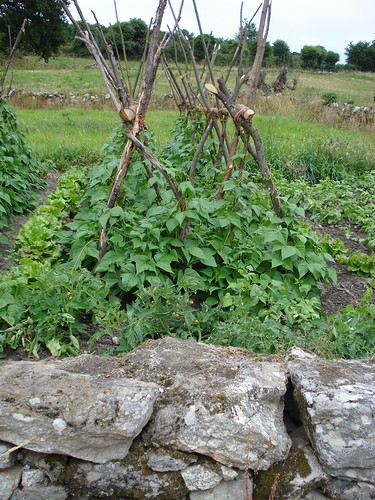
Garden in Spain, photo by Wendy A F G Stengel, some rights reserved


Their own beans.

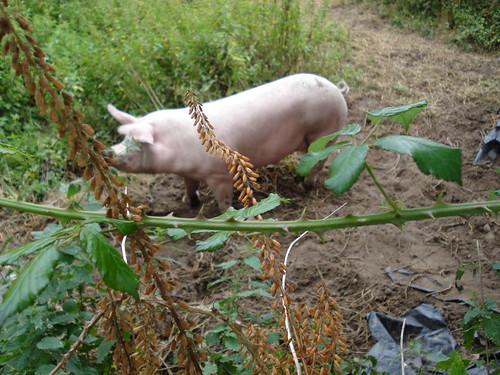
Backyard pig in Spain, photo by Wendy A F G Stengel, some rights reserved


Their own ham.

I know the pig's out of focus (and that it's not ham ... yet); I heard it grunting on the other side of a garden wall, held my camera up high, and sort of just hoped I'd get a picture of whatever was making the sound. So, out of focus or no, I love this picture of the ham-to-be.

But I digress!

I rather thought I might.

Point being: think outside the can of cream of whatever and tinned questionable crispy onionesque casserole topping, and bring a bit northern Spain to Christmas this year.

Tuesday, December 21, 2010

Santiago Cake and Nostalgia: Tarta de Almendra O Merlo

Delicioso!Christmas is just days away, and I'm filled with a hankering to bake. We had a cookie exchange at work a few weeks ago (I made 7 Layer Cookies), but there's still room in my holiday kitchen for something sweet. Okay, I'll admit it: almost all the cookies are already gone. There was a caroling party! It was raining! People ate cookies!

Getting back to the point, Delicioso! The Regional Cooking of Spain shares a baked good I had at the end of more than one happy meal in Spain.

Tarta de Almendra O Merlo
(Galician Almond Cake O Merlo)


There is hardly a restaurant in Galicia that does not offer the region’s traditional almond cake, often called tarta de Santiago because the cross of Spain’s patron saint, Santiago, is usually emblazoned in the cake with caramelized sugar.

Santiago, known in English as the apostle Saint James, was said to have traveled to Spain to preach the Gospel, and after he was martyred in Jerusalem his body miraculously reappeared in Galicia in a field that gradually developed into the glorious city of Santiago de Compostela (see my Discovering Spain: An Uncommon Guide for the full story). Santiago de Compostela became a place of mass pilgrimage in medieval times as millions of Europe’s faithful made the arduous journey on foot to reach the shrine of the Apostle. On of Galicia’s most enduring symbols is the distinctive cross of Santiago.

Tarta de almendra is a single-layer almond cake, simple and moist. Although served as a dessert in Galicia, we would probably consider it more appropriate as a tea cake. One of the best I have eaten comes from Alfonso Merlo, the owner and chef of O Merlo, in the provincial capital of Pontevedra, a restaurant specializing in tapas that are often meal-size. It is a great place to eat when here to visit the city’s quaint Old Quarter and delightful old squares.

Makes one 8-inch cake

6 ounces blanched almonds (about 1 cup)
6 tablespoons flour
¾ cup sugar
3 eggs
Confectioners’ sugar

In a processor, coarsely chop 2 ounces (about 1/3 cup) of the almonds with the flour. Remove from the processor and reserve. Now add to the processor the remaining almonds and ¼ cup of the sugar, and grind the almonds as fine as possible.

In a bowl, with an electric mixer beat the eggs until foamy. Add the remaining ½ cup sugar and beat until the mixture is light-colored and thick. Then beat in the sugar-and-almond and flour-and-almond mixtures. Pour into a greased and floured 8-inch springform pan and bake at 350°F for about 35 to 40 minutes, or until the cake springs back slightly to the touch. Cool, then remove the rim of the pan and sprinkle the cake heavily with confectioners’ sugar.

To burn the traditional cross in the sugar, heat a thin metal skewer (protect your hand with a pot holder) over a flame until the lower portion is red-hot. Press the skewer over the center of the cake to caramelize the sugar. Wipe off the skewer, reheat, and repeat to form a cross.

I never even once saw the cross burnt into the sugar. Never once. No, instead the cross was stenciled on to the cake with powdered sugar.

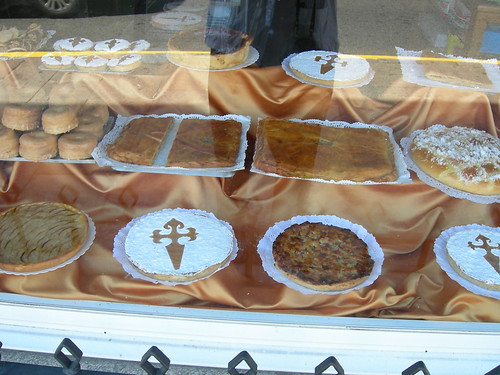
Santiago bakery window; some rights reserved


Oh, the bakery. This bakery was actually in Santiago proper, just as we were walking down the last hill into the center of town. You can see the full-sized cakes, and the smaller cakes. The apple pies. Oh! The donuts! And, dead center, there's even big empanadas.

The Santiago cake (and, yes, I only ever heard it called tarta de Santiago, and never de Almendra) is so very moist. Moist, and dense, and crumbly. I'd serve it with a dollop of stiff whipped cream on the side, and some raspberries or a sprig of mint. Even with the signature dessert of the region, things are kept best when kept simple.

I'll tell you, this goes fine with cider or wine, but I bet it'd also be amazing with some sherry. Or...some kirsch.

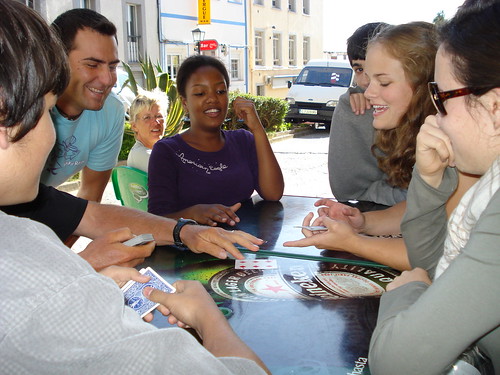
I think the first slice I had was in Palas de Rei, right after we met up again with Mr. and Mrs. Belgium. We knew their real names, but as they'd walked out their front door in Belgium months before and just kept walking, we called 'em Belgium. They thought it was funny. We played a mean game of Uno that afternoon, and a meaner game of Bullshit.

Card games on the Camino, photo by Wendy A F G Stengel, some rights reserved


The time walking on the Camino was special; the time together in the afternoons and evenings, tired and sharing a new common set of references... it was amazing. I'm feeling all nostalgic; all the youth who went on that pilgrimage with me have graduated, gone off to college... I hope I get to see them when they come back into town for Christmas.

It's not a bad time of year for nostalgia, served up with a slice of cake.

Sunday, December 19, 2010

A Forest of Greens In Every Yard: Caldo Gallego

Delicioso!Nearly every bar, restaurant, hotel, inn, and whatnot along the pilgrim trail to Santiago serves up a Menu Peregrino, a Pilgrim Meal. It's cheap as chips, three courses, and includes bread and wine. Lots of wine. Usually bottles of wine. Oh, the wine! Anyway. At nearly every place we stopped, I was offered and I greedily accepted a hot bowl of Caldo Gallego. Brothy, with greens and potatoes, and often nothing else that was identifiable, it still stood up to a tired pilgrim's appetite, especially when said pilgrim dunked in some bread. Delicioso! The Regional Cooking of Spain offers up this version:
Caldo Gallego
(Galician Meat, Potato, Greens, and Bean Soup)


Start preparation 1 day in advance
There is remarkably little variation from one cook to the next in the preparation of Caldo Gallego, the famous soup that has traveled the world with Galician émigrés. Only one ingredient, chorizo, is a point of contention. Purists reject it, yet many traditional recipes include it; it does, in fact, produce a richer, more flavorful soup. The kinds of greens may also vary, although grelos—closely akin to collard greens—are most typical. Caldo Gallego is hearty enough to be a meal, but you may choose to serve it in smaller portions as a first course or as an accompaniment to a light supper.

Serves 4-6

½ pound medium dried white beans
1 tablespoon olive oil
2 cloves garlic, minced
1 teaspoon imported sweet paprika
7 cups water
1 pound boneless beef chuck
1 beef or ham bone
¼ pound Spanish mountain cured ham, prosciutto, or capicollo, in a thick chunk
A 2-ounce piece slab bacon or salt pork
1 leek, well washed
½ pound collard greens, Swiss chard, or kale, thick stems trimmed and coarsely chopped (about 4 cups)
¾ pound small (about 2-inch diameter) new or waxy red potatoes, peeled
¼ pound sweet chorizo
Salt

Soak the beans overnight in water to cover. Drain.

In a small skillet, heat the oil and garlic and sauté a minute (the garlic should not color). Turn off the flame and add the paprika. Stir in a tablespoon or two of water.

Add to a soup pot the water, beans, beef, bone, ham, slab bacon, leek, and garlic mixture from the skillet. Bring to a boil, cover, and simmer about 2 hours, or until the beans are almost tender.
Add the greens, potatoes, chorizo, and salt to taste, cover and continue cooking until the potatoes are done, about 30 minutes.

Remove and cut up the beef, ham, bacon, leek, and chorizo and return to the pot. Discard the bone. Cover and let sit 10 minutes before serving. Reheat if necessary.

I don't remember ever seeing potatoes in my caldo, nor often any beans. It's peasant food, and as such lends itself easily to whatever you have on hand. If you have chorizo one day, add it. If not, don't do a run to Whole Foods, just go without.

I wouldn't get too precious about the kind of greens you use, either. Grelos, mentioned above, are turnip greens. You could use 'em, sure. You could use collard greens, or kale, or chard... Use what you have, or the first thing you lay hands on.

Gallego greens garden, photo by Wendy A F G Stengel, some rights reserved


Just about every home we passed on the Camino had a yard filled with greens. Big, waist- or chest-high primeval stalks. When it was time to make the caldo, they'd step outside, cut a few leaves off with their kitchen knives, and they were ready to go.

I'd file this away under "deceptively simple." It doesn't sound like much in the writing up, it doesn't look like much in the bowl, but mercy me, it's a damned fine bowl of soup.

Saturday, December 18, 2010

Pork Pie (Not the Hat): Empanada Gallega de Raxó

Delicioso!When I was a wee thing growing up in Oregon, we didn't have Taco Bell, we had Taco Time. So, I grew up thinking that an empanada was a filled, fried cylinder of questionably fruit origin, covered in sugar. Good stuff. Further experience introduced me to Latin American empanadas, big full pocket pies of meaty goodness. Let's face it: I'm a fiend for a savory pie, I'm a fiend for an individual-sized pie, so I'm a fiend for empanadas.

It comes then as no surprise that when I saw an empanada on a menu in Spain, I ordered it. This recipe from Delicioso! The Regional Cooking of Spain is spot on for the unexpected--but wonderful--empanada:
Empanada Gallega de Raxó
(Galician Pork and Peppers Pie)


Start preparation 2 hours in advance

I have never found a filling that is tastier and more succulent than this one for Galicia’s classic savory pie. Empanadas, however, may be filled with many other mixtures, from tuna, scallops, and sardines to rabbit and chicken. The dough also varies according to the cook, from a real bread dough to a much more refined modified puff pastry. Here I have provided my favorite puff pastry empanada dough from Tapas: The Little Dishes of Spain, but when I do not have the time or inclination to make my own pastry, I go to my local pizzeria and buy an uncooked pizza dough. The empanada comes out just like those of Galicia based on bread dough.
Empanadas cut in small wedges or squares make excellent tapas, and in larger portions, accompanied by a salad, make a most enjoyable light meal. I think they are at their best freshly baked but at room temperature.

Makes about 4 dinner or 8-10 tapas portions

Puff Pastry for Empanadas (p. 109) or 1 ½ pounds pizza dough
3 cloves garlic, peeled
2 tablespoons minced parsely
1 ½ teaspoons minced oregano leaves or ¼ teaspoon dried
Several strands of saffron
1 ½ teaspoons thyme leaves or ¼ teaspoon dried
¼ cup olive oil
3 tablespoons dry white wine
¾ pound boneless pork loin, cut in 1/8-inch slices, then in 1/2-inch strips
1 large onion, preferably Vidalia or Spanish, slivered
¾ pound green frying peppers, cored, seeded, and cut in long narrow strips
3 teaspoons imported sweet paprika
¼ pound tomato, skinned, seeded, and chopped
4 tablespoons (1/4 cup)finely diced Spanish mountain cured ham, prosciutto, or capicollo
Salt
Freshly ground pepper
1 hard-boiled egg, sliced
1 pimiento, imported or homemade (p. 178), cut in strips
1 egg, lightly beaten with 1 teaspoon water

If using homemade dough, prepare according to instructions.

In a mortar or mini processor, mash to a paste the garlic, parsley, oregano, saffron, and thyme. Mix in 1 tablespoon of the oil and the wine. Transfer to a bowl and mix in the strips of pork, coating them well. Marinate 2 hours. Drain the meat and reserve the marinade.

In a shallow casserole, heat 2 tablespoons of the oil and slowly sauté the meat until it just loses its color. Return the meat to the reserved marinade. Add the remaining tablespoon of oil to the casserole and sauté the onion and pepers a minute or two. Cover and cook very slowly for 15 minutes. Stir in the paprika, then turn up the heat, add the tomato, and cook 5 minutes. Stir in the paprika, then turn up the heat, add the tomato, and cook 5 minutes. Add the pork wit hits marinade and the ham and season with salt and pepper.

Roll the dough into a 14- by 28-inch rectangle. Divide into two 14-inch squares, then trim the corners to make two 14-inch circles. Place one of them on a cookie sheet (dampened if using pastry dough, sprinkled with cornemeal or flour if using pizza dough) and arrange the pork mixture to within 1 inch of the edge. Scatter on the egg slices, top with the pimiento strips, and cover with the second dough circle. Roll up the edges and press well to seal. Make several slits in the dough, brush with the beaten egg, and bake at 350°F for about 30 to 35 minutes, or until browned. Cool a few minutes before serving or serve at room temperature.
Oh, yes. Bread and meat and deliciousness, coming out looking like a stuffed pizza. Don't believe me? Take a gander:

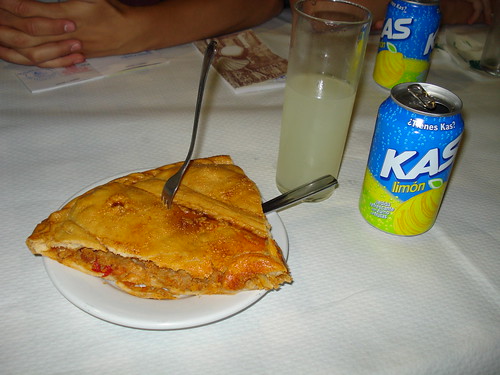
Empanada and lemon soda. Photo by Wendy A F G Stengel; some rights reserved.


Not the most artistic of all possible photos, but look! That's my wedge o' empanada, proper Spanish empanada! Beats the heck out of a Taco Time anything, I don't mind telling you. (All due and right respect to Taco Time; you taught me to dip crispy burritos in ketchup...you taught me there could be crispy burritos.) Everyone else ordered pizza, so I'm betting that they used pizza dough for the empanada, too. If anyone feels a strong need for the puff pastry recipe referenced above, I'll post it, but, really: use some pizza dough. Speed up your process. Get to the good stuff. The pork. The pie. The pork pie (not a hat).

Tasty, hearty, filling without weighing you down. Trust me. And, yes, you really do serve up a full quarter as a serving. The Camino is a long, long walk.